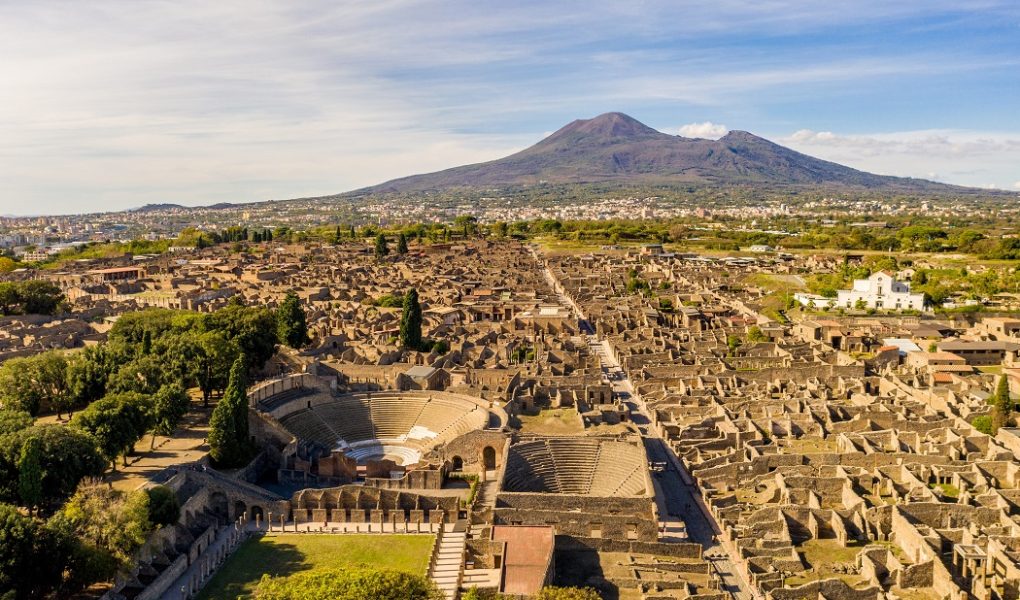
The Ancient City of Pompeii is an ancient Roman city located in the Campania region of Italy, near the city of Naples. This city was founded on an old lava layer at the foot of Mount Vesuvius in 5 thousand BC. On August 24, 79, after the eruption of Mount Vesuvius, it was buried under volcanic ash and slag and became debris. The city remained lost for about 1700 years, but was discovered by chance in 1748. Pompeii, preserved under 6 meters of ash, is one of the longest excavated archaeological sites in the world. Today, the city, which is on the UNESCO World Heritage List, is one of the most popular tourist attractions in Italy.
There have been more than fifty eruptions at Mount Vesuvius throughout its history. Its most famous eruption took place in 79 AD and buried the ancient Roman city of Pompeii under a thick layer of volcanic ash. The city, which was destroyed within 15 minutes as a result of the explosion, remained under volcanic ash and lava. Thousands of years have passed since the event, but the horror is still reflected. Recent research reveals that the city was buried in volcanic ash within 15 minutes and no one had the opportunity to escape. The ruins of the city, which was under the ashes, are well preserved and contain details that show how daily life was. The incident caused the life and time to stop in Pompeii that day. This eruption also affected other ancient Roman towns.

Research has revealed that the cause of death of the inhabitants of Pompeii was breathlessness due to volcanic ash. Due to the rapid spread of the ash cloud, the inhabitants of the city could not find the opportunity to escape and died by drowning. The dead bodies that remained in the city after this disaster were preserved for centuries and are still unearthed by archaeological excavations today. The residents of Pompeii, who live about 10 km from Vesuvius, one of the most active volcanoes in Europe, are thought to have been caught off guard by a terrifying eruption. It is also thought that the Pompeii, who lived unaware of the danger despite being so close to the volcano, did not take any precautions.

History of the Ancient City of Pompeii
Pompeii entered the history scene as a city that was founded by the Osci people in the 7th or 6th century BC and was controlled under the rule of Ancient Greece, Etruscans, Samnites and Rome. Before the explosion, it stood out as a lively center. The city has an important location for trade. Because it is located near the Mediterranean basin and the roads built by the Romans. In addition, volcanic ash from Mount Vesuvius has made the soils fertile.
The ancient city of Pompeii developed rapidly as a commercial and cultural center under Roman rule. The people of the city carried out important construction projects ranging from the amphitheater to the aqueduct and made advances in the field of art and architecture. When disaster struck, the city had a forum, food markets, temples, restaurants, baths and a population of 15,000. The houses built in Pompeii show architectural differences from time to time. But in general, traditional Italian style combined with Hellenistic Greek influence. Most urban houses are atrium houses, and most have shops on the street front. The building materials are gypsum plastered concrete on rubble and stone, and their interior surfaces are often decorated.

Pompeii is known as a place where entertainment, casinos, drinking and prostitution are common. It is also a place where slaves are killed and fights are held at night. All kinds of brutality and inhumane acts are common in the city. very deviant behavior that the people of Pompeii are damned and is believed to have incurred the wrath of God. The available sources about the explosion in the city of Pompeii have been told for generations as an exemplary story, with the spread of Christianity in Italy and the rise of the Papal office here. The emerging information about life in the city has been described for hundreds of years as an exemplary event that needs to be learned.

Effect of Volcanic Eruption
Before Mount Vesuvius erupted in late August 79 AD, Pompeii experienced a series of minor earthquakes. Most were not worried about earthquake activity, as city dwellers were accustomed to the minor tremors caused by the volcano. However, after several days of earthquakes, the volcano erupted violently, covering the entire city with ash, lava and bits of stone in fast-moving flows. Roman writer Pliny the Younger describes this event; “Broad sheets of flame illuminated many parts of Vesuvius, its light and brilliance more vivid than the darkness of night. Now there was daylight elsewhere in the world, but there the darkness was darker and thicker than any night.” described as. The great cloud of ash engulfed everything and everyone, nearly 2,000 people died, and his life in Pompeii came to a permanent halt.
Other cities affected by the same eruption include Herculaneum, Oplontis and Stabiae. Herculaneum is known as a smaller and wealthier city than Pompeii. Due to the wind blowing from the west, it survived the first stage of the explosion and allowed the people living in the city to escape. Also, unlike Pompeii, Herculaneum’s coated ash was charred. Thus, the wood of the roofs, beds and doors was preserved, while organic materials such as food were preserved.

Ruins Found in the Ancient City of Pompeii
Forgotten for centuries, the frescoes of the city of Pompeii, discovered in the 16th century, provided an orderly exposure of the area. During these excavations, archaeologists noticed that the ruins were exceptionally preserved. Buildings, objects, loaves of bread still unbaked, and murals remain intact. Among these frescoes, some of the earliest known depictions of nature are; secular portraits, religious iconographies, and erotic images.
During excavations, archaeologist Giuseppe Fiorelli discovered human-shaped cavities in the ash in 1863. These cavities were filled with gypsum and resin to create molds, as well as to outline the bodies. These patterns include babies, children, adults, and animal patterns such as wild boars. These molds provide realistic images of those who lost their lives as a result of the eruption of Mount Vesuvius. It is one of the most important findings obtained during the excavations of Pompeii. Archaeologists have used CAT scans to examine the interior surfaces of plaster and resin molds. These scans view the remains inside the molds and provide more information that gives scientists a more detailed picture of life before the explosion.

Studies provide more information about the history and culture of Pompeii and help to better understand how the ancient Roman world lived. It gives information about the age of the people of Pompeii, their gender, what they ate, what diseases they had, and their social class. Pompeii is also a popular tourist destination and is visited by 2.5 million people each year. These visitors come here to see the ancient city with their own eyes and to stand in the shadow of the ever-rising Mount Vesuvius. Therefore, while Pompeii is considered an archaeologically important center, it also stands out as a popular tourist site.


