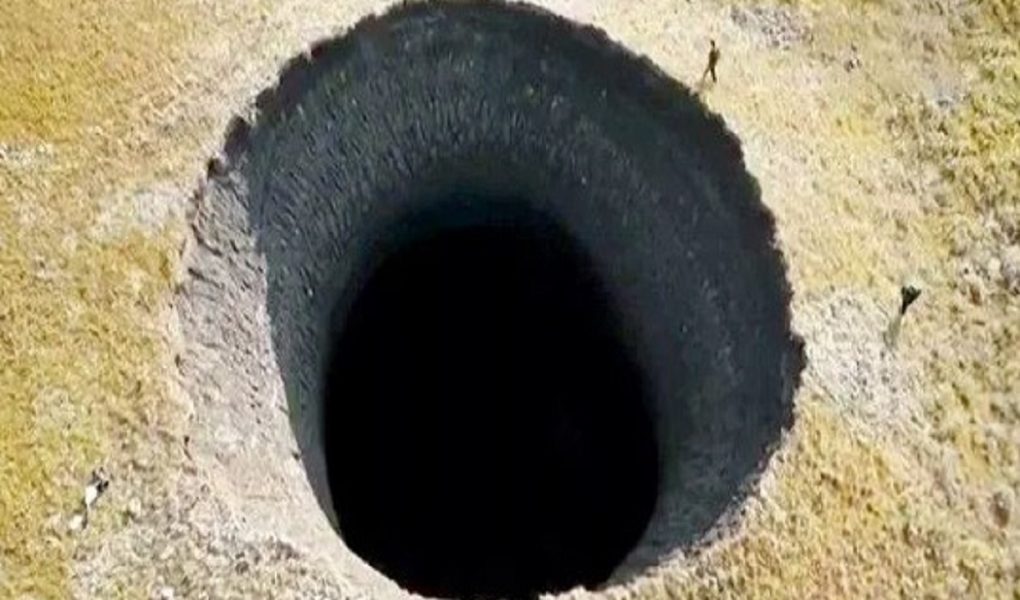
The huge holes that have emerged in recent years in the vast geography of Siberia, which has never been touched by humans and remains below zero for most of the year, leave the scientific world in shock and concern. These craters, which were first detected in 2012 and sometimes observed to be formed by explosions, raise striking questions about what is happening under the frozen soil layer called permafrost.
These structures, which can reach a depth of approximately 50 meters and a width of 20 to 80 meters, attract attention with the pieces of soil and ice scattered hundreds of meters away from their surroundings. Some witness accounts suggest that these explosion-like events could be heard from 100 kilometers away. The real mystery for scientists is that the craters appear suddenly and do not give any visible geological signs beforehand.

Craters That Have Explosion Marks, Not Sinkholes
Although it was thought that these pits were similar to classical sinkholes during the first discoveries, investigations revealed an important difference: While sinkholes are generally formed by the collapse of underground spaces, There are deposits of ejected material around craters in Siberia. This situation not only causes the structure to collapse, but also It suggests that it occurred as a result of a high-pressure explosion.
Geologists draw attention to the high methane concentrations measured especially on the crater floor. Yamal PeninsulaIn measurements made in a crater in , it was determined that the methane rate in the air reached 9.6 percent. This rate is thousands of times higher than the normal amount of atmospheric methane.

Methane Hypothesis: But It’s Not Enough Alone
The first suspicion of scientists was methane gas, which is released by the dissolution of organic materials trapped in permafrost. Warming climatic conditions are melting the upper layers of permafrost; This can lead to the release of methane. Similar processes in Arctic regions “thermokarst lakes” It leads to the formation of water bodies known as water bodies whose surface is filled with methane bubbles.
However, this explanation cannot fully explain why the craters are concentrated only in a very narrow region of Siberia, specifically the Yamal and Gydan peninsulas. Because permafrost and methane emissions are seen in a much wider geography, from Canada to Alaska.

New Theory: Hot Natural Gas Coming from Underground
Helge Hellevang, professor of environmental geology at the University of Oslo, Norway, and his team propose a new mechanism that could explain this mystery. Accordingly, Hot gas leaking from the huge natural gas reserves deep in the region rises below the permafrost layer. This hot gas melts the frozen ground from below, thinning and weakening it over time.
As the upper layers thaw due to climate change, permafrost loses its function as a cover. The gas accumulated under pressure is released with great energy in the event of a sudden rupture. The result is an explosion-like event and a giant crater is left behind. According to Hellevang, this explosion is only possible when the permafrost becomes critically thin and fragile.

There Might Be More Than Meet the Eyes
So far, researchers have only He thinks that eight large craters have been officially identified, but the real number may be much higher than that. In satellite images, especially Thousands of round depressions attract attention on the Yamal Peninsula. Some of these may be thermokarst formations; However, some of them may also be old explosion craters that have lost their traces by filling with water and soil over time.
Although the hypothesis has not yet been peer-reviewed, it was published on the EarthArXiv platform and opened to discussion in the scientific world.
Why is it dangerous for the climate crisis?
If this mechanism is confirmed, the issue is no longer just a regional geological curiosity. Methane is a much more powerful greenhouse gas in the short term than carbon dioxide. Scientists believe that these craters can suddenly and uncontrollably release large amounts of methane into the atmosphere. “natural chimneys” He warns that he may behave like this.
University of Hawaii geologist Dr. Lauren Schurmeier states that the theory is logical, but more data is needed to prove that underground gas reserves accumulate under permafrost. However, some researchers are of the opinion that the prevalence of such explosions could lead to serious deviations in climate models.

Regional Risks and Infrastructure Threat
Concerns are not limited to global climate. The Yamal region is home to some of Russia’s largest natural gas facilities. Craters, especially those formed close to Bovanenkovo facilities, are considered a potential threat to pipelines and energy infrastructure. These methane-filled pits pose a serious risk for both researchers and industrial activities in the region in terms of possible new explosions.
Frozen Ground, Not a Frozen Danger
Mysterious craters in Siberia, It reveals how dynamic and fragile one of the coldest and isolated regions of the world actually is. Scientists agree that it is difficult to make definitive judgments without understanding how often these events occur, how much methane is released, and its true impact on the global climate.
But one thing is clear: In a warming world, frozen ground no longer remains silent. And these explosions from the depths of Siberia may be one of the aspects of the climate crisis that has not yet been fully accounted for.
To join our WhatsApp group CLICK!


