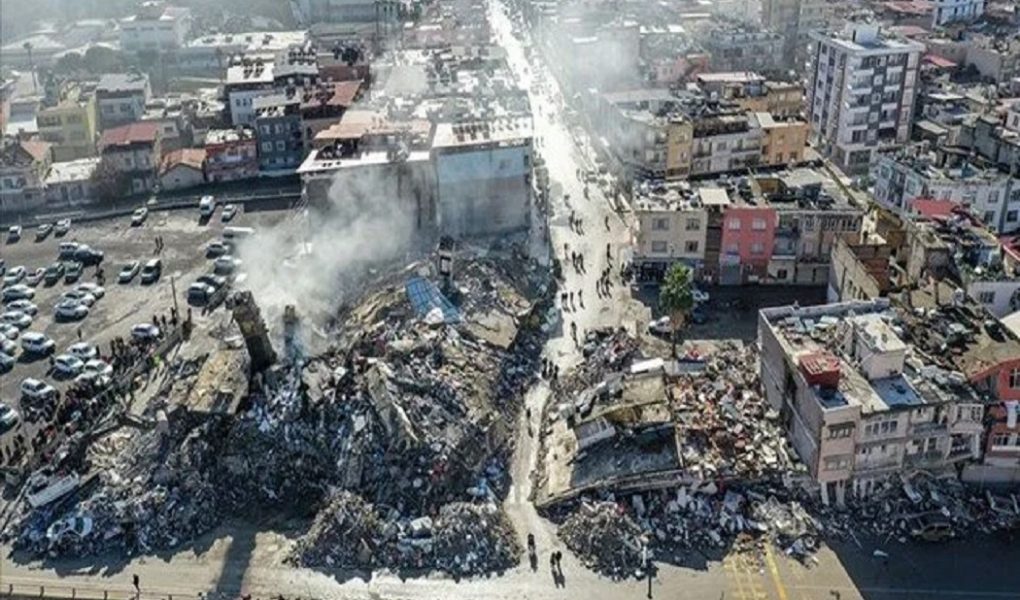

President Recep Tayyip Erdogan; announced that they have decided to declare a state of emergency that will last for 3 months in 10 affected provinces due to the earthquakes. A State of Emergency (State of Emergency) is a situation that aims to intervene primarily by increasing the powers and authorities of the state against serious dangers or risks related to the security, peace and order of the country or a region. The declaration of a state of emergency enables the state to act more quickly and effectively in the face of an emergency.
The state of emergency is the application used in situations such as natural disasters, dangerous epidemics, economic depression, widespread violence that endanger public order, where an extraordinary administrative order is required. The 3-month state of emergency decision will cover the epicenter of the earthquake, especially Kahramanmaraş, as well as Hatay, Adıyaman, Diyarbakır, Şanlıurfa, Malatya, Kilis, Gaziantep, Osmaniye and Adana. The State of Emergency decision aims to expand the powers and authorities of the state and to reduce the effects of the earthquake in these provinces during the specified period.
The process of declaring a state of emergency can be realized by fulfilling the necessary conditions of the Constitution, by a recommendation made by the National Security Council (NSC) and by a decision taken by the Council of Ministers led by the President. The state of emergency decision is published in the Official Gazette after it is approved by the Turkish Grand National Assembly (TBMM). As a result of the state of emergency, the use of fundamental rights and freedoms may be restricted or stopped altogether. Measures that guarantee these rights can be taken other than the conditions specified in the Constitution.
The duration of the state of emergency decision cannot exceed six months, but if the emergency situation continues, it can be extended by the Turkish Grand National Assembly at the request of the Council of Ministers for no more than 4 months. A state of emergency can be declared in one or more regions or in the whole country.
Article 119 – In cases of natural disasters, dangerous epidemics or severe economic depression, the Council of Ministers convened under the chairmanship of the President may declare a state of emergency in one or more regions or the whole of the country, the duration of which shall not exceed six months.
What Restrictions Could There Be in the State of Emergency?
Money, property and work obligations may be imposed on citizens. The exercise of fundamental rights and freedoms may be partially or completely stopped. An emergency decree may be issued. In cases of emergency, the authority to issue decrees with the force of law expands considerably, and judicial review of these decrees is not carried out.
In case of breach of obligations, the use of fundamental rights and freedoms may be suspended to a certain extent or completely, or measures exceeding the guarantees specified in the Constitution may be taken. However, a person’s right to life and the integrity of his material and spiritual existence are inviolable, no one can be compelled to reveal his religion, conscience, thoughts and convictions, retrospective crimes and punishments cannot be applied, and whether a person is guilty can only be determined by a court decision.
If the state of emergency covers only one province, the duty and authority belongs to the governor of that province. When a state of emergency is declared for more than one province affiliated to a regional governor, the task and authority belongs to the regional governor. When a state of emergency is declared in more than one regional governor or when a state of emergency is declared in the whole country, the duties and powers are carried out by ensuring coordination and cooperation between the regional governors.
Decisions That Can Be Taken During the State of Emergency
When a state of emergency is declared, the government has the authority to take additional measures that may limit the rights and freedoms of citizens. Among these measures;
- Limiting or prohibiting going out,
- Prohibiting the movement and gathering of people in certain places or at certain hours, the navigation of vehicles,
- of persons; to search his clothes, vehicles and belongings and to confiscate the criminal goods and evidence to be found,
- To impose an obligation to carry identification documents for the residents of the region where the state of emergency has been declared and for those who will enter this region from outside,
- To prohibit or authorize the printing, reproduction, publication and distribution of newspapers, magazines, brochures, books, leaflets and wall posters, and the introduction and distribution of those printed or reproduced outside the state of emergency zone; to seize the books, magazines, newspapers, brochures, posters and similar printed matter that are prohibited from being published or published,
- To control, if necessary, to record or prohibit speech, writing, picture, film, record, sound and video tapes and all kinds of broadcasts made with sound,
- To have sensitive public or private institutions and banks take special protection measures to ensure their own internal security or to request that these be increased,
- Supervising all kinds of stage plays and films shown, stopping or banning when necessary,
- Prohibiting the transportation or transportation of all kinds of weapons and bullets, even if licensed,
- To authorize or prohibit the possession, preparation, making or transport of any kind of ammunition, bombs, destructive materials, explosives, radioactive substances or caustic, corrosive, injuring drugs or any other poisons and suffocating gases or similar materials, and to permit their preparation or making to request the delivery of useful goods, tools or vehicles or to have them collected,
- Prohibiting the entry of persons and communities who have the impression that they may disrupt public order or public trust, taking them out of the zone or prohibiting them from entering or settling in certain places within the zone,
- Regulating, registering or prohibiting entry and exit to areas where facilities or establishments are deemed necessary to be secured within the region,
- Prohibiting, postponing, putting on permission for meetings and demonstration marches to be held indoors and outdoors, or determining, determining and allocating the place and time where meetings and demonstration marches will be held, watching, keeping under surveillance or, if necessary, distributing all kinds of meetings that are on leave,
- In cases other than the termination or termination of the service contract due to the employee’s request, situations that do not comply with the rules of morality and goodwill, health reasons, normal retirement and the expiry of a certain period, taking into account the situation of the employer, taking leave or postponing the dismissal of workers, provided that it does not exceed a period of three months,
- Association activities; to take separate decisions about each association and to stop it for a period not exceeding three months.
What is a state of emergency? What Happens When A State of Emergency Is Declared? post first explorer appeared on it.