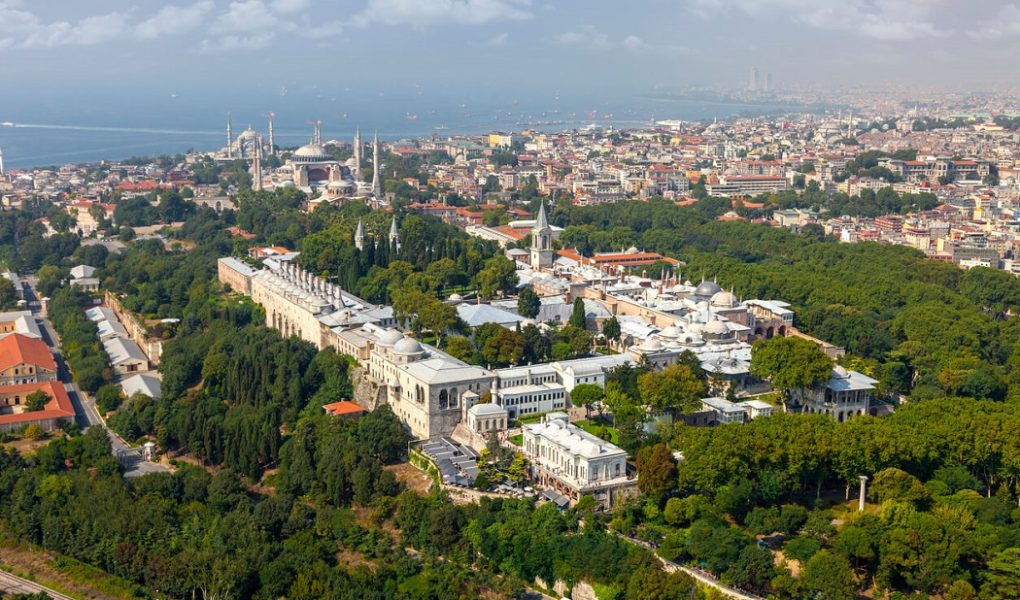
Topkapi Palace in Istanbul Sarayburnu; It is a palace that was used as the administrative center of the state for 400 years in the 600-year history of the Ottoman Empire and was the residence of the Ottoman sultans. Topkapı Palace, which is affiliated to the National Palaces Presidency, was opened to visitors on 20 April 2023 with the participation of President Recep Tayyip Erdoğan. More than 2,000 pieces of movable historical artifacts met with visitors. The Sacred Relics Department of Topkapı Palace, which has been closed since 2014, was opened as a result of restoration works of Fatih Mansion, Seferli Ward, Treasury Ward and Mecidiye Mansion.
Located in the historical peninsula of Istanbul, Topkapi Palace is located in one of the oldest parts of the city. Palace; In the region between the Bosphorus, Marmara Sea and the Golden Horn, it offers one of the most beautiful views of Istanbul. Topkapi Palace, one of the landmarks of Istanbul, offers its visitors a historical and cultural journey. In addition to the 5 opened sections, the Mecidiye Mansion located in the 4th courtyard was presented to the visitors for the first time. With the renewal of security, air conditioning and exhibition equipment, a more visitable area of 2,150 square meters was created in Topkapı Palace.

History of Topkapi Palace
Topkapı Palace was built by Fatih Sultan Mehmet in 1478 and was used as the administrative center of the Ottoman Empire and the official residence of the sultans for about 380 years. The palace, which spread over an area of approximately 700 thousand m² during its foundation years, is 80.000 m² today.
Palace; Dolmabahçe Palace was abandoned by the people of the palace, who started to move to Yıldız Palace and other palaces. However, many officials continued to live in it and it never lost its importance. The palace was repaired from time to time and was visited by the sultan and his family during Ramadan. Sacred RelicsParticular attention was paid to the annual maintenance of the Hırka-i Saadet Department.

The construction of Topkapi Palace was started by Fatih Sultan Mehmet in 1465. When the palace was opened for the first time like a museum, it coincided with the reign of Abdülmecid. The items in the Topkapı Palace Treasury were shown to the British ambassador of that period. After that, it has become a tradition to show the ancient artifacts in the Topkapi Palace Treasury to foreigners. During the reign of Abdülaziz, showcases with glass windows were built in the imperial style. Antiquities in the treasury began to be shown to foreigners in these showcases. II. When Abdülhamid was deposed, Topkapı Palace Treasure-i Hümâyûn was planned to be opened to public visits on Sundays and Tuesdays, but this did not materialize.
Topkapı Palace, which was connected to the Istanbul Asar-ı Atika Museums Directorate to be opened to the public on April 3, 1924 by the order of Mustafa Kemal Atatürk, first started to serve as the Treasury Kethüdalığı and then the Treasury Directorate. After some minor repairs were made in 1924 and the necessary administrative measures were taken for the visitors to visit, Topkapı Palace was opened to visitors as a museum on October 9, 1924. It went down in history as the first museum of the Republic. Today, it continues to serve as one of the largest palace-museums in the world under the name of Topkapı Palace Museum Directorate.

Parts of Topkapi Palace
Topkapi Palace was built on the Byzantine acropolis in Sarayburnu, at the tip of the historical Istanbul peninsula. The palace is separated from the city by the Sûr-ı Sultani built by Fatih Sultan Mehmet on the land side and by the Byzantine walls on the sea side. The monumental entrance of the palace is the Bâb-ı Hümâyûn (Gate of Sultanate) behind Hagia Sophia, and there are various land and sea gates and gates opening to different places within the palace.
Topkapı Palace is divided into two main sections in accordance with the structure created due to the fact that it is the place of administration, education and the residence of the sultan. These consist of the service buildings in the first and second courtyards of Birun, while the Enderun consists of the buildings related to the internal organization.
When the palace is entered through the Sultanate Gate, the structures consist of four passage courtyards and surrounding architectural structures. It is surrounded by palace buildings, gardens and squares. In the first courtyard, there are structures such as Hagia Irene Church, Mint, Bakery, Hospital, Wood Warehouse and Hasırcılar Furnace. This courtyard is also known as the Regiment Square.

The second courtyard of the palace is called Divan Square or Justice Square, where the state administration is carried out. In this courtyard, many ceremonies were held in history and there are structures such as the Divan-ı Hümayun (Kubbealtı) and the Divan-ı Hümayun Treasury. Also in this courtyard, there are the Justice Tower, the entrance to the Harem Office next to Kubbealtı, the Zülüflü Baltacılar Ward and the Has Stables.
The third courtyard of the palace is also called the Enderun Courtyard. In this section, structures such as the Sultan’s Supply Room, the Enderun Treasure, the Has Room and the Sultan III. There are buildings belonging to the Palace School, which was established during the Murat period.
In the fourth courtyard, which is the last courtyard, there are the sultan’s pavilions and hanging gardens. In this section, there are the Baghdad and Revan Kiosks and Iftariye Gazebo, which are the most distinguished and aesthetically advanced examples of Ottoman classical pavilion architecture. In the lower part of the fourth courtyard, the last buildings of the palace, the Mecidiye Mansion and the Dressing Room, can be seen.

Architecture of Topkapi Palace
Ottoman state philosophy and palace-subject relations played a major role in determining the plan of Topkapı Palace, which developed and grew over the centuries. When it was first built, Fatih Sultan Mehmet’s father, Sultan II. The plan and magnificence of the Edirne Palace, which was built by Murad on the banks of the Tunca River and whose ruins have survived to the present day, was also a source of inspiration.
Topkapi Palace is a modest palace; The great expenditures of the empire were mostly made for magnificent mosques, barracks, bridges, caravanserais and accommodation facilities. Even the famous architect Mimar Sinan built only one section in this palace. However, in addition to the unique buildings, exquisite tiles and natural design of the palace, its location in Sarayburnu adds a natural beauty and splendor.

Treasures in Topkapi Palace
Topkapi Palace’s extraordinarily rich collections and extremely interesting historical stories make it one of the most valuable palaces in the world. Imperial treasury, European porcelain and glass, copper and tombak kitchenware, Chinese and Japanese porcelain, silver, Cardigan-i Saadet Office and Sacred Relics, Istanbul glass and porcelain, sultan dresses, Sultan portraits and a collection of paintings and weapons are among the valuable collections exhibited in the museum.
The 86-carat Spoonmaker’s Diamond, which is considered the most famous and largest of the historical diamonds, exhibited in the Foreign Treasure Section of Topkapı Palace, has an impressive appearance. The circumference of the diamond is adorned with 49 double rows of large diamonds and is an artifact that attracts the attention of visitors. This pear-shaped gem is among the rarest stones in the world. However, some diamond experts are of the opinion that it may be a historic diamond known as the “Pigot Diamond” that was lost at the beginning of the 19th century. However, it is certain that the Spoonmaker’s Diamond was purchased and entered the Palace Treasury in the early 1680s.

Topkapi Dagger, one of the most important treasures of Topkapi Palace, was built by Sultan Mahmut I as a gift to Nadir Shah. However, upon the death of Nadir Shah, the dagger was preserved in the Topkapi Palace treasury. The value and uniqueness of the dagger becomes evident by the emerald and diamond stones used on it. Three emerald stones on the hilt of the dagger are 3-4 millimeters in size. There is also a one-piece emerald stone at the top of the handle. This magnificent dagger is among the most valuable daggers in the world.
Sultan II., which started to be exhibited in the Baghdad Mansion. Mahmut Throne reappeared after a long break. 19th century label, designed in a European style, the sultanate seat, the Ottoman state crest and the II. Mahmut carries his signature.


