
The activity in the depths of the Sun has caused impressive events on Earth from time to time. One of these events, the 1859 Carrington Event, is sometimes remembered as the Super Solar Storm of 1859. The Solar Storm of 1859 was a powerful geomagnetic solar storm that occurred in 1859, during solar cycle 10. This event occurred when a solar flare, or coronal mass ejection, struck the Earth’s magnetosphere and was observed and recorded by Richard Christopher Carrington as one of the most impressive solar storms ever recorded.
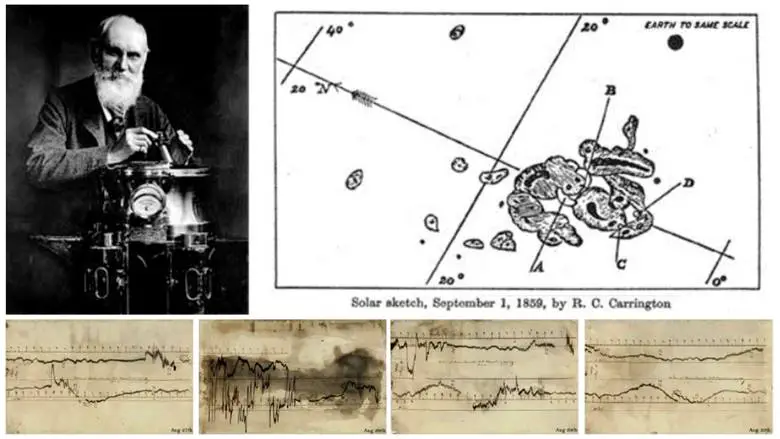
Solar Storm of 1859 or Carrington IncidentIt contains a series of extraordinary observations that lasted from August 28, 1859, to September 2, 1859. During this period, there are many suns on the Sun. Sun spot observed. In particular, on September 1, Richard Carrington And Richard Hodgson British amateur astronomers observed the first solar storm explosion in history. As a result of this explosion, a large coronal mass ejection (CME) occurred that directly impacted the Earth. While usually, such an event can take three to four days to reach Earth, this time the CME moved very quickly as it cleared plasma in the path of an earlier ejection.

Scottish physicist Balfour Stewart simultaneously used the magnetometer at Kew Observatory.crochet” he recorded his observations. On the same day, a geomagnetic storm was observed, leading Carrington to suspect a connection between the Sun and the Earth. Geomagnetic storm of 1859 Reports have been published worldwide about its effects. Elias Loomis A compilation supporting Carrington and Stewart’s observations was made by.
Effects of the Solar Storm of 1859
On 29 August 1859, even from Queensland, Australia, in the southern hemisphere polar lights (aurora) was observed.
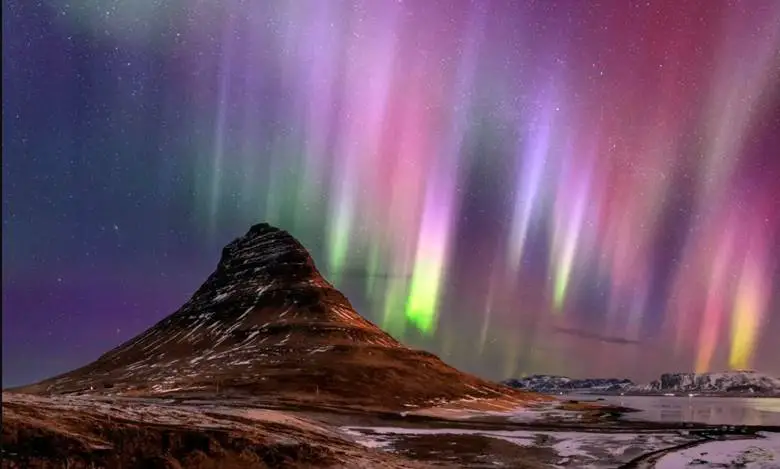
On September 1-2, 1859, the largest recorded geomagnetic storm happened. Auroras occur all over the world, including the Caribbean, and even Rocky MountainsIt was bright enough to cause the gold miners living in , to start having breakfast, thinking it was morning. In the northeastern United States, people could read newspapers in the light of the aurora. The aurora was visible over a wide area, from the Polar regions to Cuba and Hawaii.
Telegraph systems throughout Europe and North America failed. In some cases, he even gave electric shocks to telegraph operators. Telegraph poles were emitting electric sparks. Some telegraph systems continued to operate despite power supplies being cut off.
According to the Baltimore American and Commercial Advertiser on Saturday, September 3, 1859; “Those who were out late on Thursday evening had the chance to observe the spectacular aurora lights. The light-induced phenomenon was similar to Sunday’s aurora but with brighter and more colorful hues. The light seemed to cover the sky and the stars shone more clearly. It was a light that surpassed the brightness of the full Moon, illuminating everything around it with an indefinite softness and grace. Reaching its highest visibility between 12 and 1 o’clock, it was a magnificent sight under the quiet streets of the city, in this extraordinary light.”
In June 2013, a group of researchers from Lloyd’s of London and America’s Atmospheric and Environmental Research (AER) analyzed how much the world economy was affected, using this data to calculate the effects of the Carrington Event.

Analyzes Made by Space Scientists
Nitrate-rich layers of ice cores have been studied based on reliable observations to analyze the history of past solar storms. Data from Greenland ice cores have shown that these events, which are associated with high-energy proton radiation rather than geomagnetic effects, occur at a magnitude of at least one fifth every about 500 years. These data were presented in analyzes by Kenneth G. McCracken and others and examined by space scientists.
However, a more recent study has argued that nitrate spikes are not a result of solar events and that the reliability of using such a technique is questionable. The ice core community has detected similar but much stronger cosmic ray events using methods they consider more reliable, such as 10Be and 14C. These events may occur within the Solar System or even outside our galaxy.
In the past, less damaging storms caused widespread radio blackouts in 1921 and 1960. In March 1989, a geomagnetic storm caused power outages across large areas of Quebec. In July 2012, it became clear that a coronal mass ejection could have a major impact by hijacking the Earth’s orbit. These observations and information were shared with the public by NASA on April 28, 2014.


