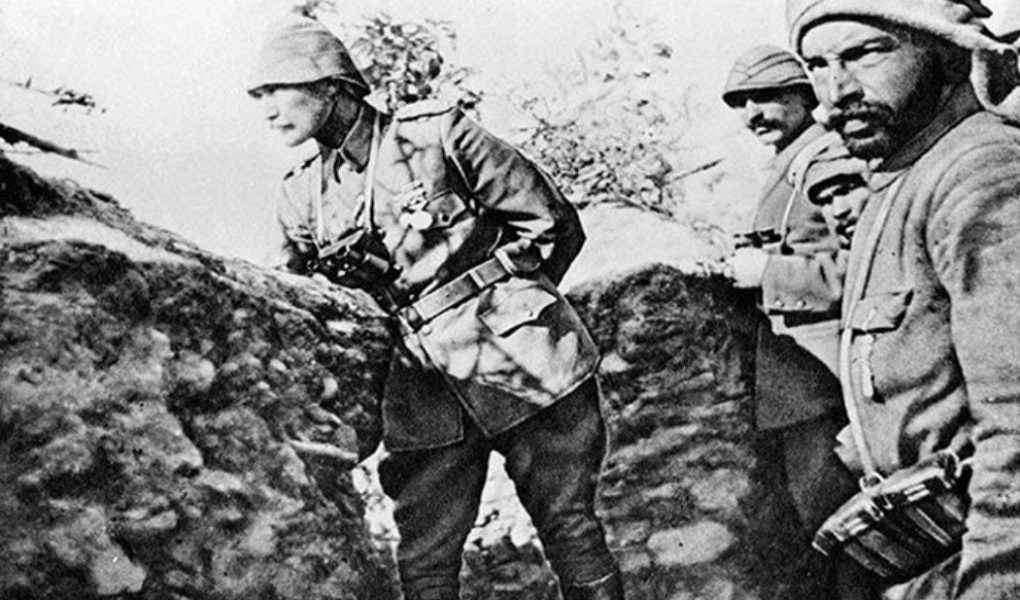
Today, we are proud to commemorate one of the epics engraved with golden letters on the historical stage of the Turkish nation. On 9-10 August of 1915, one of the most important attacks of the Dardanelles Wars took place. After the defeat of the Allied Powers at sea, this time they tried to cross the Dardanelles by land. But at this time, Colonel Mustafa Kemal, who was the Anafartalar Group Commander, was in front of them.
For this reason, many medals and decorations were given to Mustafa Kemal, who proved his military genius in the Dardanelles Wars. On the 108th anniversary of the Anafartalar Victory We commemorate our martyrs with gratitude and respect, especially Anafartalar Group Commander Colonel Mustafa Kemal Atatürk and his comrades in arms, who did not hesitate to sacrifice their lives for the indivisible integrity of the homeland and the peace and security of the Turkish nation.

Experiences in the First Battle of Anafartalar
On the morning of 9 August 1915, both Ottoman and British forces moved forward. The first clashes took place on the northern sides of the front, at the starting point of the 15 km long battle line, at around 04:40. In this struggle, the 35th Regiment of the Ottoman 12th Division encountered the forward line of the 32nd Brigade of the British 10th Division. Two battalions of the British brigade marching forward were advancing in the direction of Tekke Tepe. However, one battalion was missing and its whereabouts were unknown; When he was found, he would unite with the waiting battalion and join the operation.
Colonel Moore, who commanded the British vanguard, was soon surrounded by Ottoman troops descending from the hill. The only surviving officer was a lieutenant and surrendered. On the other hand, the Ottoman 35th Regiment continued to advance and captured Yususçuktepe. At the same time, the British brigade of eight battalions pushed back the two battalions of British Lieutenant Colonel Wilmer and captured İsmailoğlu Hill. Against the British forces, three battalions of the Ottoman 34th Regiment launched an offensive against the hill and captured the hill with a bayonet charge around 06:00.
In Yusufçuktepe, fire broke out in the heathlands under the bombardment of Allied artillery. The 32nd Regiment was forced to withdraw from the hill when it was understood that the fire was spreading towards the British troops on the outskirts as a result of the change of direction of the wind. But then the hill was settled again. There were wounded on both sides in the fire.
The fire of the Ottoman artillery against the skirts of İsmailoğlu Hill caused a sudden panic on the left side of the British attack forces. When the fire of the Ottoman artillery was shifted forward, the 34th Regiment attacked towards the center of the British lines. Although a British force consisting of three or four companies tried to get into defensive formation, it was neutralized by the attack of the Ottoman artillery.
Mestan Tepe was captured in the first half of the day, but the hill had to be evacuated as a result of intense naval bombardment and British reinforcements.
Later in the day, the Allied command attacked Yusufçuktepe four times with two brigades of the 53rd Division, which were held as reserves. The 34th Regiment managed to hold the hill despite heavy losses.
In the southern part of the front, the 7th Division under the command of Colonel Halil Bey was understaffed and consisted of two regiments. One of these regiments was held in the Saros region. The units participating in the attack were units that had fought in the Seddülbahir Front in the previous months, and thus some of the enlisted and officers had combat experience.
Although they succeeded in throwing the British troops back, the 7th Division, which had to hold on under heavy artillery fire around 10:00, suffered heavy losses with the martyrdom of Lieutenant Colonel Halit Bey, the commander of the 20th Regiment, and the injury of the 21st Regiment commander, Lieutenant Colonel Yusuf Ziya Bey. The loss of Lieutenant Colonel Halit Bey was a great loss for the Ottoman side. He displayed brilliant command ability in the First Battle of Kirte.
At around 09:00, the initiative passed to the Ottoman forces at the front. General Stopford managed to stop on the beach, driving the 53rd Division, which was being held as a reserve, to the coastline around 12:00.
As a result of this war, the loss of Ottoman forces was 2,065 soldiers and officers. The Commander of the Mediterranean Expeditionary Forces General Sir Ian Hamilton sent a telegram to the British Minister of War Kitchener, “I can’t find a good reason why we couldn’t seize the area from Ece Harbor to Büyük Anafarta yesterday morning.” used the phrase.


