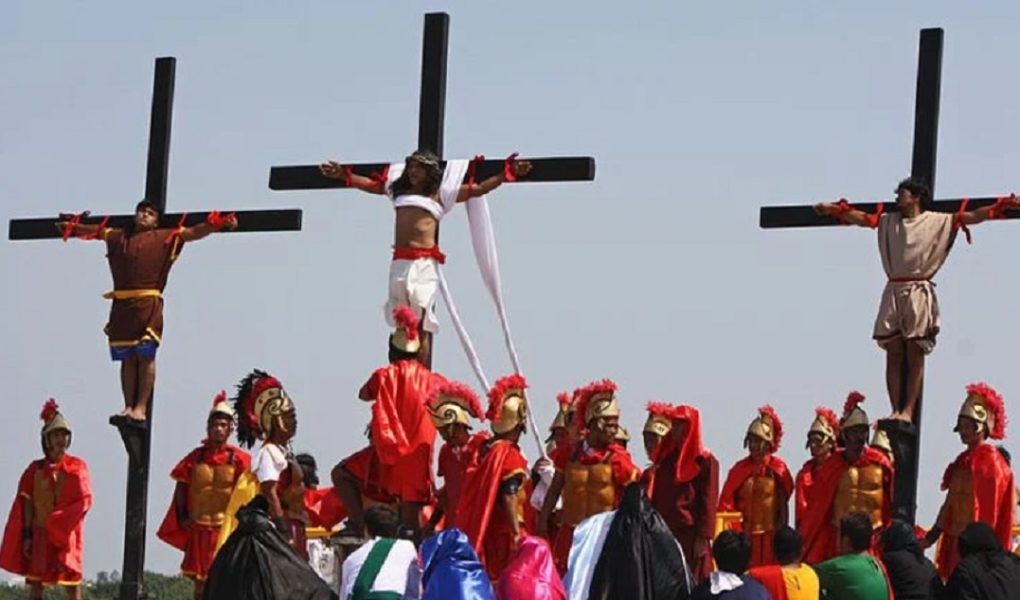
A ‘Good Friday ritual’ will be held by members of the Catholic Church in the Philippines’ Pampanga province. The 12 people participating in the ritual will perform this traditional ritual by crucifying themselves. The ceremony, which was suspended for 3 years due to the Kovid-19 epidemic, will be held this year in the town of San Pedro Cutued in the northern region of the Capital Manila. In addition to the crucifixion ritual, Christian visitors wishing to repent will walk barefoot and half-naked from the town center to the ritual site. They will confess by hitting them on the back with bamboo sticks.
However, Catholic Church leaders in the Philippines said in a statement that such rituals are risky for health and should be abandoned. Also, church leaders suggested focusing on charitable work. For example, activities such as blood donation were encouraged.
Rober Reyes, a famous Catholic priest in the country, noted that the church “failed in the classroom” in the education of Filipino Christians and said, “These bloody rituals are an indication that Filipinos are left to learn their religion in their own way. Folk Catholicism has become permanent in local areas. The town of San Pedro Cutud has stood out among the more than five hundred towns in the region due to the crucifixion and “Good Friday rites” that have been going on for years. More than 30 thousand local and foreign people are expected to attend the “Good Friday Mass” to be held this year.

What is Good Friday Mass?
Good Friday, Christians around the world It is the religious day that commemorates the crucifixion of Jesus and his death on Calvary. Part of Holy Week, it falls on the Friday before Easter Sunday and may coincide with Jewish Passover in some years. Good Friday also; Good Friday is also known as Great Friday or Easter Friday. The actual Easter Friday is the Friday in Easter Week.
Good Friday is celebrated with fasting and rituals by many of the Catholic, Orthodox, Lutheran, Anglican, Methodist, and reformed Christian denominations. The date of Good Friday can change from year to year due to both the Gregorian and Julian calendars. There may be differences in the calculation of Easter and therefore Good Friday between the Eastern and Western Churches. Good Friday is considered a public holiday in the Christian world and is usually spent in worship, prayer, and thoughtful silence.

Good Friday Catholic Mass
Good Friday ritual has three stages according to the Latin ritual. According to the Gospel of John, the rite is Hz. It begins with the account of the suffering and death of Jesus. Then prayers are offered for the church, the statesmen, the needy, humanity and the salvation of the entire world. It is continued with respect to the Cross, and this is done in two ways. In the first method, the cross covered with a closed cloth is carried to the altar. At the altar, the priest unveils the cross in three stages and prays each time, “This is the board of the Cross on which the savior of the world was crucified.” The congregation responds by saying, “Let’s worship him.” The uncovered cross is placed where everyone can see it.
In the second method, the priest carries an uncovered cross and moves towards the altar. He stops three times on the way and says, “This is the board of the Cross on which the savior of the world was crucified, Come let us worship Him”. Lament hymns or verses are recited as the congregation pays homage, either by kneeling or kissing the cross. Afterwards, bread, which was considered sacred the previous day, is given.
Great Friday Orthodox Rite
The Orthodox Great Friday Mass liturgically highlights such a horrific event as the death of God and the burial of his body and is celebrated with a certain silence. There is no Eucharist celebration during the Mass, and Great Friday and Great Saturday are the two days when the Eucharist is not celebrated, as on other days of the year.
The main feature of the rite is Hz. It is a reading of twelve gospel chapters about the suffering and death of Jesus. Some priests on the crosses Hz. They remove the icons of Jesus and wrap them in linen to revive the ancient burial customs.


