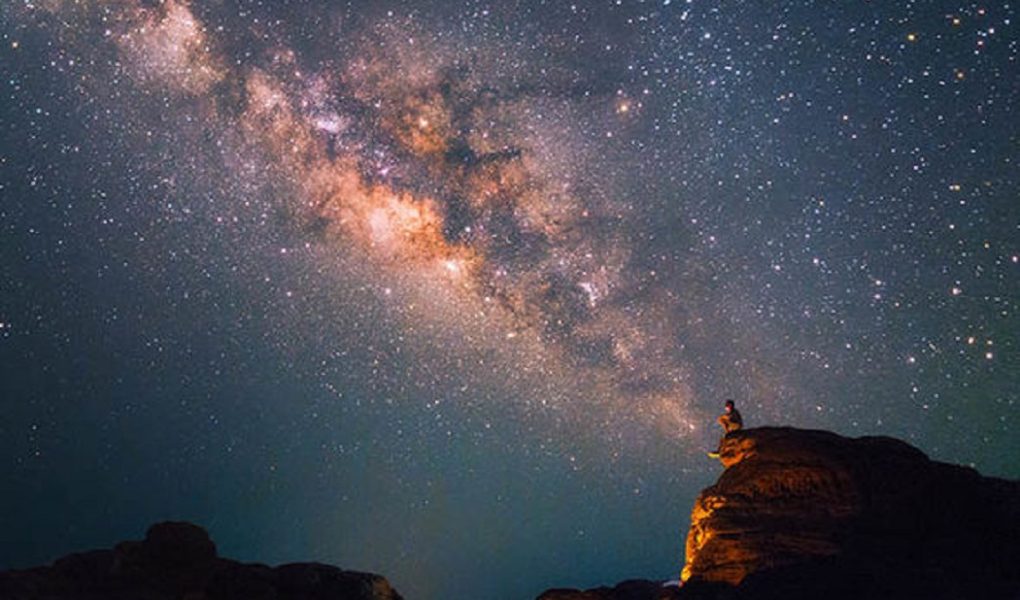
Milky Way; It is the galaxy where billions of stars are located, and of which our Earth and Solar system are also a part. Defined by its view from Earth, it is a hazy strip of light in the night sky made up of stars that are indistinguishable to the naked eye. The Milky Way is a massive star system made up of galaxies and gas. There are large gaps between these stars. The diameter of the Milky Way is about 100,000 light years. Its mass is evaluated in terms of about 2 billion light years. In ancient times, people observed the Milky Way and attributed different meanings to it. In ancient societies, there are many legends about the Milky Way.
At the center of the Milky Way is a black hole. This black hole provides a very strong gravitational effect that attracts the stars around the Milky Way and controls their movements. The black hole at the center of the Milky Way is a star system where billions of stars come together and provides the energy of the galaxy. The Milky Way is also a galaxy with many galaxies and celestial bodies. These objects are created by the black hole in the center of the galaxy and provide the energy of the galaxy. The Milky Way is also a galaxy with many stars and bright bouts of neutral hydrogen. These seizures are created by a black hole in the center of the galaxy and provide the galaxy’s energy.
Although the Milky Way has begun to be well understood by scientists today, it still has many unknown features. For example, there is still little information about exactly how the Milky Way formed and how stars were formed. Studies on these and similar issues are ongoing and more will be learned in the future.

First Discovery of the Milky Way
The Milky Way was discovered by humans thousands of years ago. Ancient societies such as Egypt, Greece, Rome, and China observed the Milky Way. They tried to explain it in different ways. However, regular observations are needed to get more detailed information about what exactly the Milky Way is a star system. Therefore, the first modern exploration of the Milky Way began in the 17th century.
In the seventeenth century, Italian astronomer Galileo Galilei discovered that the first stars he saw with the naked eye were part of the Milky Way. This discovery revealed that the Milky Way is a galaxy containing not only the Solar System but also billions of stars. This discovery is considered the first modern discovery of the Milky Way. From the 18th century onwards, various observations have been made to learn more about the Milky Way. These observations provided more information about the structure of the Milky Way, the motions of its stars, and other features. This information has helped us gain a more detailed understanding of the Milky Way.

Milky Way in Ancient Societies
In ancient times, people observed the Milky Way and attributed different meanings to it. Ancient societies such as Egypt, Greece, Rome and China tried to explain the Milky Way in different ways. In Egyptian mythology, the Milky Way is known as the “Road to the Throne”. It represents the way to the heaven of the Egyptian gods. In Greek mythology, the Milky Way is known as the “Moon Way” and represents the way to the Heaven of the Greek gods. In Roman mythology, the Milky Way is known as “Apollo’s Way”. It represents the way to the Heaven of the Roman gods. In Chinese mythology, the Milky Way is known as the “Way of the Gods” and represents the way to the heavens of the Chinese gods. It shows that ancient societies tried to explain the Milky Way in different ways and attributed different meanings to it.
There are many legends about the Milky Way galaxy and these legends are told in different ways in different ancient societies. For example, a legend told about the Milky Way in Egyptian mythology is as follows: In Egyptian mythology, the Milky Way is known as the “Way to the Throne” and represents the way to the Heaven of the Egyptian gods. The path to the Eden of the Egyptian gods passes through the center of the Milky Way, and each star of the Milky Way represents the homelands of a god. According to this legend, the Milky Way is a place where the gods live, and people’s way to Heaven passes through the Milky Way.
The term “Milk Road” used for the Milky Way in Western culture originates from a myth in ancient Greek mythology. One night, Zeus puts his son, Heracles, whom he had made from a mortal woman, on the chest of Hera, who has fallen asleep unnoticed. Baby Heracles will drink the milk flowing from Hera’s breasts and thus become immortal. But when Hera wakes up at night and realizes that she is breastfeeding an unknown baby, she throws it away and the milk that comes out of her empty breast also gushes into the night sky. According to the story, the belt called “Milk Road” (Milky Way in Turkish), which we see shining with a dim light in the night sky, was formed like this.
However, the modern use of the name Milky Way is attributed to the Italian astronomer Galileo Galilei in the 17th century. Galileo discovered that the Milky Way was a galaxy containing not only the Solar System but also billions of stars, and he named it the Milky Way after this discovery. This discovery is considered the first modern discovery of the Milky Way. The name Milky Way has continued to be used ever since.