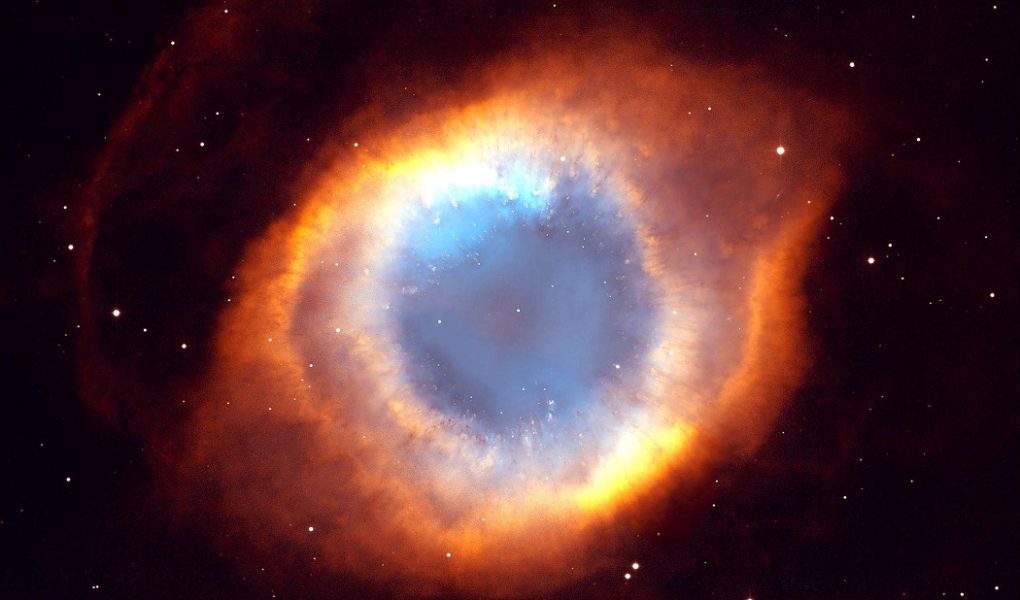
Located in the constellation Aquarius, the Helix Nebula is a sizable planetary nebula, also known as the Helix Nebula, NGC 7293 or Caldwell 63. It was discovered before 1824 by Karl Ludwig Harding. This nebula is among the brightest planetary nebulae closest to Earth. Its distance is approximately 215 parsecs, or 700 light years. It is a very popular celestial object among sky enthusiasts.
Known for its similarity to the Ring Nebula in appearance, the Helix Nebula also resembles the Weightlifting Nebula in size, age, and physical characteristics. Helis, often referred to as the “eye of God”, is also a reference to the “The Eye of Jupiter” episode of the famous TV series Battlestar Galactica.

Features of the Helix Nebula
The Helix Nebula is an example of a star in the final stage of its typical planetary formation. The nebula has a structure where the gas around the star appears to be an underlying spiral structure. Located at the center of the nebula, the white dwarf star shed its outer layers 30,000 years ago and is now very hot (110,000 degrees Celsius).
The red in the central star is so energetic that it illuminates the surrounding gas like a fluorescence. Close-up images of the inner edges of the Helix Nebula show complex gas nodes of unknown origin.

Formation of the Helix Nebula
NASA’s Spitzer Infrared Telescope has identified a dusty disk in the center of the Helix Nebula, formed from possible collisions of comet nuclei. While the gases from the outer layers of the central star were expected to scavenge dust from the surrounding space, the Spitzer telescope detected the presence of dense dust. This dense dust forms a disk at a distance of 35-150 Astronomical units from the star (the red circle in the left image shows a very small portion of the disk flare that is not clearly visible). Astronomers think this dust is a remnant of the collision of solid bodies, similar to those in the Kuiper Belt at the outer limits of our Solar System.
If massive planets once orbited the original star, which became a white dwarf, the star’s outer layers could lose mass, causing the orbits of the planets to become entangled. This could lead to Kuiper Belt-like turmoil in the Helix, with multiple collisions occurring. Also, some of the animated debris falls on the white dwarf, which can cause the white dwarf to emit X-rays on an unusual scale. However, this phenomenon is not yet fully understood.


