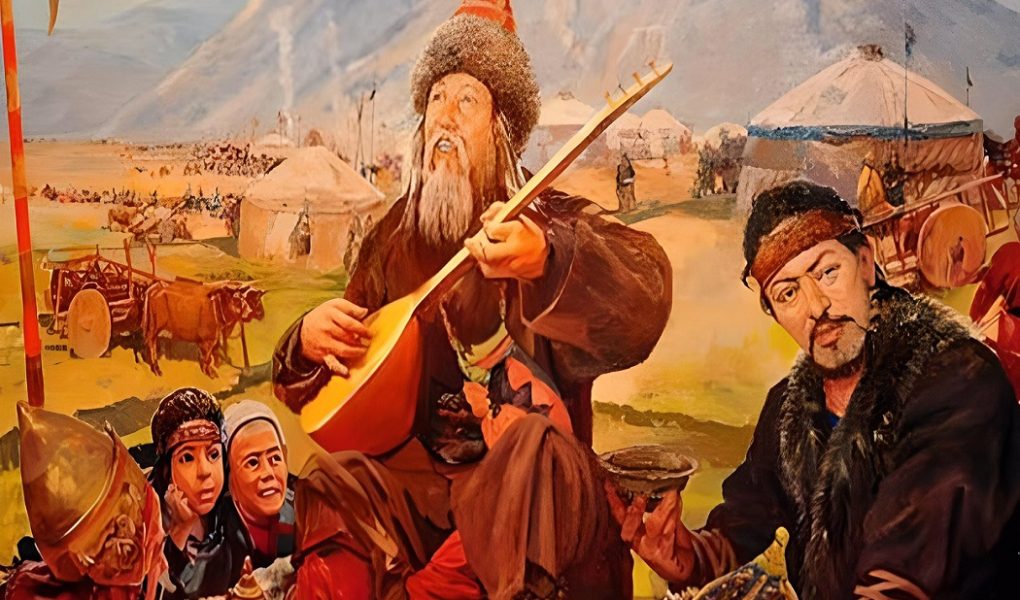
Dede Korkut Stories; The stories that tell the epic of the Oghuzs, the largest Turkish community that lived in Central Asia. These stories in the Book of Dede Korkut; It contains important information about the social life styles and pre-Islamic beliefs of the nomadic Turkic peoples. It is the common cultural heritage of Turkish communities of Oghuz origin, including Turkey, Azerbaijan and Turkmenistan. Dede Korkut Stories, which started to take shape in Central Asia, underwent some changes according to religion and environmental motifs after the Turks became Muslims and came to Anatolia.
Dede Korkut Stories, an oral literary product, were written by an unknown author in the 14th or 15th century. Dede Korkut, who gave the name to the piece, is the teacher who taught Kopuz playing in the years when Turks believed in Shamanism. The original name of the book, which consists of 12 epic stories and a preface, is “Kitab-ı Dede Korkut Ala Lisan-ı Taife-i Oğuzan” (The Book of Dede Korkut in the Language of the Oghuzes). In the book, in which many subjects belonging to Turkish customs are handled, the struggle of many folk heroes is described with beautiful and wise words.

Copies of the Book of Dede Korkut
Most of the 12 stories in the book Dede Korkut appeared for the first time between the 10th and 11th centuries, along the Seyhun River, which was the old homeland of the Oghuzs. It came to the Near East in the 11th century, with the Oghuzs capturing Northern Iran, Southern Caucasus and Anatolia. Most of the stories in the book take place in the vicinity of the Tigris, the two great rivers of Eastern and Southeastern Anatolia, the Karadere and Dereşam waters, which are tributaries of the Aras River. It is estimated that the work was written in the time of Akkoyunlular, who ruled around Erzurum, Kars.
There are two copies of Dede Korkut Stories, which are the most important work of the transition from epic period to folk storytelling. The copy bearing the name “Kitab-ı Dede Korkut Ala Lisan-ı Taife-i Oğuzan” is complete and contains 12 stories. This copy is in the library of Dresden, Germany. It was introduced to the scientific world in an article published by Heinrich Friedrich von Diez in 1815. A copy obtained by copying the Dresden copy by Von Diez is in the Berlin Library. This copy is called the Berlin Copy.
The missing copy, which consists of 6 stories, bears the name “Hikayet-i Oğuzname, Kazan Beğ ve Gayri” (Oğuzname story, Kazan Bey and others). This copy is in the Vatican Library. The fictional style and language characteristics of the stories told in these two books are different from each other. Although some researchers are of the opinion that the two copies are based on a common copy, some argue that they may have been compiled separately from two different narrators. In addition to the 12 known stories, there is a 13th story in a single copy. It is estimated that the only copy named “Salur Kazan’s Killing the Seven-Headed Dragon” belongs to the 14th century.

Stories and Features in the Book
Dede Korkut Stories; It has a narrative that gives advice with wise words. It consists of 12 independent stories. Of these stories, which are normally more than 20, only 12 have survived to the present day. Almost all of the stories begin with the sentence “declare”, which means “to tell your epic”. The work, in which both extraordinary and real events are intertwined, shows the characteristics of epic and folk tale. Dede Korkut, mentioned in the work, is described as an unknown folk poet. In the work, the wars of the Oghuz tribes and their inner struggles are told. The subjects are heroism, love, bravery and wars between tribes.
The work, which also includes many proverbs, was written in both poetry and prose. Many parts of the story contain advice. There are various characters among the 12 stories told. The most well-known of these characters are; Bayındır Han, Korkut Ata, Dirse Han and Boğaç Han, Salur Kazan, Banı Çiçek, Bamsı Beyrek, Kazan Bey, Deli Dumrul, Kazılık Koca, Basat, Tepegöz, Beğil’s Son Emren such as characters.
In the Dresden Copy, there are the following Oghuz stories, respectively;
1- Boğaç Khan, Son of Dirse Khan
2- The Looting of Salur Kazan’s House
3- Kam Büre Bey’s Son Bamsı Beyrek
4- The Capture of Uruz, Son of Kazan Bey
5- Duha’s Husband Son Deli Dumrul
6- Bloody Husband Son Kanturali
7- Kazılık Husband’s Son Yegenek
8- Basat’s Killing of Tepegoz
9- Begin’s Son Emren
10- Uşun’s Husband Son Segrek
11- Salur Kazan Captive and His Son Uruz Released
12- Stone Oguz Rebelled to Inner Oghuz and Died in Beyrek
The six stories in the Vatican Copy are as follows;
1- Boğaç Khan, Son of Storyt-i Han
2- Storyt-i Bamsi Beyrek
3- Storyt-i Salur Kazan’s House Was Looted
4- Storyt-i Kazan Begun’s Son Uruz Khan Is A Prisoner
5- Storyt-i Kazilık Husband’s Son Yegenek Bey
6- Storyt-i Taş Oguz Rebelled Against Inner Oghuz and Beyrek


