
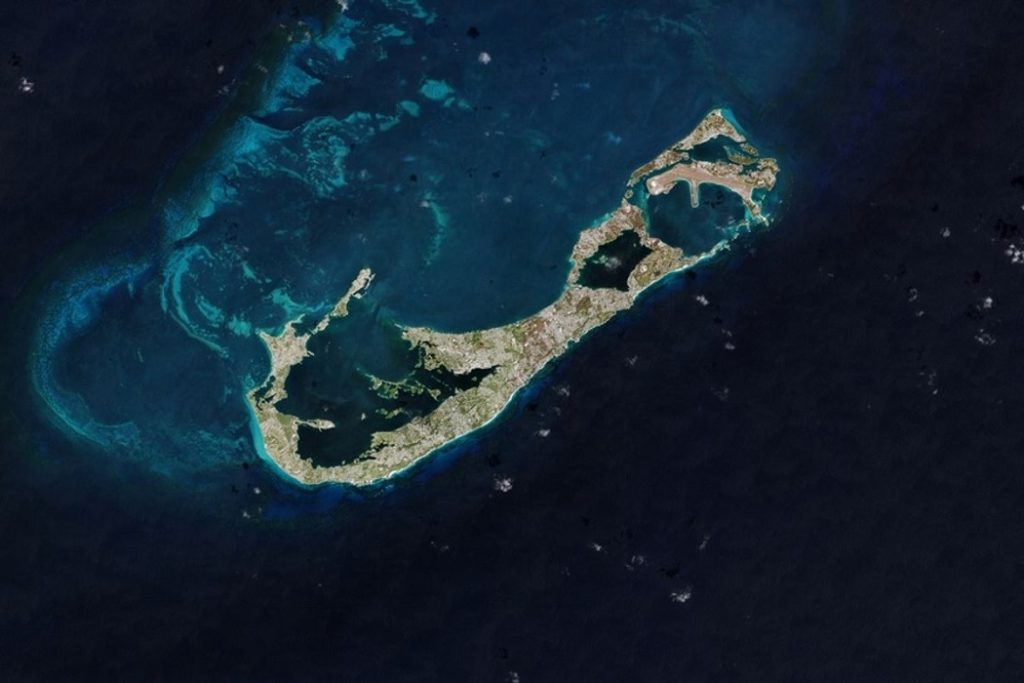
Bermuda, located in the middle of the Atlantic Ocean, has been on the agenda for years not only with the legends of the “Devil’s Triangle” but also with a real scientific riddle that puzzles geologists. The main question that baffles experts is this: Why does Bermuda seem to “float” compared to the surrounding ocean floor?
Popular narratives lost ships and planes Although the focus is on the sea, Bermuda’s real secret is hidden much below the sea surface, deep in the earth’s crust.

A Geological Anomaly Beyond Legends
Bermuda archipelago on the seabed “bathymetric swell” It is located on a wide elevation called . Often such elevations are associated with columns of hot magma from deep within the Earth. Hawaii and the Galapagos Islands are the most well-known examples of this: Tectonic plates form successive volcanic islands as they pass over a fixed hot spot.
But Bermuda does not fit this model.
There has been no volcanic activity on the island for 30–35 million years. Moreover, there is no evidence of an active mantle column beneath Bermuda today. Under normal circumstances, such a bulge should collapse over time after the heat source is removed. But Bermuda still stands.
Where Did Scientists Find the Answer?
The answer to this contradiction is in the respected scientific journal In Geophysical Research Letters It came with a new study published.
Researchers analyzed seismic wave data from distant earthquakes obtained from a single seismic station in Bermuda. Earthquake waves change speed and direction as they pass through rock layers of different densities and compositions. These changes enable the structure deep within the earth to be mapped in three dimensions.
The analyzes not only confirmed the boundary between oceanic crust and the mantle beneath it; It also revealed an additional layer of rock, approximately 20 kilometers thick, of extraordinary thickness between the two layers.. A layer of this size has almost never been observed before on mid-ocean islands.

The Invisible Support That Keeps Bermuda Afloat
This rock layer is an extraordinary example of the process known in geology as underplating. When Bermuda was volcanically active, magma rising from the mantle seeped beneath the crust rather than rising directly to the surface, where it cooled and solidified.
Since this resulting layer is lower density than the surrounding mantle material, it exerts a constant buoyant force on the seafloor beneath the island. In other words, what sustains Bermuda is no longer heat or active volcanism; a solidified underground “support block” formed millions of years ago.
Researchers state that this structure is not limited to the bottom of the island, but may extend 50 to 100 kilometers from the center, and even up to 200 kilometers, according to some estimates. It is calculated that the layer lifted the ocean floor by approximately 500 meters.
Geology Models Are Being Rethought
This finding not only explains why Bermuda did not sink after the volcanoes went out. It also forces a rethinking of existing geological models for how mid-ocean islands can survive in the long term.
The Real Threat Comes From the Sea, Not From the Underground
The biggest risk for Bermuda today comes not from the depths of the earth’s crust, but from the slowly but steadily rising sea level.
According to the US National Oceanic and Atmospheric Administration (NOAA), sea level in Bermuda rose an average of 2.18 millimeters per year between 1932–2024. This rate means an increase of approximately 22 centimeters in a century.
This sounds small, but it poses a serious threat considering that more than 20 percent of the islands are only two meters above sea level.
To join our WhatsApp group CLICK!


