
Pyramid texts are mysterious religious texts in ancient Egypt that contain various rituals regarding the protection of the dead and the afterlife.. It was written on the inner walls of the pyramids belonging to the Old Kingdom period and built by the 5th, 6th and 8th dynasties. These texts are from the Pyramid of Unas from the 5th Dynasty, from the Pyramid of Unas from the 6th Dynasty. Teti, Pepi I, Merenre and II. Besides Pepi, queens II. Anchenespepi, Behenu, Neith, Wedjebten and II. It is located among structures such as the pyramids of Iput and the Qakare Ibi pyramid of the 8th dynasty.
Pyramid texts, the largest surviving group of texts in the Ancient Egyptian language, were rediscovered on the inner walls of coffins during the later Middle Kingdom period. However, since these texts were mostly found in coffins,coffin textsThey were named “. Many of the aphorisms in both the pyramid texts and the coffin texts are considered to have been used until the later periods of ancient Egypt.
Pyramid Texts, dated to approximately 2350-2175 BC Include the oldest prayers of ancient EgyptIt inspired all religious literature of the 19th century and later. Although the origin of these prayers and the date they were first used are not known for certain, the general view is that they date back to the period before the legendary Menes and were handed down over a long period of time.
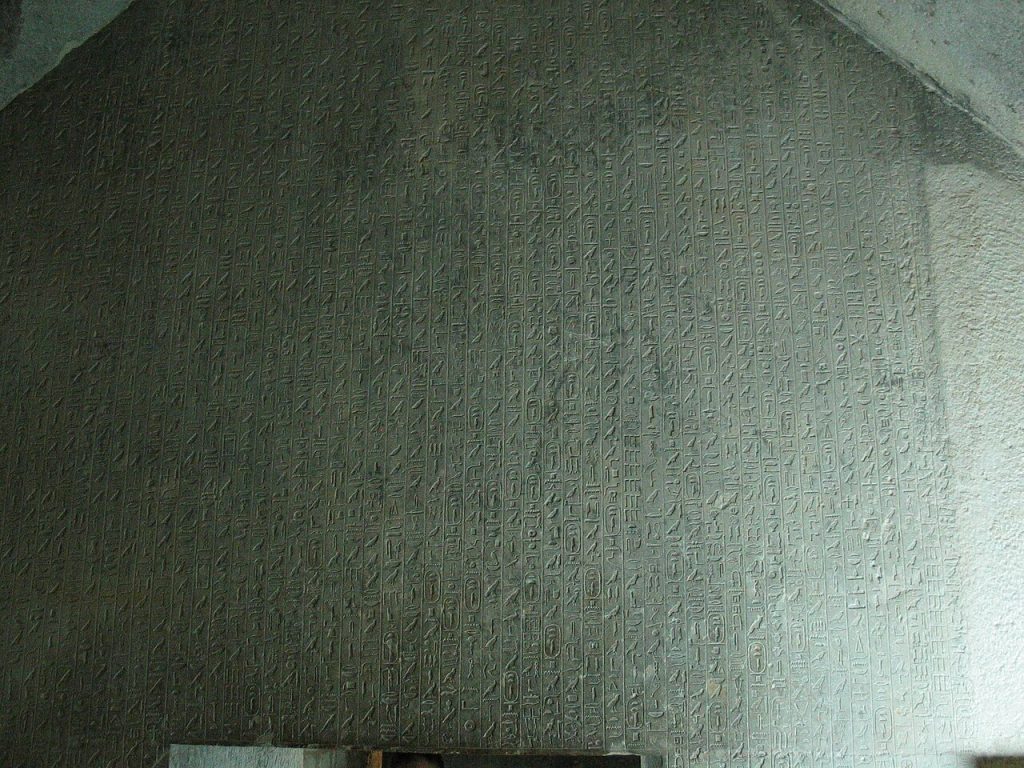
Discovery of Pyramid Texts and Research
The existence of the Pyramid Texts was first reported to Gaston Maspero, who was doing research in southern Saqqara in 1880, by the brothers Heinrich and Emile Brugsch. Later, Teti, Pepi I, Merenre I and II. It has been determined that similar texts were found in Pepi’s burial chambers. However, most of these graves are in very bad condition. For example, II. Stones fell on Gaston Maspero, who was examining Pepi’s grave, and the person who saved the archaeologist from death was Emile Brugsch. These texts, which Maspero published and became famous for in 1894, were later translated into German by Kurt Sethe, into French by Louis Spleleers, and into English by Raymond O. Faulkner.
During the excavations carried out by Swedish archaeologist Gustave Jequier between 1926 and 1933, it was observed that Pyramid Texts were found in the burial chambers of Ibi, one of the 7th Dynasty kings, and Wedjebten, Neith and İpuit, one of the 6th Dynasty queens. In subsequent investigations, in 2000, II. It was noticed that the same texts were written on the tomb walls of Pepi’s mother, Ankhesenpepi, and with this discovery, the number of pyramids on which the Pyramid Texts were written reached 10.
Among the names who made efforts to find and analyze these texts are Kurt Sethe and Raymond O. Faulkner, as well as many scientists and archaeologists such as Gaston Maspero, Gustave Jequier, Jean Philippe Lauer, Sigfried Schott, Alexander Piankoff and Samuel AB Mercer.

Themes of the Pyramid Texts
Pyramid texts, like the afterlife texts that emerged during the New Kingdom, are texts written for the purpose of protecting the dead in the Duat. However, these texts are different from the afterlife texts that emerged in later periods. Rather than the dangers that demons may pose, more concrete and understandable issues They are focused.
In these texts, topics such as protection of the dead and food supplements are discussed. Especially the food lists in the texts contain items that symbolize the eternity of the dead. For example, staple foods such as beer and bread frequently appear on lists conveying the meaning of the number 1000 in ancient Egyptian culture. In the texts, it is ordered to go to a place called “Nun” in case of hunger. This place is depicted as a paradise where everything is found; For this reason, hunger cannot survive in this place and the person dies.

The ‘Cannibalistic Hymn’, one of the most interesting sections found in the Pyramid Texts, consists solely of prayers 273 and 274, which appear in the pyramids of Unas and Teti. In these sections, it is told how the pharaoh ate the gods, symbolizing his union with them. Mark Lehner considers this theme to be a symbolic analogy with the passage of the creator god’s ‘ka’ from the pharaoh’s ancestors to the pharaoh.
In the Hymn of Cannibalism, it is described in detail how the pharaoh ate the gods. Concrete and detailed descriptions such as the cauldrons in which meat, legs, intestines and lungs are cooked are included in these texts. This situation points to a more realistic and confusing expression than a symbolic one. These hymns remind us of rituals symbolizing the blood and body of Jesus in Christian communion ceremonies and actually symbolize union with the gods. While some researchers think that these bloody rituals may have occurred in the past, others point out that the defeated gods may actually represent sacrificed sacred animals.


