In the Doğubayazıt district, located at the foothills of Mount Ararat, the ruins believed to belong to Noah’s Ark have been followed with great curiosity and interest for many years. The samples collected from the region with special permissions were subjected to a detailed examination within the scope of the research carried out in cooperation with Istanbul Technical University (ITU) and Adıyaman Construction and Environment University (AİÇÜ) and the first results were revealed.
‘Noah’s Ark’ ruinsThe first results of the examinations carried out on rock and soil samples taken from the area where it is believed to be possible have been announced. According to the research results, in this region between 5500 and 3000 years BC traces of human activities found.
Prof. Dr. Faruk Kaya said, “However, these results do not definitively confirm that the ship is here. Long-term research and study is required to confirm the reality. For this reason, we agreed to cooperate with Adıyaman Construction and Environment University (AİÇÜ) in the following period, under the leadership of Istanbul Technical University (ITU) and Andrew University. “These three universities will continue their work in this field in the future,” he said.
Scientific Research on Ruins
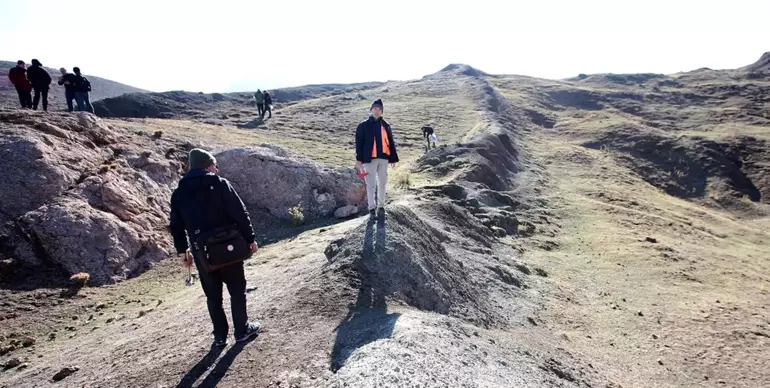
Capt. İlhan DurupınarOn September 11, 1959, in the land between Telçeker and Üzengili villages of Doğubayazıt district, Alleged ruins of ‘Noah’s Ark’ discovered. These ruins attract great attention from local and foreign tourists. However, the threat of landslides, which increases every year, has caused deterioration in the structure of this ruin and created giant fissures.
A collaboration was made between Adıyaman Construction and Environment University (AİÇÜ) and Istanbul Technical University (İTÜ) for scientific research of the ruins. ‘Mount Ararat and Noah’s Ark Research Team’ was established. In December last year, the team carried out its first investigations in the region. This team consists of academics specialized in geophysics, chemistry and geoarchaeology. Within the scope of their research, soil and rock samples were collected from the region and these samples were sent to ITU laboratories and prepared for examination.

Aging Studies on Samples
Approximately 30 rock and soil samples collected with special permission were meticulously examined in the laboratories of Istanbul Technical University (ITU). As a result of research lasting about a year, the samples were aged. According to laboratory results, samples taken from the region clay materials, marine materials and seafood It has been determined that .
Adıyaman Construction and Environment University (AİÇÜ) Vice Rector Prof. Dr. Faruk Kaya made evaluations regarding the laboratory results and stated that the samples examined aging studies He stated that as a result, it was determined that they date back to 3500 to 5000 years ago.
Stating that the project of examining rock and soil samples was carried out with Istanbul Technical University in 2022, Prof. Dr. Faruk Kaya emphasized that this study is long-term and laboratory studies have not been completed yet. However, according to the first findings, it is thought that there were human activities in the region from the period between 5500 and 3000 BC. However, these findings do not definitively confirm that Noah’s Ark was located in this area. Therefore, long-term studies will continue in the future in cooperation with Istanbul Technical University, Andrew University and Adıyaman Construction and Environment University. Prof. Dr. Faruk Kaya stated that the work will be continued by creating new commissions within the framework of this cooperation.

Work Will Be Intensified in Cudi and Mount Ararat
In addition, the 7th International Mount Ararat and Noah’s ship Stating that this issue was also discussed in the symposium, Prof. Dr. Faruk Kaya shared that the symposium made an important decision. This decision was made in the region known as Mesopotamia, mentioned in the Holy Quran and the Bible. In Cudi and Ararat regions There is a need for joint research. In this way, it was decided that it was possible to achieve more effective results.
Prof. Dr. From now on, Kaya, Cudi and Mount AraratHe stated that studies will be intensified in and research will continue in these two important regions. This collaboration and research aims to gain more information about the historical and cultural heritage of the Mesopotamian region.