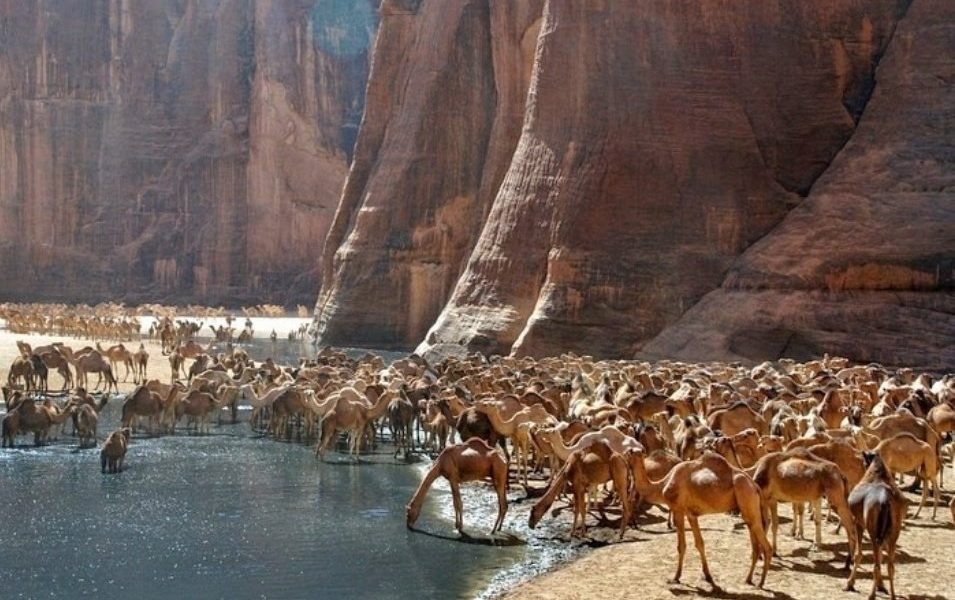
Ennedi Plateau; It is part of a mountain group also known as the Ennedi Massif located in Chad. The plateau, which is a sandstone massif, was formed by erosion caused by wind, water and heat. Due to the water resources in the region, it has been used as a living space in every period. The region, which provides protection from external influences due to its natural structure, is a very suitable environment for the passage and accommodation of caravans. It is also a tourist attraction due to the large number of structures found in the area, such as mushroom rocks, cliffs, pillars, bridges, towers, rock labyrinths and arches.
It is located in the northeast of Chad in the Ennedi-Ouest and Ennedi-Est regions. The plateau, which is home to wildlife, has a large collection of rock art with depictions. This rock art, which is considered as the cultural heritage of humanity, dates back thousands of years. The Ennedi Massif, which has a rich culture, biological diversity and magnificent natural formations, was declared a UNESCO World Heritage Site in 2016. Located in the middle of the Sahara Desert, the oasis is a desert Eden for both humans and wildlife.

Biodiversity on the Ennedi Plateau
Ennedi Plateau, located in the middle of the African-Eurasian migration route, consists of an area of approximately 60 thousand square kilometers. The highest point of the plateau, which is above sea level, is about 1450 meters. Consisting of sandstone, Ennedi has at least 20 springs and many pools.
Plateau; It is home to a unique diversity of fauna, including rare species such as the desert crocodile. These desert crocodiles living in certain regions are known as endangered “dwarf crocodiles”. At the same time, there are species such as Sudan Cheetahs and African Antelopes at different points of the plateau. The species known as the Ennedi Tiger also lives in the region.

More than 189 bird species live in the area, such as the Arabian Bustard, the Little Kestrel, and the Brown-backed Golden Sparrow. The plateau is used by birds as a stop on their migration path. The plateau, which is a paradise for iconic species living in the desert; Barbary Sheep, Striped Hyenas, Caracals, Honey Badgers and Dorcas Gazelles live.
At the same time, the last population of the African Ostrich, which was thought to be extinct in the region for nearly 20 years, was discovered in 2018. There are more than 525 plant species in the oasis, which has a remarkable biodiversity. The existence of the oasis is extremely important for the preservation of the biodiversity of the ancient desert.

Human Life on the Ennedi Plateau
Within the Ennedi Massif; There are many archaeological sites in very well preserved condition, such as mausoleums, engravings and rock paintings. These sites are extraordinary documents that shed light on the history of human life in the Neolithic period. Most of the paintings on the walls are in the form of patterns of cattle, horses, camels and people.
History BC. The Ennedi people, who are thought to date back to 5000 and 4000 years; It is thought that they mostly made a living by hunting, fishing and gathering. They used this area as a settlement because it was suitable for life. Pottery vessels with dotted, wavy and striped patterns typical of the period were found in the area. It is thought that over time, there were changes in the lifestyle of the community and they switched to cattle breeding. They also began to use some stone tools, including axes.

There are 30 thousand nomads who legally pass through this land every year and are dependent on it. Located in a safe location, the Ennedi Massif is among the most famous and accessible sites of Saharan tourism. For this reason, African parks and the Çat government have jointly undertaken the management of this area since the beginning of 2018. The area was designated as Ennedi Natural and Cultural Reserve by the Chad government in 2019.