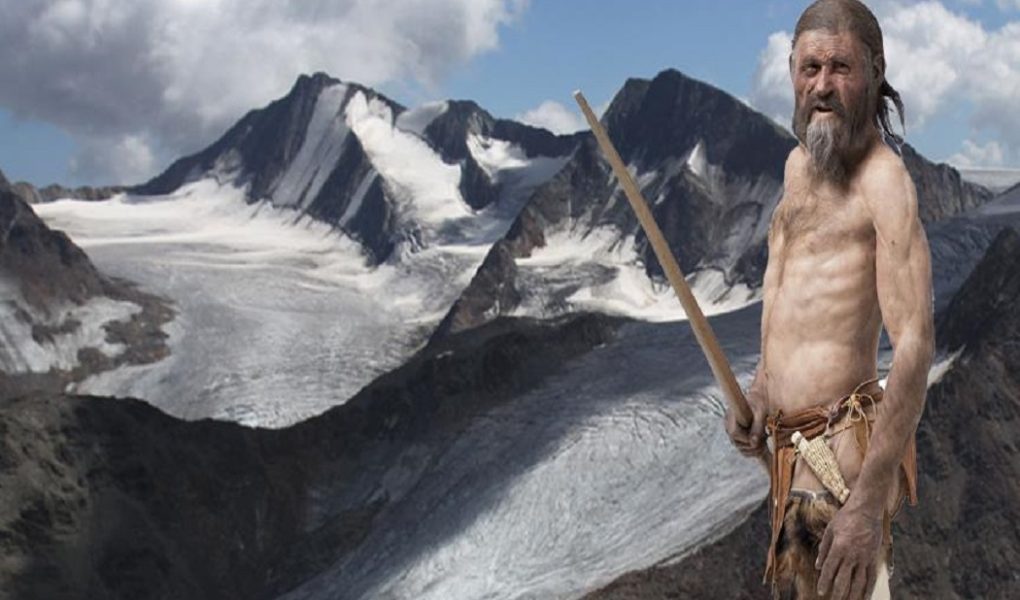
When history freezes the flow of time, sometimes humanity finds the opportunity to peek into the secrets of the past. The iceman Ötzi is one of these secrets, an ancient mummy that has been hidden in the glaciers for thousands of years and has been unearthed through careful research. Ötzi, who lived between 3400-3100 BC, still looks at us from the depths of history, thousands of years after his death, in the lap of the Alps.
Although Ötzi is called by different names (Ice Man, Simulaun Man, Ice Man from Tyrol, etc.), his real story lies in his genetic map and origin. Genetic studies show that Ötzi’s origin goes back to Anatolia. Could Ötzi have descended from immigrant ancestors from Anatolia under the challenging conditions of the ice ages? This question remains an exciting question mark as we try to illuminate the complex fabric of humanity’s past. However, Ötzi’s secret is not only in his genes, but also in his physical appearance. His dark eyes, swarthy skin and sparse black hair are hints of his age.

Discovery and Characteristics of Ötzi the Iceman
Ötzi was discovered on September 19, 1991, at an altitude of 3,210 meters on the eastern ridge of Fineilspitze in the Ötztal Alps, where the Austrian-Italian border is located, by two German tourists, Helmut and Erika Simon. The Simon couple, who were in the area as tourists at the time, encountered a corpse while walking on the mountain pass road between Hauslabjoch and Tisenjoch. Thinking it belonged to a dead mountaineer, they informed the authorities. The next day, gendarmerie teams and a nearby Similaun chalet ranger tried to free the body from the ice beneath it, using a pneumatic drill and ice axes. However, this effort was not successful due to bad weather conditions.
The next day, eight separate groups arrived in the area, including the famous mountaineers Hans Kammerlander and Reinhold Messner. Finally, on September 22, the body was quasi-officially exhumed and fully recovered the next day. The body was moved to the forensic office in Innsbruck, along with other objects found. On September 24, archaeologist Konrad Spindler, who examined the finds, suggested based on the typology of the found ax that the finds date to about 4,000 years ago.

Ötzi, also known as the Ice Man, is the highly preserved mummy of a man who lived between 3400 and 3100 BC, under natural conditions. This mummy is also referred to as the Man of Simulaun, the Man of Hauslabjoch, the Ice Man of Tyrol, or the Mummy of Hauslabjoch. It was found in September 1991 in the Ötztal Alps, between the Similaun and Hauslabjoch mountains on the Austrian-Italian border. For this reason, he was nicknamed “Ötzi”.
Ötzi, Europe’s oldest known natural mummy, provides valuable information about the lifestyle of European people in the Copper Age. His body and belongings are on display at the South Tyrolean Archaeological Museum in Bolzano, in the South Tyrol region of Italy. Dark eyes, sparse black hair, light freckles and dark skin… Ötzi, a 5000-year-old glacial mummy found in an undecayed state in the glaciers of the Ötztal Alps, had these characteristics while he was alive.

Research on Ötzi’s Origins in Anatolia
As a result of a new research, it has been revealed that Ötzi’s origins go back to Anatolia. Scientists conducted extensive research to learn more about Ötzi’s genetic background and physical appearance and determined that Ötzi’s origins lie in Anatolia. Research conducted jointly by the Max Planck Institute for Evolutionary Anthropology and the Eurac Institute for Mummy Studies showed an unexpectedly high level of genetic similarity between Ötzi and the farmers who migrated from Anatolia in the early period.
Albert Zink, co-author of the study and head of the Eurac Institute for Mummy Studies, said Ötzi had a dark complexion. he said.

Ötzi’s genome was first sequenced in 2012, and findings at the time suggested that he came from steppe herders. However, the new research revealed that Ötzi’s hunter-gatherer genes were low in proportion. Researchers determined that Ötzi grew up in the north of Italy and his ancestors came from Anatolia and started to migrate to Europe. Zink stated that researchers now have a better understanding of Ötzi’s ancestry and that this study improves knowledge about Ötzi’s physical appearance.
It is not certain how Ötzi died, although there are various speculations about his death. The most common theory is that he was killed as a result of a conflict. It was stated that Ötzi died as a result of a blow to the head and that he had arrow and stab wounds on his body.


