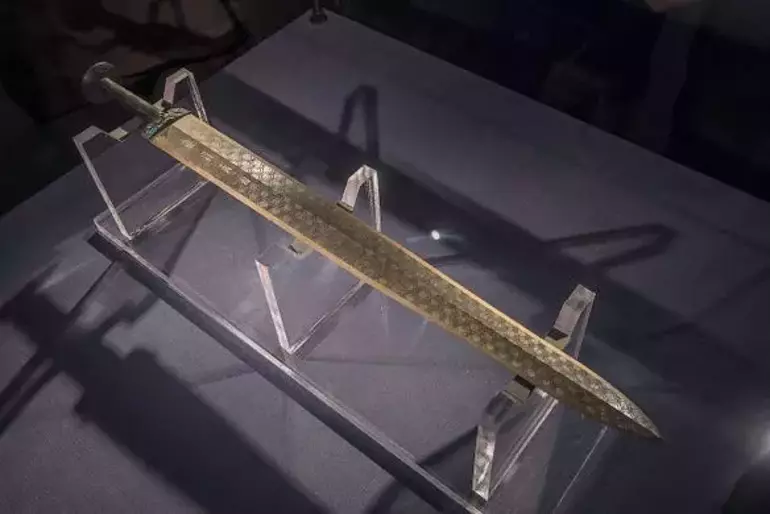
The Goujian Sword, an archaeological find dating back 2,500 years, is an engineering marvel that defies the effects of time and nature. This sword, discovered along with a human skeleton in a water-damaged coffin in 1965, astonished archaeologists. Because the sword was not rusted and had not lost any of its sharpness. Legendarily, it was sharp enough to cut through 20 sheets of hard paper in one go.
The Goujian Sword Discovered in 1965 and Defying the Effects of Time
In October 1965, Jingzhou city of China An archaeological excavation around the nearby Zhang River uncovered many ancient tombs. More than 2,000 artifacts were found during these excavations. However, during the research that ended in January 1966, there was a discovery that was completely astonishing with its features.
Archaeologists found a sword along with a human skeleton inside a water-damaged coffin. However, although this sword was soaked in the coffin, it did not rust and did not lose its sharpness. Goujian SwordIt attracted attention with its complex design, extraordinary sharpness and resistance to tarnishing. The sword, which was 55.6 cm long and weighed 875 grams, looked as if it had been newly made. It was so sharp that one of the archaeologists cut his finger while holding the sword.
According to the Hubei Ministry of Culture, this sword was effective enough to cut 20 sheets of hard paper with a single blow. The subtleties in the sword’s design make it outstanding not only aesthetically, but also functionally.

Material Selection and Protective Effect of the Coffin
The sword’s hilt was wrapped in silk and its body was made of copper, so it was unlikely to break. Its edges were covered with tin, which made it more resistant to impacts. Additionally, the darkening of the patterns was prevented by using sulfur. The handle of the sword was designed to support the base of the hand with a shape consisting of 11 circles, designed to provide a perfect grip to the user.
One of the reasons why the sword was so well preserved was that the coffin it was in had a structure that was almost airtight. This helped preserve the sword better over time, allowing it to remain as good as the first day even after 2,500 years.

To Whom Does the 2,500-Year-Old Goujian Sword Belong?
Goujian SwordIt was not only a tool of war, but also an object symbolizing the power of a historical leader. The sword was commissioned by a king during the time of China’s epic heroes, at a time of wars and plunder.
There was an inscription on the underside of this sword, which remained sharp and rust-free for 2,500 years. When archaeologists examined the writing, “King of Yue” and “He made this sword for his personal use.” However, at the time when the sword appeared, nine different kings ruled the Yue Kingdom. As a result of their detailed examinations and research, historians and linguists have determined that this sword belongs to the people who ruled between 496-465 BC. King GoujianThey decided it belonged to .

Design and Function of the Sword
The Goujian Sword had a shorter design compared to other swords of the period. This feature made it possible to use the sword with a shield or as a secondary weapon on the belt. At the same time, since it was extremely light, it had high maneuverability and could be thrown quickly.
The sword’s center of mass was located in the middle, allowing for both cutting and stabbing attacks. This design made the sword not only aesthetic but also highly functional on the battlefield.
Where is the Goujian Sword Today?
The Goujian Sword was loaned to Singapore in 1994. However, because it was damaged by a worker, it has since been banned from being exhibited abroad. Today, Hubei Provincial Museum in China’It is protected in a special airtight wooden box. This special casing prevents the sword from being damaged further over time, ensuring the preservation of this historical artifact for many years to come.
To join our WhatsApp group CLICK!