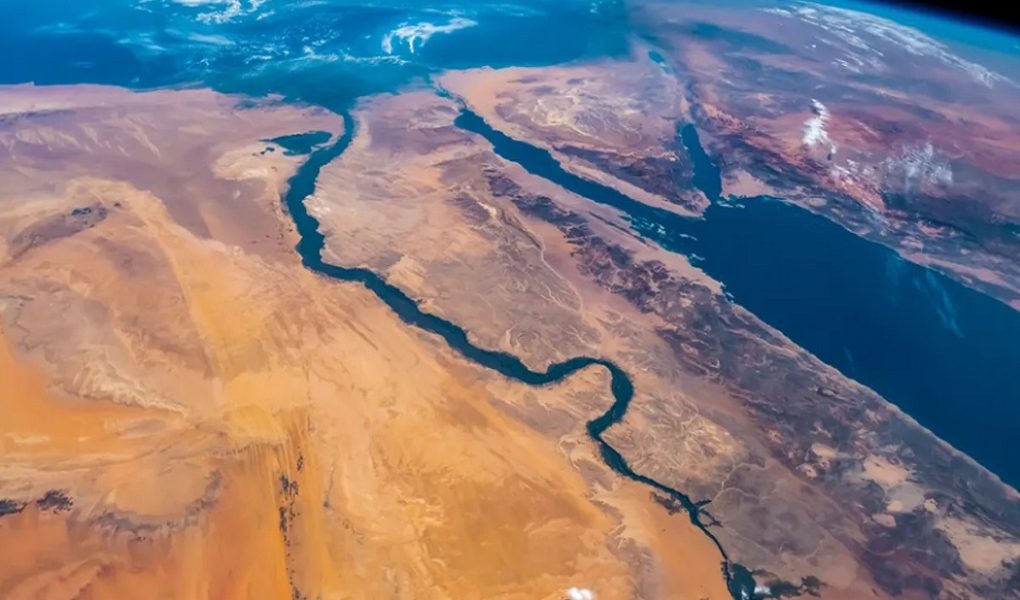
The Nile River is known as the second longest river in the world and has a total length of 6,853 kilometers. The basin of the Nile River occupies one-tenth of the African continent. This great river flows from south to north and has three main tributaries: the White Nile River, the Blue Nile River, and the Atbarah River.
The source of the Nile River, which has flowed for thousands of years, is still an unsolved mystery! While the question of what is the origin of the Nile River may seem simple on the surface, the origin of the longest river on Earth has continued to confuse people for thousands of years. Even today, in an age filled with a wealth of satellites and geophysical information, the mystery of the source of the Nile is still not as simple as you might imagine.
With a simple answer, it is possible to say that the Nile River has two main sources. The Blue Nile originates from Ethiopia and contributes to two-thirds of the entire flow of the Nile. The other source comes from the African Great Lakes region. However, when we go back historically, we can see that things are a little more complicated.

Efforts to Find the Source of the Nile River in History
Ancient Romans in Latinsearching the head of the NileThey used the proverb “Nili caput quaerere” meaning “. This idiom was used to express the efforts of those who were searching for something unattainable or impossible. The Romans, a society that did not shy away from any challenge, tried to find the source of the Nile in a mission initiated by Emperor Nero between 60 and 61 AD. With the help of Ethiopian guides, a small group of the emperor’s personal guards made their way across the Nile into the unknowns of Africa.
It is believed that they reached an important water source, which they believed to be the source, but it is not known exactly where their search ended. Some claim it was a gorge near Juba in present-day South Sudan, while others think it reached it further south in Uganda around Murchison Falls. In both cases, they were unable to solve this mystery in the end. Nero died by suicide in AD 68, and this quest seems largely forgotten after the Roman Empire shelved plans to invade Africa beyond Egypt.
Before Rome, the Ancient Egyptians were also trying to discover the source of the Nile, but most importantly, they used these rivers to irrigate their land and use it as a means of transportation. They are believed to have traced the Nile to Khartoum in Sudan, and its source is thought to be the Blue Nile from Lake Tana in Ethiopia.
An expedition organized by order of Pharaoh Ptolemy II Philadelphus, who ruled Egypt in the 3rd century BC, reportedly determined that the source of the Blue Nile could originate from the Ethiopian mountains. This discovery showed that the understanding of the origin of the Blue Nile was correct, but there is no evidence for the discovery of the White Nile by the ancient Egyptians.

Information on the Source of the Nile River
Today, there is broad consensus that the two sources of the Nile meet in Khartoum, the capital of Sudan, and that the Blue Nile and the White Nile converge here and continue northward into Egypt. The Blue Nile originates from Ethiopia’s Lake Tana from the east, while the White Nile emerges from around Lake Victoria, originating from Jinja in Uganda. For this reason, Lake Victoria, Africa’s largest lake by geographic area, is often considered the source of the Nile. But even this point is more complicated than it might seem at first glance.
Famous adventurer Sir Christopher Ondaatje explained in an article he wrote in the journal Geographical in 2016 that Lake Victoria was actually a reservoir fed by other rivers. In 1996 Ondaatje went on an expedition in Africa to search for the source of the Nile River and discovered that the waters of Lake Victoria were flowing into Lake Albert. He found that the White Nile is fed not directly from Lake Albert, but via other rivers such as the Kagera River and the Semliki River, which originate from the Ruwenzori Mountains in the Democratic Republic of Congo. As a result, he defended the thesis that the source of the White Nile can be traced to the Kagera River and the Semliki River.
“The Ruwenzoris are as important a Nile water source as Lake Victoria,” Ondaatje wrote.
In conclusion, it is clear that the Nile River does not have a single source and is fed by a complex river system and other water bodies. It may be optimistic to pinpoint the source of the Nile in one spot, but the reality is often not that simple.