Rubber is a versatile and flexible material that we encounter in many areas of our daily lives. Rubber, obtained from the sap-filled veins of weeping trees, has had an indispensable place in human life for centuries. This extraordinary material, first discovered by the Aztecs, over time revolutionized technology and industry and became one of the cornerstones of the modern world.
People have been using the durable and elastic structure of rubber to produce various products for more than a thousand years. In the early periods rubberAlthough it is obtained directly from natural sources, with the increasing demand over time, scientists syntheticthat is, they started to produce artificial rubber. Most of the rubber produced today is produced synthetically.
Rubber, with its natural and synthetic varieties, is used in a wide range of products, from automobiles to medical products, from shoes to building materials. Are you ready to discover every stage of this fascinating journey, from the sap collection methods of trees to the synthetic production processes in laboratories?
Origin and Types of Rubber
Rubber is obtained from the sap of tropical plants (latex) or is a flexible material obtained from fossil fuels such as oil and natural gas. obtained from trees natural rubberThe one produced from petroleum-based raw materials is called synthetic rubber. Both natural and synthetic rubberThey are durable materials with a wide range of uses. Products made with rubber are often called “tyres”.
Rubber tree (Hevea brasiliensis)It originates from South America and is grown today in Brazil, Ceylon, Mexico, Java and various parts of Africa. For centuries, rubber production has resulted in leaching that scratches the bark of trees. by collecting and drying the latex sap has been carried out. In the 20th century, with the developments in the field of chemistry, it became possible to produce synthetic rubber that could be used instead of natural rubber.

Two-thirds of the rubber produced today is of synthetic origin. The origin of the word “rubber”, which came into Turkish from French, is Quechua The word “kauchuk” in the Turkish language. Rubber in some languages “eraser” (rubber) means. This is because it was first used for writing purposes when it was brought to Europe in the 18th century.
“rubber” in Quechua language, “weeping tree” and this naming is associated with the drop by drop leakage of latex obtained from the tree.

History of Rubber and Usage Areas of Rubber
When we look at the history of rubber, at least in the 15th century aztecs We see that it is known by. in 1493 Christopher ColumbusDuring his exploration of the New World, he recorded that the Aztecs played with a ball made of tree sap. However, the person who introduced rubber to the modern world was Charles Goodyear in the 1840s. Goodyear processed rubber into its current durable and flexible form.
Approximately half of the rubber produced worldwide is used in the production of automobile tires. Natural rubber contains 3% protein and 97% cis-1,4-polyisoprene material. Rubber, known as latex in its raw form, is combined with cotton or viscose and used to make corsets, rubber socks and belts.

Rubber plays an important role in making clothing, hoses and various rubber products thanks to its flexibility and durability. Rubber’s vibration-absorbing properties make it a usable material in automobile suspension systems and industrial machinery. At the same time, its waterproof properties enable use in diving suits, rain jackets and medical tanks.
Thanks to its electrical insulation, rubber is often preferred in covering electrical cables. In addition, rubber can be converted into foam form with air bubbles and thus can be used in the production of light and durable products such as sponges and pillows.

Natural Sources of Rubber
Natural rubber is made from a liquid extract called latex, obtained primarily from some types of trees. The most preferred tree in rubber production, “rubber tree” It is also known as Hevea brasiliensis. These trees grow naturally in South America, but are now more commonly found in Southeast Asia.
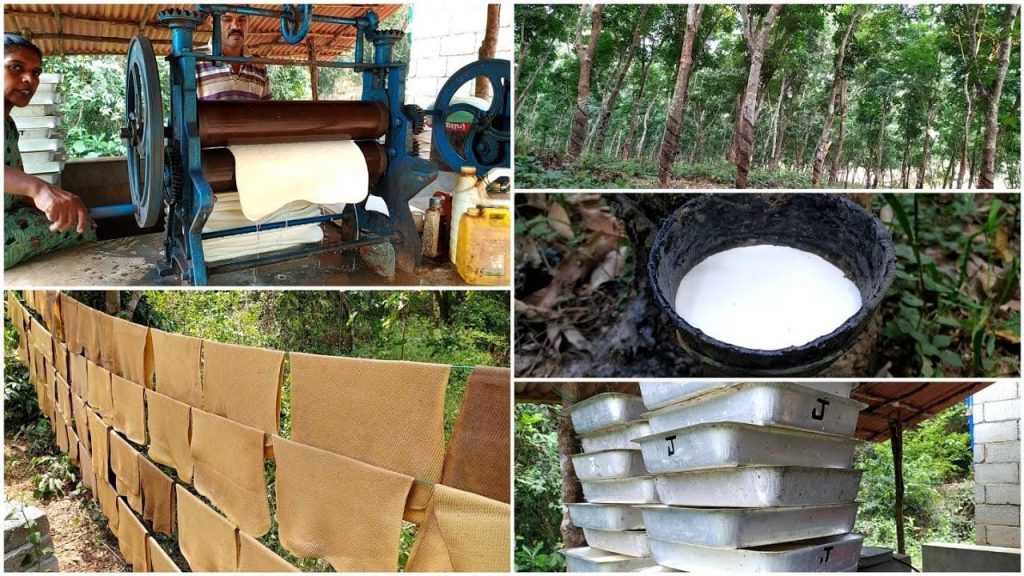
Latex is obtained by cutting the bark of the tree and the filtered sap is collected in containers. Name of this process “tapping” It is known as. Ammonia is added to prevent the latex from solidifying, and then acid is added to the mixture to promote coagulation. Removing rubber this way usually takes 12 hours.
The mixture is then passed through rollers to remove excess water. When the drying phase is completed, the rubber becomes ready for processing and is stored in bales.

The Birth of Synthetic Rubber
During World War I, when natural rubber resources were decreasing, German scientists developed the production of synthetic rubber. first produced synthetic rubberIt was of lower quality than natural rubber. However, with improvements made over time, synthetic rubber has become as strong and durable as natural rubber.
Synthetic rubber, unlike natural rubber, is produced in a laboratory environment. This process is achieved by bonding polymer molecules together, resulting in a flexible and durable material.

Rubber Processing Process
Whether natural or synthetic, rubber must undergo a series of processes to be transformed into a final product. These processes may vary depending on the purpose of the product to be used.
Natural rubber productionIt starts with collecting the sap of the rubber tree. Special cuts made in the bark of the Hevea brasiliensis tree allow the latex sap inside the tree to flow. This processing “tapping” It is called and is usually done in the morning hours because the sap flow is higher at that time. The collected latex is stabilized by adding ammonia to prevent it from solidifying. Then acid is added to ensure coagulation, and this process takes approximately 12 hours.

The latex is passed through rollers to remove excess water and subjected to a drying process. Once dry, the natural rubber layers are left to air dry or hung on shelves. As a result, natural rubber is processed for various industrial applications.
During the fabrication phase, rubber is first stabilized. This stabilization process prevents the rubber from becoming brittle or sticky. Often fillers such as carbon black are added to the mixture to increase its strength. The rubber is then mixed thoroughly and allowed to cool before being shaped. Shaping of rubber, or “calendering” It is carried out by passing it through rollers called “extrusion” method or by making hollow tubes by the “extrusion” method.

Vulcanization: Strengthening of Rubber
The final stage to increase the durability of rubber vulcanization must go through the process. During this process, rubber is heated with substances such as sulfur, creating extra bonds between molecules. This makes the rubber more durable and does not crumble easily. The vulcanization process was first discovered by chance by Charles Goodyear. Goodyear noticed how rubber hardened with heat when he accidentally dropped it on a hot stove.

After vulcanization, the rubber is shaped or molded into the final product. At this stage, possible defects are corrected and the rubber is made suitable for the final product. Today, rubber is an important material that continues to be used in many different industries.
Rubber has a wide range of uses, from vehicle tires to waterproof seals, from shoe soles to pipe coatings. Thanks to its durability and flexibility, it has become an indispensable material in the modern world.

To join our WhatsApp group CLICK!