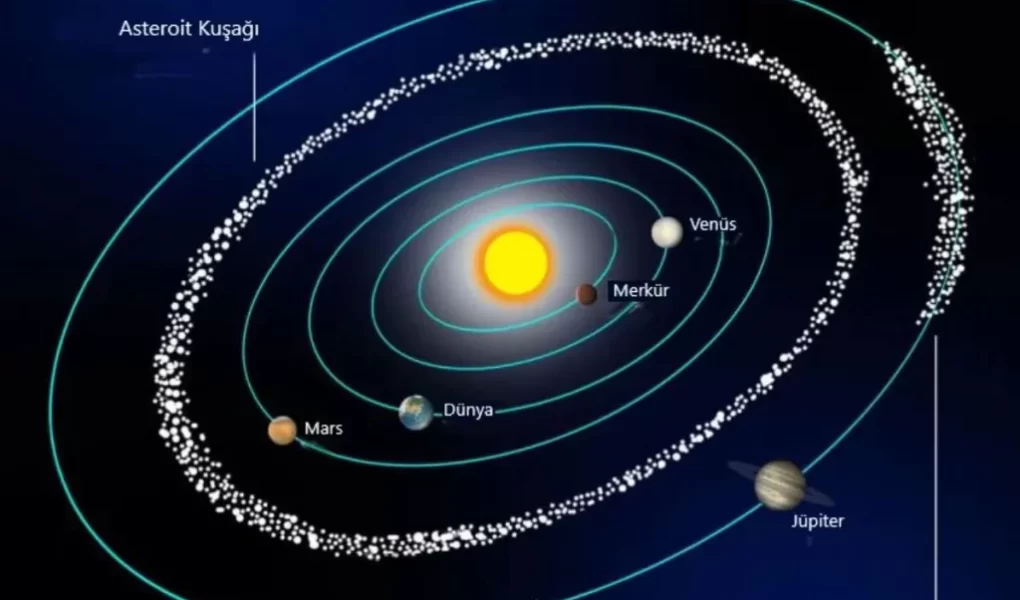
The asteroid belt is a torus-shaped region in the Solar System between the orbits of the planets Jupiter and Mars. This area contains irregularly shaped celestial bodies of various sizes called “asteroids” or “minor planets”.
Although these objects vary greatly in size, they are much smaller than the planets and the average distance between them can be up to a million kilometers. This region is Solar systemOther in asteroid to be distinguished from communities main asteroid belt or main generation also known as.

The Innermost Region of the Solar System
Asteroid Beltis the smallest and innermost subsidence ring in the Solar System. Other small groups of Solar System objects include near-Earth objects, centaurs, Kuiper belt objects, scattered disk objects, sednoids, and Oort cloud objects. About 60% of the mass in the main belt is concentrated in the four largest asteroids: Ceres, Vesta, Pallas, and Hygiea.
The total mass of the asteroid belt is estimated to be 3% of the mass of the Moon. The largest object in this region, Ceres, has a diameter of about 950 kilometers, while other large objects have diameters of less than 600 kilometers. Other celestial bodies can range in size from a speck of dust to a mere speck of dust.
Asteroid Belt Density and Collisions
The material in the asteroid belt is so sparsely distributed that many uncrewed spacecraft have passed through the region without incident. However, collisions between some large asteroids can occur, which can result in families of asteroids with similar orbits. Asteroids within the belt are classified by their spectra into three main categories: carbonaceous (C-type), silicate (S-type), and metal-rich (M-type) asteroids.

Solar Nebula and Planetoids
The formation of the asteroid belt is the formation of the protoplanetary planets that formed from the primitive solar nebula. planetoidsIt consists of. The region between Mars and JupiterPlanet formation was not completed due to Jupiter’s strong gravitational influence. As a result, the colliding planetesimals broke apart into smaller bodies that make up most of the belt.
During the first 100 million years of the Solar System, 99.9% of the asteroid belt’s original mass was lost. Some of these bodies drifted into the inner Solar System, colliding with planets and causing meteor impacts.
The orbits of asteroids experience major perturbations when their orbital periods around the Sun enter into orbital resonance with Jupiter. These resonances cause asteroids to shift to other orbits and drift into regions called the Kirkwood gap. This dynamic process has an important role in understanding the complex structure and evolution of the asteroid belt.

Kepler’s Prediction: A Planet Between Mars and Jupiter
In 1596 Johannes Keplerin his work “Mysterium Cosmographicum” “I am placing a planet between Mars and Jupiter” He suggested that there might be a planet between the orbits of these two planets. While analyzing Tycho Brahe’s data, Kepler noticed that there was a fairly large gap between the orbits of Mars and Jupiter, according to the planetary models used at the time. This gap did not match the order of the planetary orbits, and Kepler thought there must be a planet there.

Titius-Bode Law and the “Lost Planet” Idea
In 1766, German astronomer Johann Daniel Titius noticed a pattern in the orbits of the planets. This pattern could be used to estimate the radius of the planets’ orbits by creating a numerical sequence. According to this sequence, Mars and Jupiter were separated by 24 units, suggesting that a planet might be there.
This discovery of Titius was later Titius-Bode law When William Herschel discovered Uranus in 1781, the planet’s orbit perfectly obeyed this law, reinforcing astronomers’ belief that there might be a planet between Mars and Jupiter.
On January 1, 1801 Giuseppe Piazzi, He discovered a small celestial body in Sicily. This body should be between Mars and Jupiter according to the Titius-Bode law. Piazzi “Ceres” He named it and initially thought it was a comet. However, the fact that Ceres does not have a gas cloud called a coma raised suspicions that it could be a planet. Thus, Ceres was included among the planets, along with the eight planets.
With the discovery of Ceres, astronomers began an intensive study to investigate the space between Mars and Jupiter. Franz Xaver von Zach formed an informal group of 24 astronomers known as the “celestial police.” About 15 months later, Heinrich Olbers discovered a second celestial body, which he named Pallas. Unlike the other planets, these bodies did not appear as a disk when viewed through a telescope, but as a point of light, and could be distinguished from stars due to their speed.

Asteroids: Small Star-like Objects
In 1802, William Herschel stated that objects like Ceres and Pallas should be placed in a different category, calling them “asteroid” The term was derived from the Greek word “asteroeides,” meaning “star-like.” Herschel argued that these objects could be classified as neither a planet nor a comet because they looked like small stars when viewed through a telescope.
By 1807, two new celestial bodies had been discovered in the region: Juno and Vesta. However, the burning of Lilienthal, where most of the exploration work took place, during the Napoleonic Wars, brought an end to the explorations in this period. However, a fifth asteroid (Astraea) was discovered in 1845, and new asteroids were found rapidly thereafter. As the number of these bodies increased rapidly, it became difficult to include them in the list of planets. As a result, the term “asteroid” became common and was separated from the planets.
The discovery of Neptune in 1846 called into question the accuracy of the Titius-Bode law. Neptune’s orbit did not match the position predicted by this law. This was a disappointment to astronomers who supported the law, and a general view developed that the Titius-Bode law was a coincidence. To date, no scientific explanation has been provided for this law, but the discovery of asteroids between Mars and Jupiter has gone down in history as one of the most important predictions of this law.

Early Uses and Popularization of the Term “Asteroid Belt”
The term “asteroid belt” came into common use in the early 1850s, but it is not clear who first used the term. The first known English use is in Elise Otté’s 1850 translation of Alexander von Humboldt’s Cosmos. Humboldt describes an “asteroid belt” that intersects the Earth’s orbit and moves at planetary speeds. Robert James Mann’s A Guide to the Knowledge of the Heavens also mentions asteroids in a wide belt. The American astronomer Benjamin Peirce may have adopted and popularized the term.
By the mid-19th century, the number of asteroids being discovered was rapidly increasing. By 1868, more than 100 asteroids had been discovered, and the introduction of astrophotography by Max Wolf in 1891 accelerated the pace of discovery even further. By 1921, a total of 1,000 asteroids had been found, by 1981 this number had reached 10,000, and by 2000 it had reached 100,000. Modern asteroid search systems have made this discovery process much faster with automated instruments today.

Discovery of Water Vapor on Ceres
On January 22, 2014, the European Space Agency (ESA) announced that water vapor had been detected on Ceres, the largest object in the asteroid belt. This discovery was made thanks to the far-infrared observation capabilities of the Herschel Space Observatory. This finding was a surprise to scientists, as water vapor is usually observed on comets, while such activity was not expected on asteroids. This showed that the distinction between comets and asteroids is becoming increasingly unclear.
Theories on the Origin of the Asteroid Belt
In 1802, Heinrich Olbers, shortly after discovering Pallas, suggested that Ceres and Pallas might have been fragments of a large planet that had once existed between Mars and Jupiter. This hypothetical planet was called “Phaeton” and was thought to have been broken apart millions of years ago by an internal explosion or a comet impact. Odessa astronomer K. N. Savchenko argued that these celestial bodies were not fragments of an exploded planet but were moons of that planet that had been scattered around.
However, these theories have not gained widespread acceptance for several reasons. The amount of energy required to destroy a planet is too large, and the total mass of objects in the asteroid belt is too low to show any signs of such an event (only about 4% of the mass of the Moon). In addition, the chemical differences between the asteroids make it unlikely that these objects came from the same planet.

To join our WhatsApp group CLICK!


