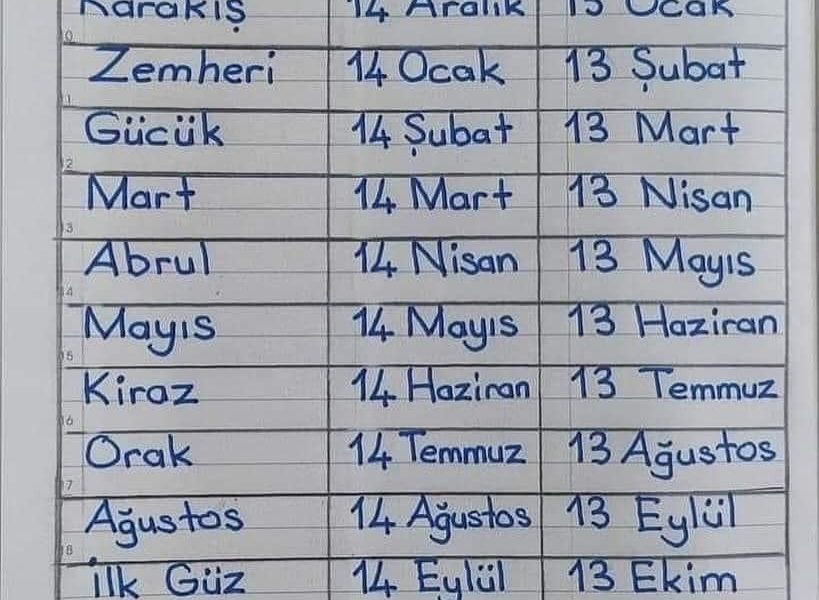
A folk calendar is a calendar that has no official character and is generally specific to a particular region or community and not accepted by everyone. This calendar serves to divide time and remind certain periods based on a community’s natural events, long-term experiences and cultural accumulation. It stands out as a time measurement tool based on oral tradition, in which historical, local, religious, mythological and agricultural symbols represent the flow of time.
The folk calendar is a generally accepted tool in the region in which it is used, and is sometimes more widely used than the official calendar. However, today, urbanization and the increase in technology have reduced the use of folk calendars and socially relegated them to the background.
This calendar, unlike common official calendars, names and divides the year, months and days in different ways. Sometimes natural events or agricultural concepts may be decisive in this naming. Some folk calendars may, in part or in their entirety, achieve official calendar status. For example, some month names in today’s Turkish calendar were inspired by folk calendars.
It attributes various qualities to periods of time and sometimes to natural events. In some cases, these time periods are named according to natural cycles or social beliefs. According to traditional belief, not complying with folk calendars and not being in harmony with the experience and knowledge accumulated by society can cause great harm.
When Does Dark Winter Start According to the Folk Calendar?
According to the Folk Calendar, known as the “infallible calendar”, the “dark winter” season begins on December 14. This ancient meteorological calendar was established over many years of experience and is still an important reference point in some communities. winter season, It will start on December 14 and last for about a month..
The Folk Calendar was widely used in the past and played an important role, especially in planning agricultural activities. This calendar was used to organize agricultural work such as sowing, planting and harvesting in order to minimize the effects of adverse climatic conditions.
Agriculture, animal husbandry and fruit growing activities are referred to by special names in some calendars, dividing the months into long and short periods. For example, ram moon – the month in which rams are produced, sickle moon – the month in which crops are harvested, cherry moon – the month in which cherries are harvested, etc. In folk calendars, the year is generally divided into two parts: November and Hıdrellez. November begins at the beginning of November and covers the winter season that lasts until May. Hıdrellez starts on May 6 and represents the summer season that lasts until November.
The winter period is divided into three main parts called zemheri and hamsin. This period includes the period when winter is at its harshest and is followed by people to take the necessary precautions. The first 135 days of the winter period, which lasts 180 days in total, are called “numbered” or “calculated”. There is another 45-day period that completes winter, which starts on March 21 and continues until May 6. This period is given different names in Anatolia, such as “nine of nine”, “April fifth”, “stork winter”, “capricorn winter”. This calendar is an important guide for those engaged in agriculture and animal husbandry because it provides the necessary information to protect animals and plants from severe cold.


