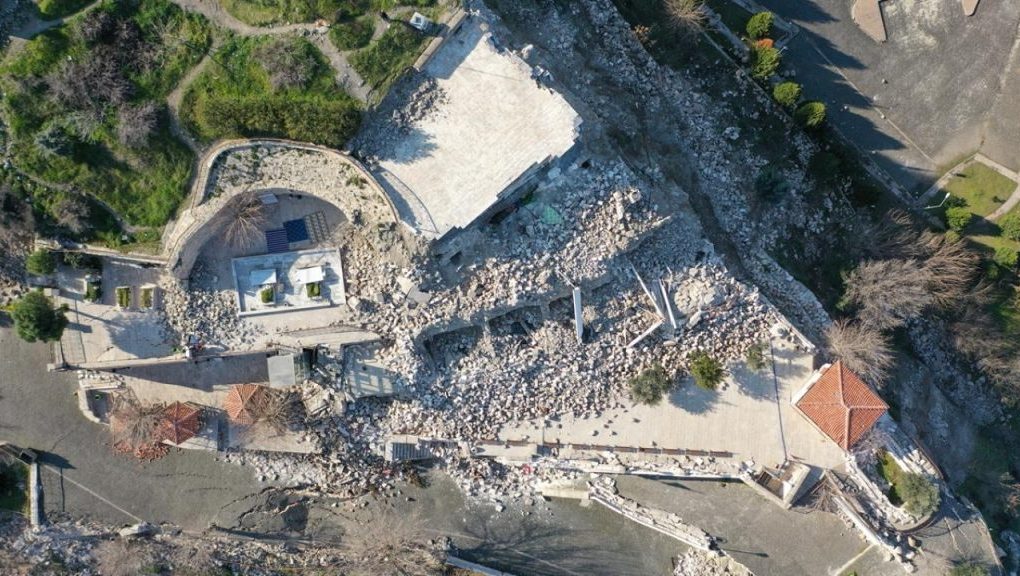
In the earthquakes, which are described as the disaster of the century, the Bayezid-i Bistami Tomb in the Kırıkhan district of Hatay suffered great damage. The tomb is located in Darb-ı Sak Castle, which was one of the important castles of the Crusader Principality of Antakya and was damaged in the earthquake. Tomb; It is located in the area formed by the cutting of the rocks in the west and bordered by the city wall in the north. It consists of four rectangular-planned, barrel-vaulted spaces connected by a door. However, due to the earthquake, the roads, entrance gate and epitaph of the tomb remained under the stones falling from the castle. The çilehane and sarcophagi inside the tomb were not damaged. It was seen that some of the historical arches around Darb-ı Sak Castle were destroyed.

The Life of Bayezid-i Bistami
Bayezid-i Bistami was born in the city of Bistam in Semnan Province of Iran in 804. His ID is Abu Yazid, his name is Tayfur, and his father’s name is Isa. His grave is also in Bistam. There is also a tomb in the Kırıkhan district of Hatay. His grandfather was a Zoroastrian who converted to Islam and he had three sons named Adam, Tayfur and Ali. All of them were known as people who chose to live a life of asceticism.
Bayezid was born as Tayfur’s son and spent most of his childhood alone at home and in the mosque. Although he lived a solitary life, he received frequent visitors to his home to discuss Sufism. Bayezid abandoned all his worldly desires in order to be alone with Allah and was living a life of asceticism in accordance with the tradition of Melamilik-Kalderiyya.

Bayezid-i Bistami is known as a Sufi who lived in the 9th century. He is known for his “Fena Fî’Allah” and “Beka Bi’Allah” levels in Sufism. The level of “Fenâ Fî’Allah” is the state of “perishability in Allah” and is considered as the state of mind in which a person is closest to Allah. “Beka Bi’Allah”, on the other hand, refers to the concepts of “existing with God” or “being one with God” and emerged when Bayezid-i Bistami abandoned all the blessings of the world due to his excessive love for God. Bayezid-i Bistami is considered to be one of the active mystics in history and is known by the nickname “Drunk Sufi” because of the love of God.
In addition to his love for the Twelve Imams, Bayezid’s respect for the Islamic world, as well as his transfer of mystical teachings to his students and his unique style, brought a new breath to Islamic thought. Among his students are well-known Sufis such as Ebû’l Hassan Harakânî, Hace Abdullah el-Ensari, and Ebû’l Kâsım Gurganî. Bayezid’s teachings were especially effective in the Naqshbandi sect and have survived to the present day. In addition, it is known that Celaleddin Rumi, the founder of the Mevlevi sect, was also influenced by Bayezid’s works and fed by his thoughts.

Khorasan Erens who migrated to Anatolia from their generation
His grandchildren, Isa and Moses, migrated to Anatolia from Iran’s Khorasan. They first lived in the Kırıkhan district of Hatay, but later they moved to the inner parts of Anatolia and left Kırıkhan. The people of Kirikhan killed Jesus there because they did not want the brothers to go. Sheikh Isa Tomb is on a hill, four kilometers from the town centre, to the north of the Alabeyli Village of Kirikhan. Sheikh Musa, the other brother, came to the Zile district of Tokat, continued his enlightenment here and lies here. It is thought that his descendants also live in Zile. The tombs of Bayezid-i Bestami and Mustafa Şevki Pasha are located in the Darb-ı Sak Castle, on the northern side of the Alabeyli Village of Hatay’s Kırıkhan-Hassa road.
Popularly known as Beyazıbesten (Sheikh Ethem Çelebi Mosque), the place of visit is located in Ali Kadı District of Zile and is visited for headaches and eye pains and various wishes. In the Şeyh Ethem Çelebi Mosque in Zile, our Prophet (pbuh) was buried. Muhammad has blessed cardigans. These cardigans were passed from Veysel Karani to Bayezid-i Bistami. It was first moved to Tokat, and then to the Ankara Ethnography Museum on September 17, 1944, on the grounds that it could not be preserved in the first years of the Republic and the people of Zile did not take care of it sufficiently.