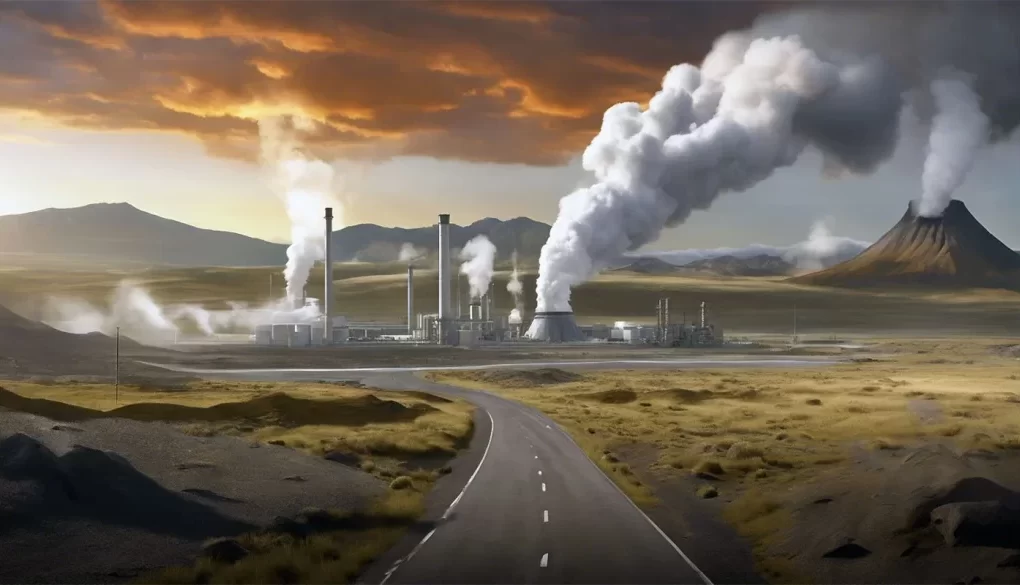
Icelandic scientists are preparing to undertake a remarkable project with the aim of using their country’s natural resources more effectively. In this ambitious project, it is planned that the country will benefit more from super hot geothermal energy by opening tunnels up to the magma chamber of the volcanoes. Scientists aim to obtain large amounts of clean energy with this method.
northeast of Iceland Krafla volcanoIn this project to be carried out in By drilling a hole in the Earth’s crust It is expected to go to depths of up to 2 kilometers. If successful, this project a first in the history of science will be.

Iceland is a Leading Country in Geothermal Energy
IcelandWith more than 200 volcanoes, it is a leading country in geothermal energy. This system, in which heat and hot water vapor are removed and separated into liquid water or steam, enables the steam passed through turbines to be used in various areas. Geothermal energy plays a major role in areas such as electricity and heat production, energy supply in greenhouses, food manufacturing and heating. If this new project is successful, Iceland will further increase its capacity in energy production. an environmentally friendly energy sourceIt will contribute more to.
Iceland, a major leader in green energy resources, focuses on environmentally friendly energy use by heating approximately 90% of its homes with geothermal energy. However, since geothermal energy is generally around 250°C, according to Energy Transition, fossil fuel energy It is lower than the temperature of the steam produced in power plants, which is around 450°C. This means that the use of the magma chamber can increase the country’s overall energy stock by providing a stronger energy supply.

It is of Vital Importance for the Success of the Project
Volcanologist John Eichelberger, working at the University of Alaska – Fairbanks, states the following on this subject: “It remains quite inefficient at these low temperatures. Therefore, there is interest in developing superhot geothermal energy.” This interest is at higher temperatures geothermal energy It reveals the potential to increase efficiency in energy production by using its resources. This development could further strengthen Iceland’s environmentally friendly energy policies and contribute to its national efforts towards sustainable energy production.
Project manager Björn Þór Guðmundsson said in a statement to the Daily Mail newspaper: magma He states that the energy obtained from the super-hot geothermal energy nearby aims to be up to two times more powerful than conventional wells. “With the same energy output, we can drill one well instead of 10,” says Guðmundsson.
The project is led by the Krafla Magma Testbed (KMT), an Icelandic magma research organisation, and is a continuation of a study begun in 2009. In the related study, a research team working at a power plant tried to drill a well near a magma chamber that extracts geothermal energy from the Krafla volcano.

The original goal was to reach the chamber to investigate geothermal energy options; However, since the chamber was not deeper than expected, the magma chamber was reached as a result of the accident. When the probe hit the magma, the steel in the well casings corroded and the high temperature of 450°C destroyed the well. This situation stands out as an example where the project encountered unexpected difficulties.
Scientists at KMT are working on the ability of the materials to be used in the new project to withstand scorching temperatures. This is vital to the success of the project. According to New Scientist magazine, another important development in the project is that it has been confirmed that drilling a hole in the magma chamber will not cause the volcano to erupt.
“One of KMT’s main objectives is to develop the wells with the right materials that can withstand these harsh conditions,” project manager Björn Þór Guðmundsson told the Daily Mail newspaper. This is a critical factor for the project to proceed sustainably and safely.

Krafla, One of the Most Explosive Volcanoes in the Country
Krafla is a volcano that has erupted approximately 29 times in Iceland’s history and is one of the country’s most explosive volcanoes. The last eruption took place in 1984. The volcano that erupted in December was located near the town of Grindavik in southwestern Iceland. In this context, confirming that the project will not cause a volcano to erupt is an important step to address environmental and safety concerns.
Scientists working at KMT stated the following in a 2018 article: “Utilizing superhot or supercritical steam from the adjacent heat source can increase energy transfer to the surface by two times and conversion efficiency to electricity by 3.5 times.”
“When combined with the advantages of continuous operation, no need for fuel or waste transportation, limited carbon emissions, and advances in long-distance HVDC (High Voltage Direct Current) energy transfer, geothermal energy could completely change the electrical energy game.”

The project also aims to obtain pressure measurements with sensors that will help scientists working at KMT to observe the magma chamber. In this way, it is thought that eruption predictions can be improved.
According to the Daily Mail newspaper, other experiments to be carried out before 2030 include changing the pressure and temperature by injecting liquid into the chamber and measuring the results. Scientists working at KMT stated the following in the article they wrote in 2018: “The need for understanding magmatic systems, improving volcano observation strategies, and developing new generation, high heat-retaining geothermal energy directs the project.”
The researchers also continue with the following statements: “Observing the temperature profile at the roof of a magma chamber will reveal the actual heat flow from the magma to the hydrothermal system. With this unprecedented observation, the potential and sustainability of Super Hot Geothermal Systems (SHGS) will be tested. SHGSs are systems above 350°C.”
To join our WhatsApp group CLICK!