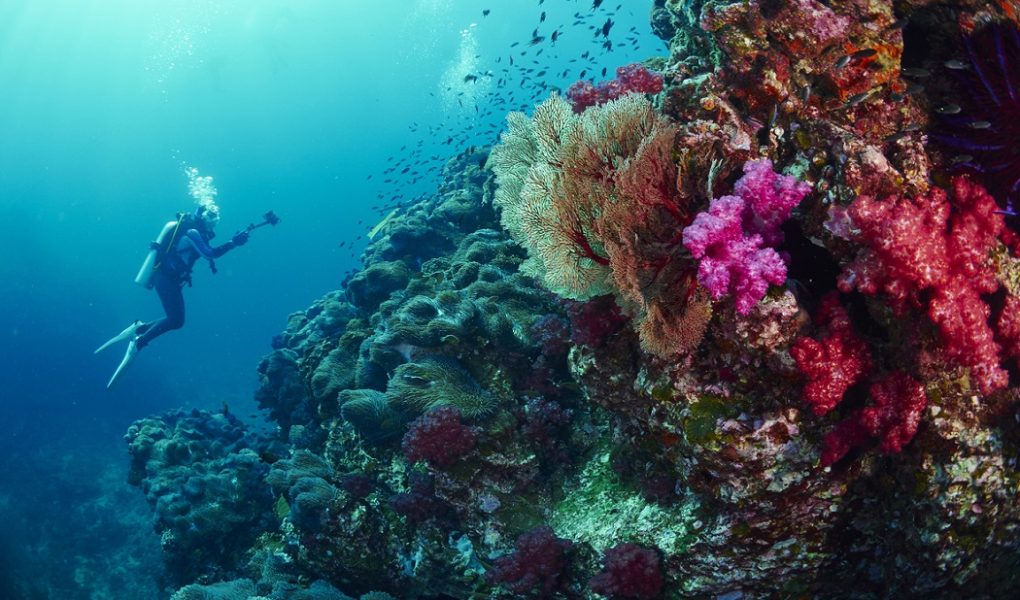
Turkey is known as one of the leading destinations when it comes to sea and sun tourism. However, Turkey’s appeal is not limited to its beautiful beaches and sunshine. It is also home to some of the world’s best diving spots. Every year, both domestic and foreign diving enthusiasts choose Turkey, having the opportunity to explore historical ruins, shipwrecks, and colorful underwater fauna.
In recent years, Turkey has become a favorite destination worldwide, with hundreds of diving centers and experienced instructors. This makes it an excellent option for both beginners and experienced divers. Those wishing to receive diving training can explore this unique underwater world with expert guidance and create unforgettable memories. Türkiye’s diving tourism attracts everyone by offering opportunities suitable for all ages and skill levels.
Great Reef, Bodrum

Located just 20 minutes from Bodrum city center, Büyük Resif (Great Reef) is a spectacular diving spot. Resembling a mountain, Büyük Resif offers a breathtaking view with its 35-meter-deep seabed and 7-meter-high peak. For this reason, it is known as one of the areas with the highest concentration of marine life. Also a stopover point for Red Sea migrants, Büyük Resif is famous for its rich underwater life.
The Great Reef has varying depths, starting at 4 meters at the top and reaching 32 meters in the south and 36 meters in the north. The section facing Gümbet descends in terraces, while the section facing Karaada requires a steep wall dive. This variety makes it a suitable dive site for both beginners and experienced divers.
In the shallow areas of the Great Reef, you can observe marine life such as black sea bream, octopus, and scorpionfish. Beyond 20 meters, you’ll encounter fish like moray eels, snappers, groupers, and sea bass. You can also explore the sponge formations that have formed along the walls of the Great Reef during your dive. Don’t forget to look at the surface occasionally during your dive, as schools of barracuda can offer pleasant surprises. You can enjoy diving in Bodrum, including at the Great Reef, year-round. However, it’s important to note that the water temperature drops to 14-15 degrees Celsius during the winter months.
Crazy Mehmet, Ayvalık

Ayvalık is a beloved resort town in the Northern Aegean, attracting divers with its diving spots and islands. One of the best diving spots in this region is Deli Mehmet. Deli Mehmet consists of two islands. The first is called Deli Mehmet 1 and has a depth of 18-70 meters. Intermediate divers generally prefer to dive in this area.
The second island is known as Deli Mehmet 2 and reaches depths of 27-70 meters. This area is suitable for professional divers. Deli Mehmet 2 offers a visual feast, adorned with coral reefs and gorgonians, extending from 27 meters to 50 meters. On both islands, you can observe various creatures such as red corals, yellow gorgonian trees, moray eels, insects, and colorful fish, as well as other species like sea bugs, antia fish, grouper, octopus, moray eel, wrasse, and black sea bream.
Ilyosta, Ayvalık

Although Ayvalık has many diving spots, Deli Mehmet and İlyosta Islands are among the most frequently chosen by divers. İlyosta Island, located west of Ayvalık, is home to colorful and diverse marine life, inspiring both divers and photographers.
Gavur Limanı, located on İlyosta Island, is one of the island’s popular diving spots. Gavur Limanı has depths ranging from 3 to 35 meters. You can easily dive in Gavur Limanı regardless of your skill level. During your dives in this area, you might encounter moray eels, beetles, and even sea hares. Whether you go to İlyosta Island or Deli Mehmet, you should definitely get a lighthouse, especially to enjoy observing the red corals.
Saros, Çanakkale

There are many diving spots in the Saros Bay, including İbrice Limanı, Cennet, Cehennem, Toplar Burnu, Asker Taşı, Üç Adalar, Kömür Limanı, Bebek, and Minnoş Kayalıkları. One of the most well-known spots is Minnoş Kayalıkları. Located approximately 15 meters above sea level, Minnoş Kayalıkları has a colorful seabed. Orange corals accompany you during your dive, and you may have the chance to observe dolphins and turtles. At the end of the rocks, you may encounter anglerfish and large stingrays.
The Gulf of Saros is also home to shipwrecks. The Lundy Wreck, built in 1908 and weighing 188 tons, is one of them. This wreck is located in Suvla Bay, in the south of the Gulf of Saros. The silhouette of the ship becomes clearer after 13 meters, and you can walk around the captain’s cabin after 18 meters. At the same depth, black sea bream await you on the deck. Where the ship meets the sand, lobsters and amberjack greet you.
The newest addition to Saros Bay is an Airbus A330 aircraft. This plane was sunk in Saros Bay to revitalize diving tourism and to be used as an artificial reef. Now, there is a brand new shipwreck waiting to be discovered in Saros Bay. Saros Bay, with its shipwrecks and colorful fauna, is one of the most enjoyable places for diving. You can have an unforgettable diving experience here.
Samandağ, Hatay

Samandağ district in Hatay, though not widely known, is considered the Red Sea of Türkiye and even the Eastern Mediterranean. Kel Dağı, an inactive volcanic mountain, reaches a height of 1736 meters and has a landscape resembling fairy chimneys. The cave, accessible by diving 20 meters below sea level, is a suitable area for divers with at least a 3-star rating and instructors, and is suitable for diving in both summer and winter. While swimming amidst the fascinating scenery of stalactites, stalagmites, and columns, you can have the chance to observe various underwater creatures such as stingrays, cave shrimp, moray eels, cardinalfish, and shadow fish.
Samandağ is one of the most important places in Türkiye in terms of underwater richness, making it a must-visit location for professional divers. Diving here allows you to explore the fascinating world of the underwater realm.
Delikli Cave, Bodrum

Located on the Kos side and in the center of Karaada Island, Delikli Mağara (Holey Cave) is situated 40 minutes from Bodrum harbor. This area contains two different underwater caves, offering a moderate level of challenge for divers. Divers enter the caves at a depth of 12 meters and exit at a depth of 4 meters. The depth in one part of the caves decreases to 20-25 meters, while in the other part it reaches 40-45 meters. The entrance to the first cave is narrow and 15 meters deep. The second cave is located 20-30 meters away from the first and has a more accessible entrance. The second cave has a considerably larger interior. You have the chance to ascend up to 6 meters through a 1-meter diameter hole at the top of Delikli Mağara. Even just watching the air bubbles from the regulator trying to escape through the cave cracks will make you want to dive here.
The purple and yellow formations inside the Hole Cave will fascinate you. You can also enjoy swimming with marine life such as scorpionfish, shrimp, and lobster in the cave’s crevices. There’s also a chance you might encounter a large grouper in the cliffs at the front of the cave, which are nearly 25 meters deep. The Hole Cave is an ideal option for both experienced divers and beginners.
Orak Island, Bodrum

Orak Island gets its name from the sickle shape of one end of the island and is located 1.5 hours from Bodrum center. Situated at the entrance to the Gulf of Gökova, Orak Island is one of the largest islands, and the diving area is the narrow headland on the south side of the island. Although it is possible to dive in two directions from the headland, dives towards Gökova are particularly exciting. In the cave in this direction, it is possible to observe purple sponges at depths of 32-34 meters. In addition, the presence of an underwater wall that descends first to 25 meters and then to 190 meters in the same area makes this spot a frequent choice for wall diving enthusiasts.
Orak Island has a very sparse marine life. While you can see schools of fish of various sizes in the shallow areas, schools of amberjack can be found on the open side of the wall. As you move along the wall, you may also encounter marine life such as groupers, stingrays, moray eels, and sea bass. Orak Island, with its depths, creates a feeling of being on the edge of a cliff and offers an unforgettable diving experience.
Canyon, Kas

Kaş, with its tranquil bays and turquoise sea, is one of the world’s leading diving destinations. Among the dozens of diving spots in Kaş, Kanyon stands out. Located between two islands, Kanyon consists of a narrow gorge. This area features steep walls starting at 20 meters and extending up to 30 meters, as well as a tunnel-like cave. In this cave, you can observe crustaceans such as sponges, lobsters, anemones, and crabs.
The canyon is also a hunting ground for Mediterranean seals, so caution is advised when diving both inside and outside the cave. The canyon boasts a rich diving environment and diverse marine life, but its most notable feature is the Dimitri Wreck, which you can encounter in the depths. Sinking in 1968 after hitting a mine, the Dimitri Wreck descends to a depth of 42 meters. Due to wind and waves, the best time to dive in the canyon is in the morning. The canyon is generally a preferred diving spot for experienced divers. Here, you can have an unforgettable diving experience where you can discover not only marine life but also history .
Flying Fish, Kas

When it comes to diving in Kaş, two areas come to mind: Kanyon and Uçan Balık (Flying Fish). Uçan Balık gets its name from an Italian warplane that was shot down by anti-aircraft fire during the bombardment of Meis Island in World War II. In this area, the remains of an Italian Savoia-Marchetti SM79 model, a three-propeller aircraft nicknamed Sparviero (Hawk), are hidden at depths of 55 to 70 meters. The upper part of Uçan Balık is 6-7 meters high, and its length is 75 meters. Underwater visibility is generally over 30 meters. The water temperature is around 17-18 degrees Celsius in winter and 25 degrees Celsius in summer.
Flying Fish has a strong current and is generally suitable for professional divers. If you are an amateur, it is recommended to seek assistance from an experienced diver for your diving experience in Flying Fish. Due to the currents in the area, you may have the opportunity to observe different marine life. You can swim with endangered species such as large groupers, black sea bream, and schools of amberjack. In Flying Fish, there is also always a chance of encountering stingrays or loggerhead turtles.
Aquarium Bay, Fethiye

Aquarium Bay is a unique area catering to all types of divers. Whether you’re into wall diving, scuba diving, or are a professional or amateur, Aquarium Bay offers a suitable experience for everyone. Here you can take various courses, from beginner dives to advanced diving training. If you’re an amateur diver, you can dive to depths of 18-20 meters. If you’re a professional, you can enjoy long dives of up to 60 minutes in Aquarium Bay.
Diving in Aquarium Bay usually starts from the left side, about 150 meters outside the bay. The rocky areas in the bay and the wall area called “Aquarium Reef” are the most productive diving spots. Here you can hold onto the rocks and observe many creatures. In Aquarium Bay, you can see seahorses, octopuses, orange sponges, sand carp, groupers, and even, if you’re lucky, sea slugs. Rarely, you might even encounter sea hares in this bay.
Especially professional divers seeking a different experience often prefer night diving. Aquarium Bay is one of the most suitable night diving spots in Türkiye. During your night dives here, you will greatly enjoy watching the dance of tiger moray eels. No matter your skill level or preferred diving style, you can be sure you’ll have an enjoyable diving experience at Aquarium Bay.
Afkule, Fethiye

When it comes to diving in Fethiye, Afkule is one of the first places that comes to mind after Aquarium Bay. Afkule is one of the best spots in Türkiye where you can dive safely. It is suitable for advanced divers and offers the opportunity to observe many different species of marine life.
Afkule, nestled on steep mountain slopes, boasts two caves in its crystal-clear blue waters. Dives usually begin in the cave with the deeper entrance, which rises up to 7 meters, allowing you to observe marine life such as groupers and schools of sea bass in its crevices. By swimming into the bay and passing through a large opening, you can reach the second cave, known as the Turkish Bath, whose interior is surrounded by red sea roses. It is 6 meters deep, and watching the light filtering in from the top is quite enjoyable. We recommend visiting Afkule, especially on windless days.
Fener Island, Çeşme

Fener Island, located off the coast of Ildır Village in İzmir, a popular holiday resort in Çeşme, is a suitable area for divers of all levels. With an average depth of 18 meters, Fener Island is a great option for those who want to explore the underwater world. You can swim with schools of fish such as sea bream and striped mullet, and enjoy a pleasant diving experience accompanied by yellow tube sponges and flower corals. Fener Island also has several old seal caves, and seals can sometimes be spotted there.
Fener Island is generally windy, so we recommend choosing calm weather conditions for an enjoyable and healthy dive. A delightful diving experience awaits you, where you can fully enjoy the deep blue and crystal clear waters and discover many species of marine life.