
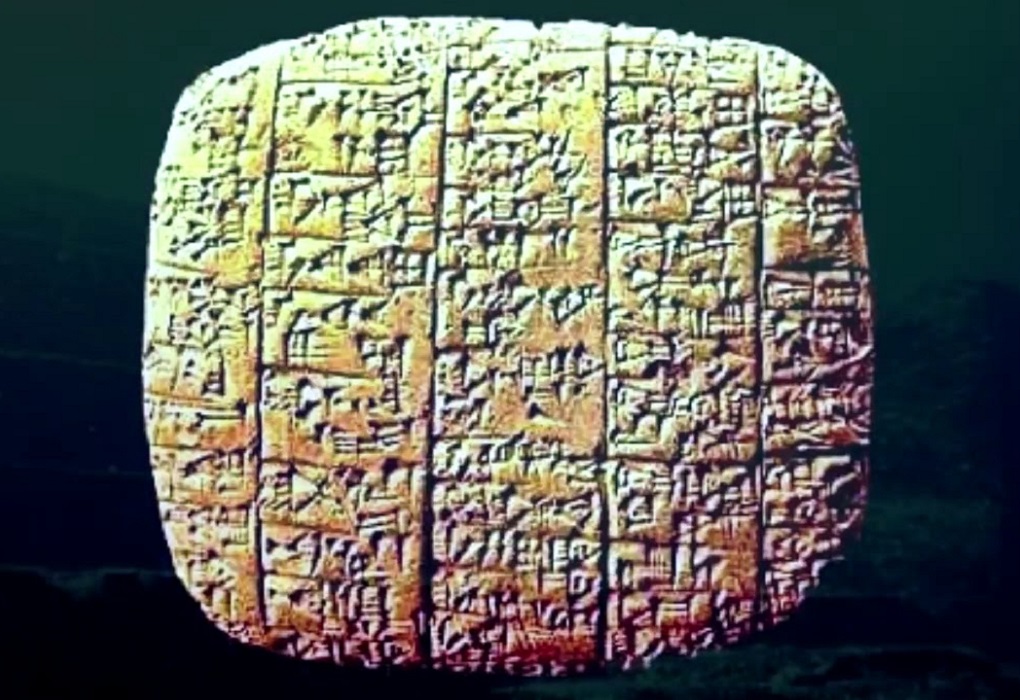
The continent of Mu, thought to be twice the size of Antarctica, is considered the first place where humanity existed. It is also seen as the source of all religions, symbols, and legends. All symbols, tablets, mythological beliefs, and records in the world are attributed to Mu. Among these are Sumerian tablets. Colonel James Churchward put forward the idea of Mu based on his translation of hundreds of tablets he found in the Hindu Kush and Tibetan mountains.
In his book, “The Sacred Symbols of the Lost Continent of Mu,” James Churchward presents a study exploring the origins and meanings of sacred symbols used in world religions. The book emphasizes that the symbols of different religions share a common origin and that the religious symbols of the Mu Civilization are used worldwide. During his 50 years of research, Churchward traveled almost the entire world, conducting investigations to gather more information and identify similarities in this area.
Furthermore, examinations of over 2,600 tablets found in Mexico were conducted by neurologist and archaeologist Dr. William Niven. These examinations support Churchward’s theory. Moreover, these tablets are not the only documents Churchward used as sources in his books. The Troano Manuscript, the Easter Island Tablets, Indian and Mayan records, Egyptian records, the Lhasa document, and the Codex Cortesianus are among the documents he used as sources on this subject.

The Continent of Mu According to the Tablets
According to the tablets , the continent of Mu covered an area of 5000 kilometers from north to south and 3000 kilometers from east to west, consisting of three separate landmasses. It is also stated that it was surrounded by islands such as Indonesia, Polynesia, Quan Fernandez, and Easter Island. Remains belonging to Mu have been found on these islands, and these findings are thought to include tunnels, temples, statues, and symbols. It is suggested that empires associated with Mu, such as Egypt, India, and the Mayan-Aztec empires, were extensions or colonies of Mu.
The religion of Mu was based on the belief that God is “One,” that the soul is immortal, and that continuous rebirth is necessary for spiritual development. Therefore, it is considered the ancestor of modern beliefs such as karma and reincarnation. Because Mu is the oldest known religion, it is thought that other religions have been influenced by it. Furthermore, it is said that the flood caused by the sinking of the continent of Mu led to the Flood of Noah.
The Mu religion has four fundamental concepts:
1- God is one. Everything originated from Him and will return to Him.
2- The soul and the body are separate. The body dies and decomposes, but the soul does not die.
3- The soul is reborn in different bodies to attain perfection.
4- The soul that reaches perfection returns to God and unites with Him.
Sun Symbol
In the religion of Mu, God was represented by the Sun, the symbol of life. The Sun was chosen because it was easily memorable and considered the most suitable symbol for God. Therefore, Mu was called the “Sun Empire,” and the name “Ra” was used for the Sun. The name Ra was later used with the same meaning in Egyptian and Mayan religions. The Egyptian Sun God is known as Ra.
The sun symbol has been used in many cultures as both a divine symbol and a symbol of eternity. The sun is seen as a life-giving and energy-providing force. Its rising and setting, its cyclical movement, and its daily rebirth are also interpreted as a symbol of infinity. The sun symbol is often depicted as a circle. Because a circle has no beginning or end, it represents a continuously ongoing cycle.

The Meaning of Pyramid Structures
The Mu culture, in all its colonies, depicted the immortality of the soul and its continuous ascent, ultimately culminating in union with God and reaching the highest level (Eternal Life, Nirvana). To represent this spiritual progression, they symbolically constructed pyramid structures. Each layer represents a different stage, eventually reaching completion and perfection.
How people built such pyramid structures in a primitive era, and where they obtained the knowledge without a more advanced civilization or teachings, has always been a subject of research. Several documentaries and accounts have been written about the Egyptian pyramids, and the engineering aspects of these structures are truly remarkable. Building pyramids was possible in ancient times when labor and time were abundant.
However, these structures are not limited to the Egyptian pyramids . Pyramids can also be found in Mexico, China, and many other countries. It seems that pyramids, not only in Egyptian belief but in every region of the world, are built with the same idea as a general global belief. They are a symbol of spiritual development, tapering from the bottom to the top and finally reaching completion. They represent a temple that symbolizes reaching Nirvana in a pure state by paying back a few more karmas in each incarnation.

Son of the Sun Symbol
The Mu colonies, once they reached a level where they could govern themselves, organized themselves as empires or kingdoms while remaining loyal to the motherland. In this way, the world transformed into a large family governed from a single center. This is consistent with Freemasonry ‘s “One World Order” philosophy and the mission of New Age Spiritualism, which aims for a society without nations, states, or races.
While Mu was the ruling power of the world, the Sun became the symbol of the kingdoms formed by Mu’s small colonies. However, Mu was represented as a fully radiant Sun, while the colony empires carried dim or partially visible sun symbols on their flags, thus symbolizing their allegiance to Mu. At the same time, the kings of the colonies also adopted the title “Son of the Sun.”
When the Mayan colony in India grew into a kingdom, the first king was named Ra Ma. Their coat of arms featured a partially visible sun symbol. Even today, they still bear the sun symbol. However, since the Mu empire no longer existed, or for other reasons, the sun symbol is no longer used in its partial form. Nevertheless, the kings still bear the title “Son of the Sun.” The rising sun symbol is still seen on the flags of various countries today, including Japan, Persia (ancient Iran), and some Central American republics.

Square Symbol
The square symbol is known for representing the four elements (fire, water, earth, air) because it has four sides. Similarly, the square represents the four directions (east, west, north, south), with a guardian assigned to each direction. This is why the expression “the four corners of the world” is sometimes used. The square symbol also represents the four fundamental laws of the universe. These laws have been associated with sacred qualities over time. The cross has also come to be used to symbolize the sacred quartet. The cross symbol, like the swastika, can have varying meanings.
The symbols and names used may change over time, but the four symbols always carry the same meaning. Expressions like the Four Horsemen of the Apocalypse or the Four Angels are often used to show that the four symbols express the same meaning. The Holy Four are considered the building blocks of the Seven Commandments. God gave the seven commandments and fulfilled them through the Holy Four. The Great Four were known by different names in different cultures over time. They were known as Amshaspand by Zoroastrians, Elohim and Seraph by the Hebrews, and Rabiri and Titonads in Hesiod’s Theogonia. Today, the term Four Great Angels is generally used.
Winged Circle
These four powers, often depicted with a circle in the center or within a circle, signify that God governs the four fundamental powers, or that the four fundamental powers are one with God and originate from Him. In this context, a commonly used symbol to represent the four fundamental powers is the winged circle.
The feather-winged circle symbol is used in the Naacal culture, with one of the oldest known examples.
Over 2,600 tablets discovered by Niven in Guatemala feature the symbol of a winged circle. The Assyrian, Babylonian, and Egyptian periods appear to be the era in which the winged circle symbol was most prominently used. In Egypt, the winged circle symbol was used in various forms. Its most well-known form is depicted in the tomb of Queen Hatshepsut, on the wall opposite the entrance. The curved wings are thought to represent special patronage and protection. The winged circle symbol is also found in the tomb of Thutmose I. Furthermore, the winged circle symbol was also used in Greek culture.

Triangle Symbol
The triangle symbol is a fundamental symbol in the belief in the Trinity. Each side of the triangle represents the earth, heaven, and humanity/God. In Christianity, this triangle is interpreted as the Father, the Son, and the Holy Spirit. The Eye symbol placed inside the triangle represents Ra’s all-seeing eye. This symbol conveys the understanding that God exists between the spiritual universe, the material universe, and the human mind.
The ornate carvings made of crystals and precious metals on top of the pyramids are known to have been used for magical purposes, such as reflecting sunlight. This symbol has been used throughout history, from Mu to Osiris, from Osiris to Hermes, and from Hermes to Freemasonry. Even today, this symbol is openly used by groups such as Zionism and the Illuminati.
The letter Y was also used to represent the Trinity. The letter Y represents three corners together and can be seen in Uyghur and Chinese cultures. The original design of the cross and the appearance of the person hanging on it already resembles the shape of a Y. This conveys the message, “This person was sacrificed—killed—punished in the presence of God or by God.” Another source of the three symbolism is the fact that Mu consisted of three landmasses: Mu, Atlantis , and Lemuria.
The Star of David, also known as the Star of David, is a six-pointed star formed by the joining of two triangles. The upward-pointing triangle symbolizes goodness and the path to God, while the downward-pointing triangle represents evil and recurrence, in accordance with the law of rebirth. This symbol represents justice and also signifies the coexistence of good and evil.
These symbols can be found not only in Mu but in all the religions mentioned. Over time, an eye was placed inside the triangle, transforming it into a square swastika, then a cross or a winged circle. These symbols are both secondary symbols in the Mu records and coded symbols whose meanings have been altered over time.

Mu Royal Coat of Arms
The Royal Coat of Arms of Mu is composed of symbols used in various cultures. These symbols have also been adopted by communities such as Native Americans, Maori, Nevadans, Mexicans, and Guatemalans. The shapes within the coat of arms are thought to represent the letter “M” from the Mu alphabet, which is the symbolic letter of the continent.
The outer section of the coat of arms represents the number four and the four powers. The circle surrounding the coat of arms represents the Sun, an important symbol. The combination of these three symbols creates the meaning “Mu, the Sun Empire.”
The eight-pointed star within the coat of arms is significant because this symbol is still used with the same meaning in many cultures. In particular, the sun shape on Japan’s flag and their designation as the “Sun Empire” are rooted in the origins of this symbol. The eight-pointed star also symbolizes the sun’s rays and the eight cardinal points. This symbol also reflects the belief that Mu once ruled over the entire world.

Mu Cosmic Diagram
The symbol features eight downward-sloping stripes. This shape symbolizes return and rebirth. It also represents the eight stages the soul must pass through during reincarnation. The soul must traverse these eight paths to ascend from the level of an inanimate being to the level of a superior human being.
Some books on the religion of Spiritualism also mention eight Dimensions of Existence. Humans on Earth are currently at the fourth Dimension of Existence. The levels of existence extend from atoms to plants, animals, humans, and even other extraterrestrial life forms and angels. The eighth level is considered the Divine Realm.
The circle surrounding the six-pointed star in the symbol signifies the existence of realms beyond Earth. Furthermore, the 12 outer tassels represent the 12 evils that humanity must avoid. Before the human soul can pass into other realms, it must rid itself of these 12 earthly inclinations. These 12 evil tendencies are a symbolic representation of temptation.
The six-pointed star in the symbol represents justice and balance, symbolizing the coexistence of good and evil. The circle outside the star shows God’s all-encompassing presence, while the central circle represents the Sun Ra, God, and his all-seeing eye. This symbol was also used in Egypt and is still used in some organizations, such as Freemasonry.

Column Symbol
Two pillars are erected at the entrance of temples, and the destruction of these pillars signifies the destruction of the temple as well. Among African natives and Pacific islanders, two tall totem poles (pillars) are erected, much like idols, and used as objects of worship. This practice is also seen in New Zealand and Northwest America. It has played an important role since the earliest times of humanity. The Egyptians, in their mythology, placed two pillars at the entrance of Amenti. In the Egyptian Book of the Dead, one is called Tat, meaning “power,” and the other Tattu, meaning “to be established.” When these two are combined, the meaning becomes “Established by Power.”
In Hebrew, the word “Yakin” means “to establish,” while “Boaz” means “by power.” Two columns, each a pair, were erected at the entrances to King Solomon’s Temple and Osiris’s Hall of Judgment. These columns carry the same meaning.


