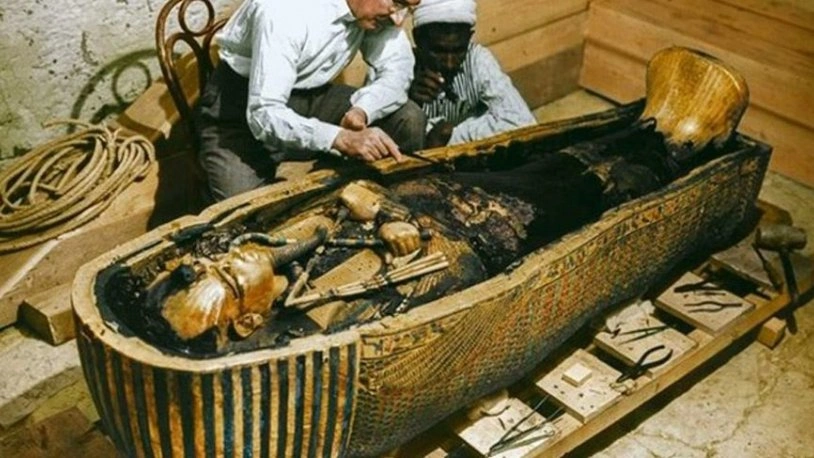
Tutankhamun; Egyptian pharaoh who reigned from 1332 to 1323 BC, and the last leader of the 18th dynasty during the New Kingdom of Egypt. His father is the pharaoh Akhenaten, who was found mummified in the tomb of KV55. Tutankhamun’s tomb was discovered by archaeologist Howard Carter and is considered one of the world’s greatest archaeological discoveries. Treasures in the tomb On the other hand, it had a great impact in the world and the artifacts found became the symbol of Ancient Egypt.
Tutankhamen ascended the throne by marrying his half-sister Ankhesenamen, who was from another mother after his father died. In the early years of his reign, there was a return to the ancient polytheistic religion of Egypt. The child king Tutankhamun ascended the throne at the age of 9 and died at the age of 18. It is estimated that the famous pharaoh struggled with many diseases due to his consanguineous marriage and this shortened his life. However, some legends suggest that the pharaoh was assassinated or had an accident.

Archaeologists Tutankhamun’s 1920s Valley of the Kings’When he entered his tomb, he found a one meter long dagger. When this dagger, found in Tutankhamun’s tomb, was scanned with X-rays, it was revealed that the metal alloy was taken from a meteorite. Suspecting that the dagger was forged at a low temperature, the research team also thinks that the dagger was produced in Anatolia, not Egypt.
Interesting Features of Tutankhamun’s Dagger
The blade of the dagger found in Tutankhamun’s tomb in the Valley of the Kings is made of iron. But since the Iron Age took place nearly a century after the death of the pharaoh, this was considered a surprising discovery. Researchers from the Chiba Institute of Technology in 2016; carried out a new study after a study suggesting that the dagger found may be of meteorite origin. In the research, two-dimensional chemical analysis was performed to non-destructively examine the structure of the dagger. This analysis allowed the density of iron, nickel, manganese and cobalt to be examined and the basic structure of the blade to be mapped. Sulfur, chlorine, calcium and zinc were detected in the blackened spots on the dagger. Their distribution was the most interesting part.
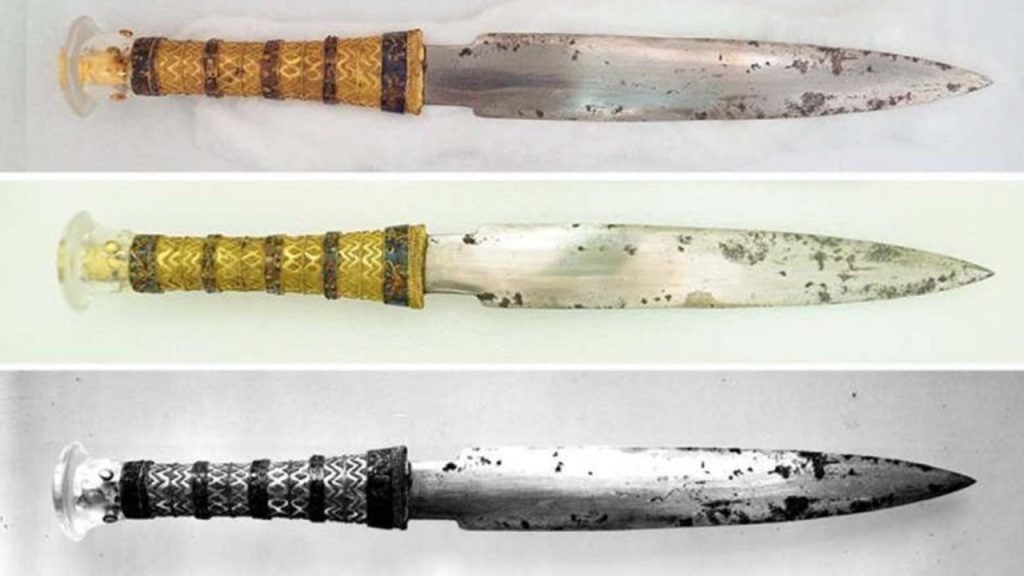
Researcher Arai said, “We noticed a criss-cross texture on both sides of the dagger. This brings to mind the Widmanstätten pattern unique to octahedrites, which are iron meteorites. It was a very surprising moment for us.” said. The Widmanstätten pattern is a noticeable effect caused by nickel in some metallic meteorites. Detection of this pattern on Tutankhamen’s dagger indicates that the dagger was made of an octahedrite type meteorite. Octahedrites are known as the largest group of iron meteorites.
Arai continued: “We also saw small black spots on the surface. At first we thought it was rust, but later it turned out to be iron sulfide, which is often observed in octahedrite iron meteorites.” The researchers note that the Widmanstätten pattern, as well as the presence of iron sulfide, indicate that the dagger was forged at a relatively low (less than 950 degrees Celsius) heat.
The Place Where The Dagger Was Forged Could Be Anatolia
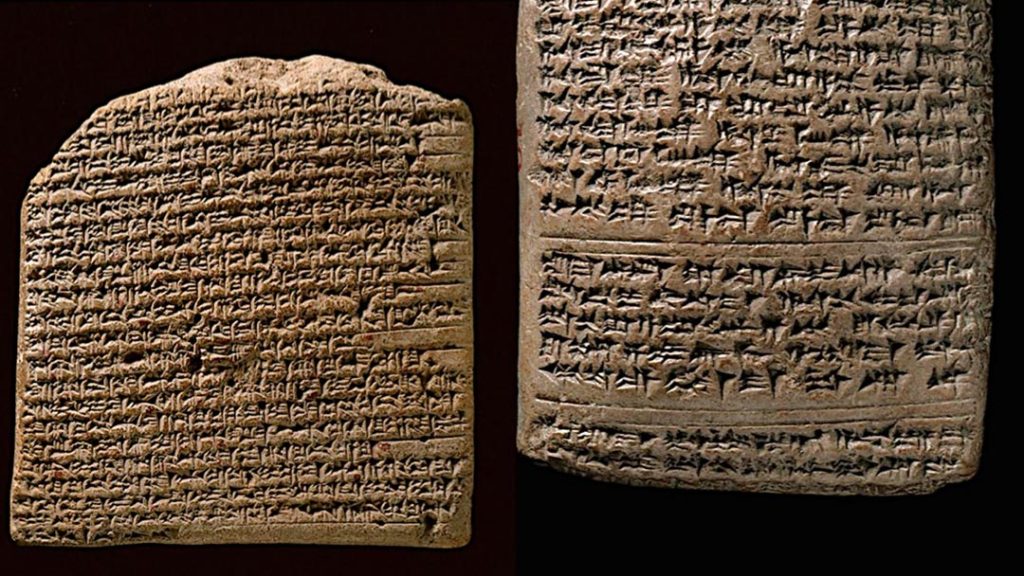
Since it did not provide precise information on where the dagger was forged, the research team turned to a series of 3,400-year-old tablets called the “Amarna Letters,” which document diplomatic activities in Ancient Egypt. In these letters, Tutankhamun’s grandfather III. It was said that Amenhotep married the daughter of the Mitanni king in Anatolia, and therefore an iron dagger with a gold sheath was presented to the pharaoh. This indicates that Tutankhamun’s alien dagger may be a family heirloom from “abroad”.
Elemental analysis also revealed that the precious stones on the hilt of the dagger were bonded with a lime plaster common at Mitanni but not seen in Egypt. Arai stated that future research could more definitively confirm the origin of the knife.