Scientists; He suggested that the Earth’s inner core did not spin in the same direction as the Earth’s, but stopped, and may even have begun to spin in the opposite direction. Earth is made up of three main parts: crust, mantle and core. Earth’s core is equal to the temperature of the sun’s surface, and iron is a metal ball made of nickel. Research at a university in China has shown that the rotation of the earth’s core has stalled and changed direction over the years. These changes can affect navigation and the length of the day because the magnetic field is dependent on these movements.
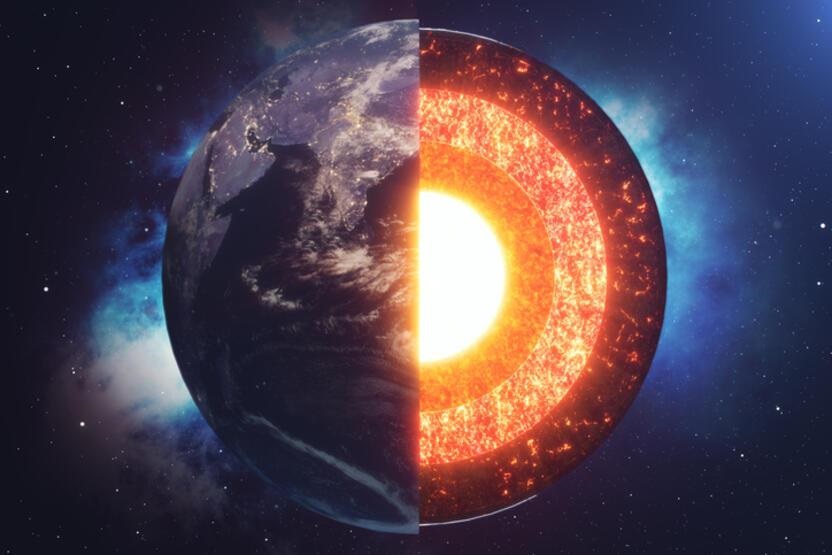
Three different parts of the Earth can be thought of as eggs; the earth’s crust is the shell of the egg, the mantle is the white of the egg, and the core is the yolk of the egg. The inner core is as hot as the surface of the Sun and has a metallic structure. It is a metallic ball because of the warmth depth and pressure. Scientific studies have shown that the inner core has a liquid metallic structure separated from the outer core and need not be in sync with the rest of the planet.
It Changes Direction Every 35 Years
According to the research published in the journal Nature Geoscience; Earth’s inner core, which appears to be a ball of hot iron the size of Pluto, may no longer be spinning in the same direction as the planet, but may even be spinning in the opposite direction. The inner core, called a “planet within a planet” within Earth, can rotate independently as the liquid metal floats inside the outer core. The way the inner core spins is a matter of debate among scientists. The latest research has also led to debates in the scientific world.
Beijing University scientists Xiaodong Song and Yi Yang study the Earth’s deep mobility by investigating seismic waves caused by earthquakes. Large earthquakes occur on the Earth’s surface, and the resulting energy goes deep into the ground. As a result of monitoring seismic waves, it has been discovered that little has changed in the last ten years. The findings show that the rotational function of the Earth’s inner core has stalled, and over the years the cycle has evolved from one direction to the other.
Analysis of seismic waves created by earthquakes and nuclear explosions shows that the Earth’s inner core has stopped spinning in the same direction as the Earth’s, or even rotates in the opposite direction. The researchers studied seismic waves from earthquakes to determine the way the inner core spins, and found that the inner core “nearly stopped in 2009, then turned in the opposite direction.” Researchers believe that the inner core swings back and forth like a swing, and they think that one cycle takes about 70 years, changing direction on average every 35 years.
Chinese researchers predict that in the early 1970s the inner core changed direction and the next change would be in the mid-2040s. This change is similar to the changes in the so-called “day length” in the time it takes for the Earth to rotate on its axis.

Effect on People
Changes in the Earth’s core will also affect the magnetic field, which could change people’s navigation, the length of the day, and even people’s lives. The magnetic field is created by the magnetic force generated by the rotational motion of the Earth’s metal core. The rapid movement of the north magnetic pole in the past years has caused changes in navigation devices. The magnetic field is created by the rotational motion of the Earth’s metal core. It is not in the same place as the geographical north and south poles. They are in motion, and the north magnetic pole has shifted 1,400 miles from Canada towards Siberia since 1832.
The earth’s magnetic field is responsible for controlling the rate of rotation of the earth around its axis and the length of that spin. A very small slowdown in this rotation has required the addition of 27 leap seconds since the 1970s to keep the time accurate. The Earth’s axial rotation speed is thought to change due to the rotation of the inner core, which changes over time. But not all scientists agree on these results. American geophysicist Dr John Vidale is skeptical of the results announced by Chinese scientists and says our view of the Earth’s interior is still blurred. “Something is going on and I think we’ll be able to figure it out, but it may take ten years,” Vidale says. The effect of the inner core on the surface inhabitants has not yet been proven.