NASA’s “Parker Solar Probe”, also known as the “Parker Solar Probe”, will achieve its goal of “touching the Sun” by reaching its closest distance to the Sun in December 2024. This means that the vehicle will break the record for the fastest moving vehicle again. The spacecraft was launched from the USA on August 12, 2018 and headed towards the Sun.
Parker Probe, Can withstand temperatures of 1371 degrees It is equipped with special materials and is protected against the effects of supersonic particles and intense radiation. determined 6 years and 321 days tenure During the course of time, it will examine the corona, known as the Sun’s atmosphere, in detail and collect important data on how this region is heated.
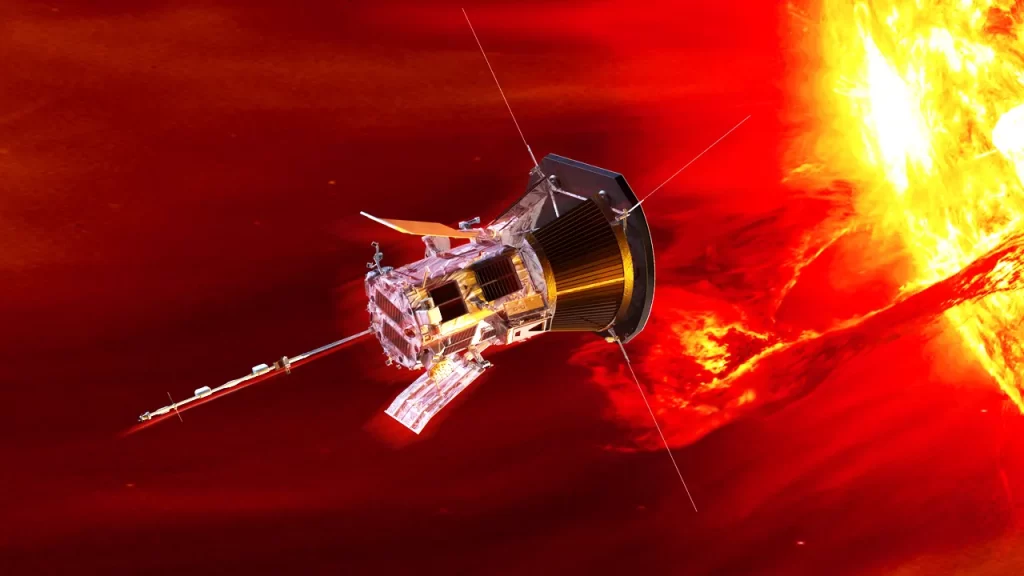
The Fastest Man-Made Object
NASA’s Parker Solar Probereaching 635 thousand kilometers per hour fastest man-made object obtained the title. This speed is twice the speed of lightning or 200 times the speed of a rifle bullet. Parker Solar Probe, designed to “touch the Sun”, will once again break the record for the fastest moving vehicle and reach the closest position to the Sun in December 2024.
The Parker rover will cruise at a speed of approximately 700 kilometers per hour at a distance of 6.16 million kilometers from the Sun’s photosphere. Parker’s expected speed would allow him to cover the distance between New York and London as the crow flies in about 7 seconds. This will make Parker the fastest man-made vehicle and closest to the Sun.
At the point when the rover is closest to the Sun, the temperature of the protective shields on Parker’s outer surface is expected to rise to 1400 degrees.

What is the Parker Solar Probe?
Parker Solar Probe (PSP), formerly called Solar Probe, Solar Probe Plus or Solar Probe+ NASA Space ProbeIt was launched in 2018 with the mission of studying the Sun’s outer corona. The PSP will approach up to 9.86 solar radii (6.9 million km or 4.3 million miles) from the center of the Sun and travel at 430,000 miles per hour (690,000 km/h) at its closest point, or 0.064% of the speed of light.
The project was first announced in 2009 and costs US$1.5 billion. The spacecraft was designed by the Johns Hopkins University Applied Physics Laboratory and launched on August 12, 2018. This project was carried out by Professor Emeritus at the University of Chicago. physicist Eugene Newman ParkerIt is the first NASA spacecraft to bear his name.
A memory card containing the names of more than 1.1 million people was placed on a plate mounted under the PSP’s antenna on May 18, 2018. This card also contains photographs of Parker and a copy of a 1958 scientific paper predicting important aspects of solar physics.