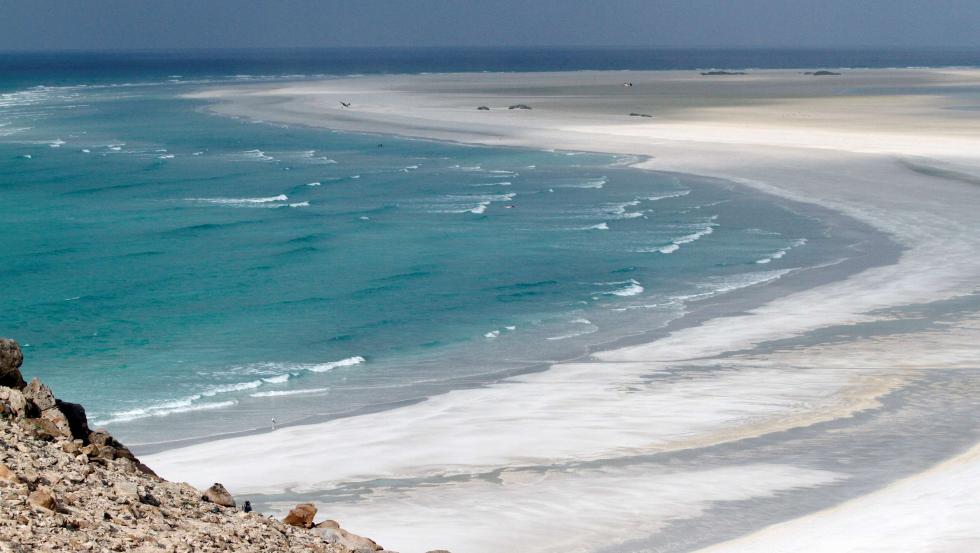
Socotra Island consists of four islands, an archipelago of Yemen, and is located in the Indian Ocean about 350 km south of the Arabian Peninsula. The island, which was a part of the province of Aden for a long time, became a part of the province of Hadramut in 2004 and was transformed into the independent province of Socotra with the arrangement made in 2013. The island’s distinctive warm, harsh and windy world is home to strange plant and animal species. With these interesting features, those who visit the island can feel themselves on a different planet or in a different era in the history of the world. Socotra Island is included in the UNESCO World Heritage List due to its unique vegetation.
Separated from the African mainland for the last 6 or 7 million years, Socotra Island is filled with as many as 700 rare animal and plant species. One third of these are endemic species living only on this island. Although the climate on the island is harsh, hot and dry, there is a wide variety of vegetation. The island’s distance from Somalia and Yemen has helped preserve trees and plants due to a long period of geological isolation. Some plant species date back 20 million years. The different geography and unique structure of the island caused it to be called “Alien Island” among people.
Interesting Flora and Fauna of the Island
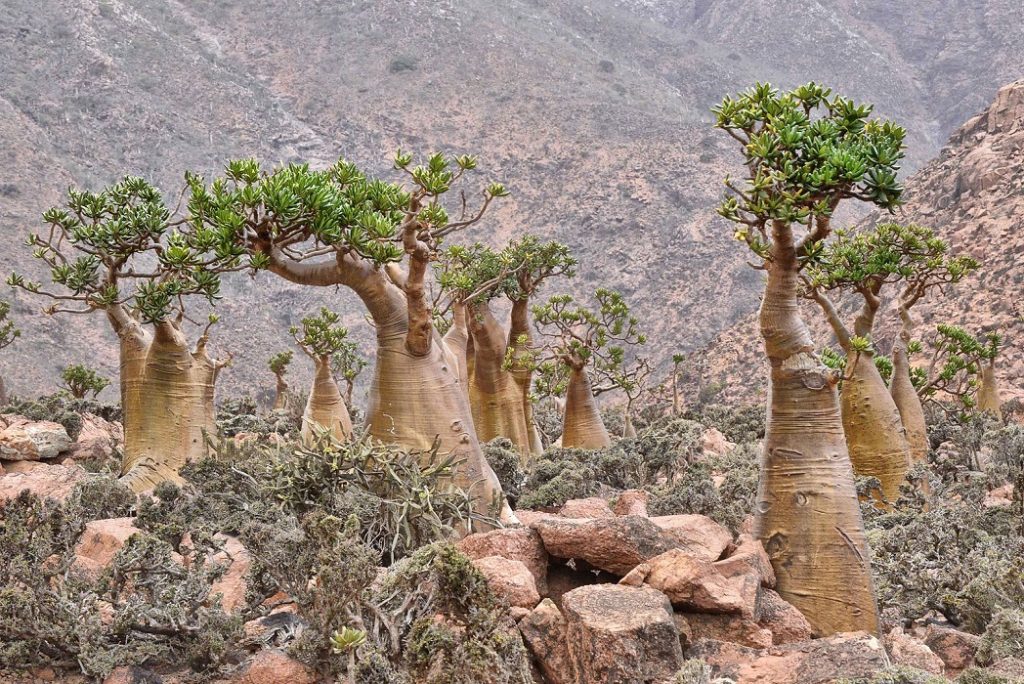
There are more than 800 plant species on Socotra Island, of which more than 300 are endemic. One of the most important plant species native to the island is the Desert Rose Tree. These trees attract attention with their different trunk structures and bloom beautifully in spring. Due to the fact that the island is close to the desert climate, trees can adapt to the environment thanks to their trunks that can store water. Desert Rose Tree is a tree species that can be 5 meters tall and 3 meters wide.

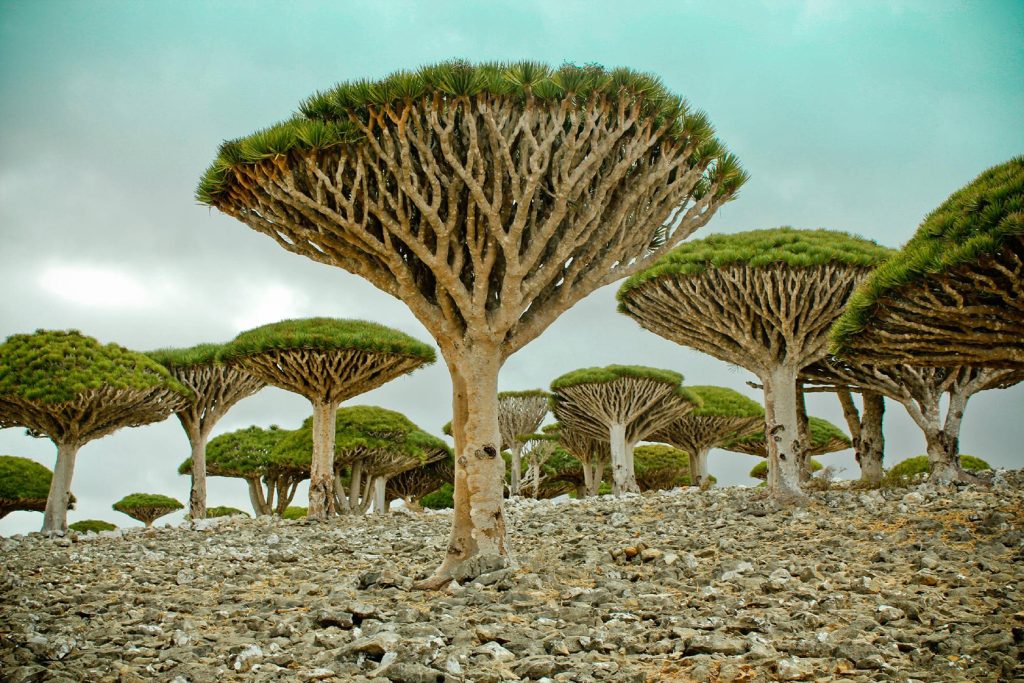
Dragon’s Blood Tree, on the other hand, is the botanical symbol of Socotra and uses its branches reaching towards the sky to absorb moisture from the air in the highlands. However, conservationists are worried because the future of these trees is at stake due to problems with reproduction. The Dragon Blood Tree gets its name from the dark red natural resin that the tree produces. This valuable resin is obtained from trees that grow only on Socotra Island and in the Amazon forests of South America in the world. It is completely natural and organic and has a very sharp and sour odor due to its high antioxidant content.
Mythologically, they are known as trees rising from the blood of Draco Hesepros, the Lord of Dragons. Today, however, these miraculous trees are in danger of extinction and are under protection. Dragon Blood forests no longer grow new seedlings and young trees. Many experts attribute this to a decrease in water availability with reduced seasonal cloud cover. For this reason, it is widely believed that the groves may disappear within a century.
In addition to its unique flora, Socotra Island is home to a rich bird population. There are several endemic bird species on the island. These include the Socotra Starling, Socotra Sunbird, Socotra Sparrow and Socotra Golden-winged Finch. Socotra is an island where, unlike many isolated islands, bats are the only native mammals. The biodiversity around the sea of the island is very rich. The region consists of a diverse mix of species from the western Indian Ocean, the Red Sea, Arabia, East Africa, and the vast Indo-Pacific.

History of Socotra Island
The Island of Socotra is mentioned as Dioskouridou “Dioscurides” in the Greek logbook Periplus Maris Erythraei in ancient times. However, it is stated that the origin of the name Socotra is not Greek, but derived from the Sanskrit word dvipa sukhadhara (“island of happiness”). In the past, Greek and Arab sailors associated this strange and fertile land with paradise. Some have even considered Socotra to be part of the lost legendary continent of Atlantis.
According to a local belief, the natives of the island converted to Christianity in 52 AD. The 10th-century Arab geographer Abu Mohammed Al-Hassan Al-Hamdani noted that the island was mostly Christian at the time. In 1507, Portugal invaded the island to liberate Christians on the island from Arab Islamic rule. However, they were not as well received as they expected and left the island four years later.

The islands passed under the control of the Mahra sultans in 1511. In the late 1700s, Socotra briefly became part of the Austrian Empire. Later, in 1886, Kish and Socotra, along with the rest of the Mahra Province, became a British protectorate. It has been a strategic place for the British. In 1967, the Mahra sultanate was abolished. After its independence, Socotra became part of the People’s Republic of South Yemen. Today, it is in the territory of Yemen. However, in 2018, the United Arab Emirates occupied the island.
Socotra Island has been changing rapidly in recent years due to tourism and infrastructure development. The construction of the airport and roads, especially in Hadibo, caused an influx of tourists to the island. Tourism and other human activities have negative effects on the natural life of the island. The increase in tourism causes the loss of some traditional lifestyles and environmental destruction. At the same time, there are cultural differences between the islanders and tourists. Therefore, the preservation of Socotra and the implementation of a sustainable tourism plan are important for the future of the island.