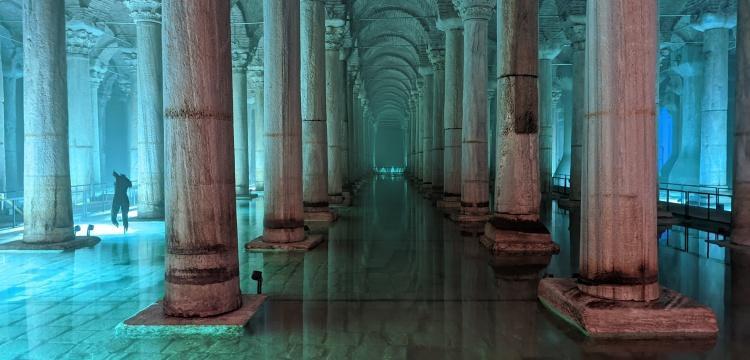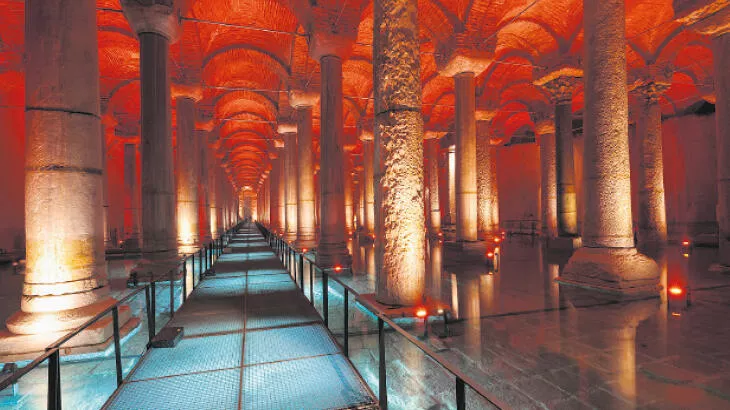
Located in Istanbul’s Sultanahmet Square, the Basilica Cistern almost resembles a palace hidden underground. Remaining from the Byzantine period, the cistern is one of the oldest and most magnificent works of the period. This cistern, which is one of the early architectural examples, is accepted as one of the important cultural heritages of the world. The cistern, known for its legends, is one of the structures that draws attention with its Medusa head, Crying Column and magnificent architecture.
Basilica Cistern is also known as “Basilica Cistern” because it is located under the Stoa Basilica. It has a magnificent beauty that will fascinate those who see it, due to the numerous marble columns rising from the water when you enter it. The 1500-year-old structure, which has the appearance of a column forest, was reopened on 23 July 2022 with its renewed face after the restoration works.
The Purpose of the Basilica Cistern
Since the establishment of Istanbul, water has been constantly brought from outside in order to meet the city’s water needs. During the Byzantine period, cisterns were built at various points of the city to store the water brought from outside. The most magnificent of the cisterns built to collect the water coming from outside is the Basilica Cistern. The cistern was built by Emperor Justinian in 532. It is said that 7 thousand slaves worked in the construction of the cistern.
The water brought to the cistern was supplied from the Eğrikapı water distribution center in the Belgrad forest, 19 kilometers from the city. The waters brought were provided by the “Valens Arch” built by Emperor Valens. This arch was built in 368 and is 971 meters long. At the same time, water was carried by the 115-meter-long “Mağlova Aqueduct” built by Emperor Justinianus.

The Magnificent Architecture of the Basilica Cistern
Covering a rectangular area, the giant structure is 140 meters long and 70 meters wide. It descends into the cistern with a 52-step stone staircase. There are 336 columns, each reaching a height of 9 meters. There are 12 rows with 28 columns in each row. The columns were erected at intervals of 4.80 meters to each other. These columns rising out of the water resemble a vast forest. While most of these columns, which were carved from various types of marble and granite, are in one piece, some of them consist of two pieces on top of each other.
The capitals of the cylindrical columns have different characteristics. While 98 of these columns reflect the Corinthian style, some of them reflect the Doric style. The walls of the cistern are made of bricks and the floor is brick paved. The floor and walls were plastered with a thick layer of Khorasan mortar and made waterproof. The area of the cistern, which has a water storage capacity of approximately 100 thousand tons, is 9800 square meters. Some of the columns are decorated with repetitions of peacock eye, drooping branch and teardrop shapes in carving and relief.
Under the two columns in the northwest corner of the cistern, there are two Medusa heads, one of the masterpieces of Roman sculpture art. IV. There is no definite information about from which building these heads belonging to the 19th century were taken and brought here. It is thought that it was removed from an ancient structure belonging to the Young Roman Age and brought here.

The Basilica Cistern was used for a while after the conquest of Istanbul in 1453 and water was supplied to the gardens of Topkapi Palace from the cistern. After the Ottomans established their own water facilities in the city, they did not use the cistern. The cistern was rediscovered by the Dutch traveler P. Gyllius in 1544 and 1550 during the search for Byzantine ruins.
The Basilica Cistern has undergone various repairs since its establishment. It was restored twice during the Ottoman Empire. The first restoration in the 18th century III. It was built during the reign of Ahmet. The second major restoration was done by Sultan II in the 19th century. It took place during the reign of Abdulhamid. In the Republican Period, the largest restoration was made. The 50 tons of mud in it was removed and a sightseeing platform was built and made open to visitors. Finally, in 2016, the restoration process was started by the Istanbul Metropolitan Municipality Department of Cultural Heritage and it was opened to visitors after 5 years of work.
Legends About the Basilica Cistern
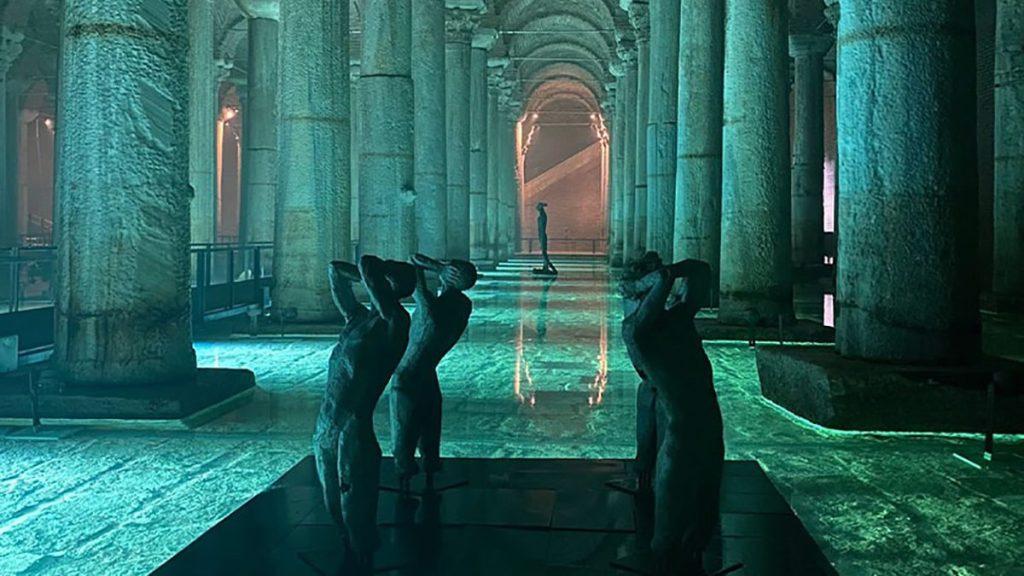
It is not known exactly from which building the Medusa heads, which reflect the sculpture art of the Roman Empire, were brought. The Romans, who believed in polytheism, adopted Christianity after the 4th year. For this reason, it is thought that they put the heads of Medusa in this part to remove the Pagan symbols. Some legends have emerged over time about the Medusa heads, which are among the structures that attract attention.
According to the legend told; Medusa, who is proud of her beauty, loves Perseus, son of Zeus. Athena, who loved Perseus like Medusa, was jealous of Medusa and condemned her to an eternal curse. Because of the curse, each of Medusa’s long hair turns into a snake, while the people who look at her turn into stone.
Another remarkable structure in the cistern is the Crying Column. Since the top of this column is constantly moist, it is known as the Column of Tears. The cry of the column is believed to represent hundreds of slaves who died during the construction of the structure.
Underground cities in Istanbul and there are tunnels connecting these cities. One of these tunnels, the dog killer channel; It is said that starting from a secret part of the Basilica Cistern, it proceeds in the northeast direction and passes under the sea from where the strait opens to the Marmara Sea. The canal, which passes under the sea, bends to the southeast after Üsküdar and continues on the Üsküdar-Kadıköy coasts in a straight line. It is said that the channel that goes on like this ends in the monastery on Kınalı Island.