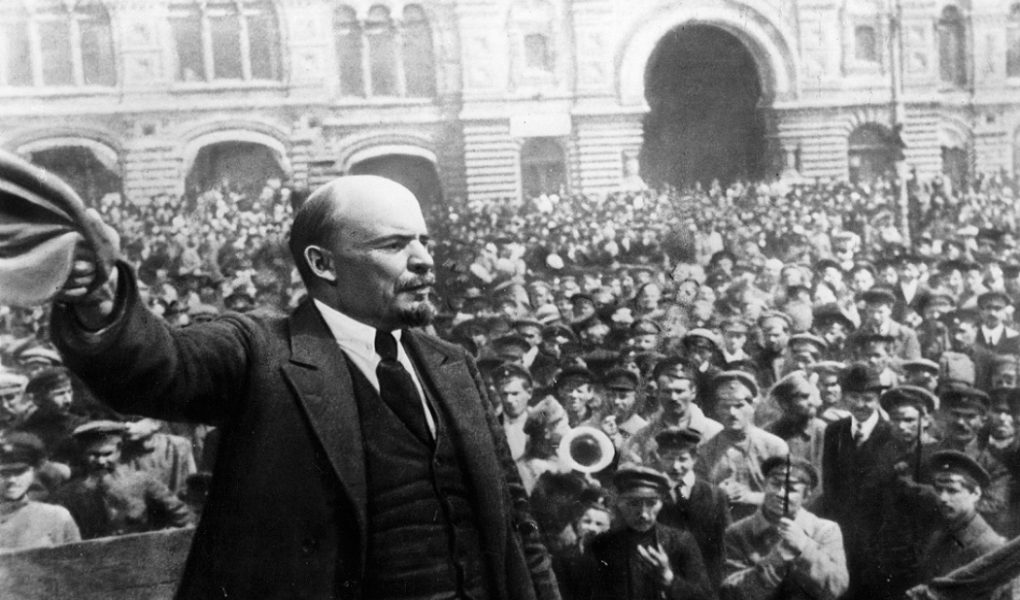
At the beginning of the twentieth century, while Russia appeared as a powerful empire from the outside, there were important problems inside. As a result of the collapse of the Tsarist rule, a series of revolutions called the Russian Revolution took place, which led to the establishment of the Soviet Union. October Revolution or Bolshevik Revolution; It is a revolution that took place in Russia in 1917 and was carried out with the slogan of “bread, peace, freedom”. This revolution took place under the leadership of Vladimir Lenin and the first sparks were thrown in the city of Petersburg. While the Russian Revolution of 1905 took place with the will of the people, the October Revolution was made with the leadership of the party. This revolution led to the overthrow of the Tsarist administration and the establishment of the Soviet Union.

The Revolution of 1905 That Happened ‘Bloody Sunday’
Economic difficulties, misery and Tsar II. Nikolai’s authoritarian rule had created discontent among the people. On January 22, 1905, under the leadership of priest Gapon, about 200,000 people marched to the Winter Palace to explain their economic and social problems to the Tsar. However, this peaceful demonstration ended in a massacre with the fire opened by the soldiers on the people. This event became known as “Bloody Sunday” and around 500 people died. This event caused the last spiritual bond of the Russian people to break with the Tsar. It is considered a turning point where the foundations of the Soviet Revolution were laid. These events were later called the “Revolution of 1905”.
After the 1905 Revolution, unrest among the people continued. Despite increased demonstrations, strikes, and nationalist waves, these movements were silenced for a time in the early days of the First World War, which began in 1914. But as the war progressed, defeats and attrition also affected frontline soldiers, civilians and the economy. The hunger and misery brought on by the war began to spread rapidly in Russian cities.

The February Revolution, which also started on International Women’s Day
The first spark of the 1917 October Revolution was ignited when the Putilov workers went on strike on February 23. The wave of strikes, which is also part of International Women’s Day, caused thousands of workers and women to gather in the capital. Demands for bread, peace and freedom soon turned into slogans of “Down with the Tsar”. The revolutionary wave, which grew with the uprising of the soldiers on February 27, shook all parts of the country. Within four days the Tsar abdicated. These events are known as the “February Revolution,” and 1315 people lost their lives during it.
After the February Revolution, a dual structure was formed. On one side, the Duma Committee, which was the legislative assembly of Tsarist Russia, formed a structure dominated by the bourgeois class. On the other side, the Soviets, where the working class was concentrated, were formed. In the early periods, power was predominantly under the control of the Duma. The Liberal Government that was established decided to continue the First World War, contrary to the socialist demands. The Provisional Government had decided to continue the ongoing war with Germany. However, the Bolsheviks and other socialist groups opposed this decision and fought for its withdrawal.

October Revolution Led by Lenin
In April and May the socialists increased their power. In exile, Lenin returned to Russia in April. While the war was going on at the front by the liberal government, the Bolsheviks under the leadership of Lenin increased their power within the Soviet committees. In July, a new wave of insurrection swept the country as the 1st Artillery Division, one of the Bolsheviks’ strongest points, developed to be sent to the front. The government declared martial law and arrested the Bolsheviks. He accused Lenin of German spying and treason. Lenin fled to Finland, where he wrote “State and Revolution” during his days of exile.
Although the government succeeded in suppressing the July uprising, the Bolsheviks continued to gain power. Finally, on the night of October 24, 1917, the Winter Palace, the headquarters of the Provisional Government, was besieged by the Bolsheviks. On the morning of October 25, Kerensky, Prime Minister of the Provisional Government, fled the palace disguised as a Serbian officer. On the night of October 26, the Winter Palace, almost deserted except for a contingent of women, was captured by a force of several hundred men. The October Revolution, summarized by Lenin with the slogan “All Power to the Soviets”, took place.

Members of the Provisional Government were arrested. At the Second Russian Congress of Soviets held on November 8, Lenin was elected “President of the Council of People’s Commissars” (head of government). After the October Revolution, one of the first acts of the new regime was to withdraw from the First World War. With the Brest-Litovsk Agreement signed on March 3, 1918, Soviet Russia withdrew from the war. On the night from July 16 to July 17, the Tsar Family were killed in the basement of the house where they were imprisoned. There is basically no clear information as to whether the death sentence was taken by the newly formed central government or by the local Soviets.
What Happened After the October Revolution
Although the Soviet administration ended the First World War, it was faced with a new war. While the Red Army, led by Trotsky, was established by the Soviet government, the White Army formed by the supporters of the old regime received support from countries such as England and France. The Civil War between these two armies lasted from 1919 to 1920. With the victory of the Civil War by the Red Army, the new regime established full control within the country. He started the construction works of the Union of Soviet Socialist Republics, which will mark the 20th century. This union aimed at the implementation of the socialist order and the adoption of communism.

By the land decree, lands, monasteries and churches, along with other property, were taken from the big landowners and distributed to the people. In total, 150 million hectares of land were distributed to the people and the debts of the peasants were nullified. At the same time, unemployment and free health insurance for workers and civil servants were implemented, and the working hour was set at 8 hours. All privileges and divisions between different nations and indigenous peoples were abolished. New rights such as equality of rights, sovereignty and self-determination were granted to the people. Between 1922 and 1928, a 5-year development plan was prepared and the public was provided with free access to education and health.