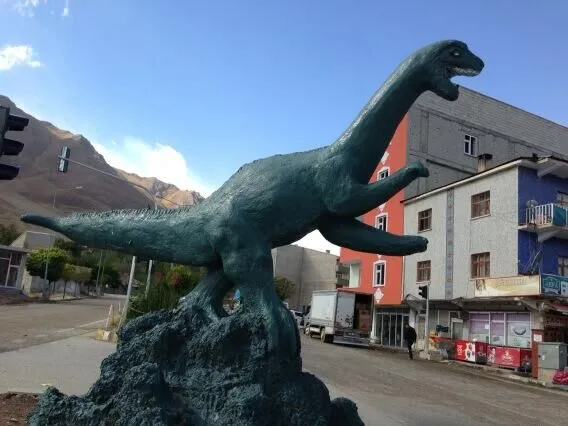
The Lake Van Monster has been a legend that has attracted the attention of locals and visitors for years. The origins of this legend are not limited to modern times, but go back deep into the past. The reliefs on the walls of Akdamar Church and the news in Ottoman-era newspapers make the story of this mysterious creature even more intriguing.
Lake Van MonsterIt is a legendary creature claimed to live in Lake Van, located between Van and Bitlis provinces. In 1993, Türkiye was shaken by reports of a mysterious creature allegedly living in Lake Van. According to those who claimed to have seen this creature, it was a 15-meter-long monster with sharp protrusions on its back. This unique sea animal was named after the lake it was found in. “Lake Van Monster” was named.

Monster News and Scientific Research in the Ottoman Empire
Until now Lake Van Monsterwas considered an unfounded legend made up to boost regional tourism. However, research has shown that the first monster incident in the lake In the Ottoman Empire in 1889 reveals that it happened. In the Saadet newspaper, published in Istanbul at that time, in its issue numbered 1323, dated 28 Şaban 1306 (29 April 1889), there was news that the monster had grabbed a person who wanted to perform ablution in Lake Van and dragged him into the lake.
According to the accounts of those who said they saw the monster, The creature is 15 meters long, very dark in color, with sharp protrusions on its back. and a creature similar to a Plesiosaurus or Ichthyosaurus. Over time, the number of people claiming to have seen this creature increased, and the incident was reported in the press, and a scientific research team was sent to the region by official institutions. However, as a result of the research, no traces of any unusual creature were found in the lake.

A few years later Ünal Kozak, a faculty member at Van Yuzuncu Yil Universityclaimed that he encountered the creature during his research in the lake and managed to capture it on camera, and sent the video he shot to the relevant institutions for analysis. He also wrote a book on the subject Although the video footage did not convince anyone.
Criticisms of this situation are that the camera angle never shifts to the left, because there is a boat pulling the creature with a rope on that side. In the recording, which was also watched by biologists at Cambridge University, the creature moves straight ahead without turning in any direction, which is an It could be a model towed by a boat. increased their suspicions.
A statue of approximately 4 meters high was erected in the center of the Gevaş district of Van in memory of this monster. In addition, many people state that this rumor greatly revived tourism in the region and attracted great interest from visitors. Former Prime Minister of Turkey, Bülent Ecevit, also included the Lake Van Monster in a poem he wrote.

Mythological Expressions of the Lake Van Monster
According to recent scientific research, its age is determined as 600 thousand. Van Lakehas been the subject of various mythological stories and legends since the settlement of humanity in and around Van. The main settlement story of Van, which dates back to the Paleolithic Age, began in the 2000s BC, and during this period, Van’s myths and legends were passed down from language to language and from civilization to civilization.
Although every civilization and period has created its own myth, Lake Van has made great contributions to the sociology, economy and social structure of the city, and has also made a significant contribution to tourism with its mythological aspect. The most interesting story in the contribution of the lake to tourism is Lake Van Monster is a legend.
Although generally known as a legend of the 1990s, the Lake Van Monster is a myth from Armenian mythology. Vishaab and after the sightings during the Ottoman period Bestami It has been known by such names and has found a place in the mythology of these civilizations.
Evliya Çelebi in his work “Seyahatname” in the 17th century He tells that during a trip he made around Lake Van, he heard stories from the local people about the existence of such a monster. Moreover, they took Evliya Çelebi to a cave on the shores of Lake Van where they claimed the monster lived.
According to what people say, a baby monster living in this cave frequently leaves its cave and enters Lake Van, and returns to its cave after hunting. Evliya Çelebi could not see the creature mentioned during his visit to this cave, but he said he heard the monster’s voice.

Akdamar Church and the Beast Reliefs on its Walls
Akdamar Churchalso known as the Church of Aghtamar, the Church of the Holy Cross or the Cathedral of the Holy Cross. The church is located on Akdamar Island on Lake Van. According to legend, it was built between 915 and 921 by the architect Manuel on the orders of King Gagik I in order to house a piece of the True Cross that was smuggled from Jerusalem to Iran. This religious building, which was left without a congregation after the Armenian Genocide, currently serves as a museum.
Gagik, the king of the Ardzruni Dynasty, the first feudal family to convert to Christianity, built a palace, fortress, harbor and a church decorated with reliefs on the exterior in the 10th century. Apart from the church designed by architect Manuel, no trace of these structures has survived to this day, because the other structures were destroyed by the rising waters of Lake Van. Structures such as chapels, bell towers and porches added to the church over the centuries have significantly changed the original appearance of the church.
The walls of the church facing the four cardinal directions are surrounded by relief bands of different heights and sizes. The main band consists of the lowest 2-meter-high band and low reliefs. Above this band is another band, more clearly and deeply carved, consisting of ancient symbols and animal figures.

Above this belt, there are intertwined vine branches. Scenes from the life of the people are seen between the branches; scenes of the cultivation of the fields, harvest, wine preparation, entertainment, daily activities, hunting scenes and the herding of wild animals. On the uppermost pediment, there are wild animals chasing each other, lion figures, masks, coats of arms and symbols.
Two reliefs on the walls of the church, Lake Van MonsterIt raises questions as to whether or not the ‘really existed’. In these reliefs, a man can easily be seen being fed to a monster swimming in a lake by three people. The helpless man in the centre of the relief is being pushed into the monster’s mouth by those on the ship in cold blood. The creature in the lake is the most striking element of the scene with its chilling structure. With its scaly body, wide mouth and powerful tail, it is unlike any creature we have encountered before.

In another relief, his body is covered with scales, a half-fish, half-lion-like creature with wings and feet In this image, all of this once again brings us to Turkey’s most talked about monster incident.
Despite the centuries that have passed, the legend of the Lake Van Monster still lives on today. These reliefs on the walls of the Akdamar Church, Evliya Çelebi’s narratives and the stories passed down from generation to generation ensure that the Lake Van Monster maintains its mystery. Perhaps these legends continue to exist as one of the important elements that increase the mystical atmosphere and cultural richness of the lake.
To join our WhatsApp group CLICK!