
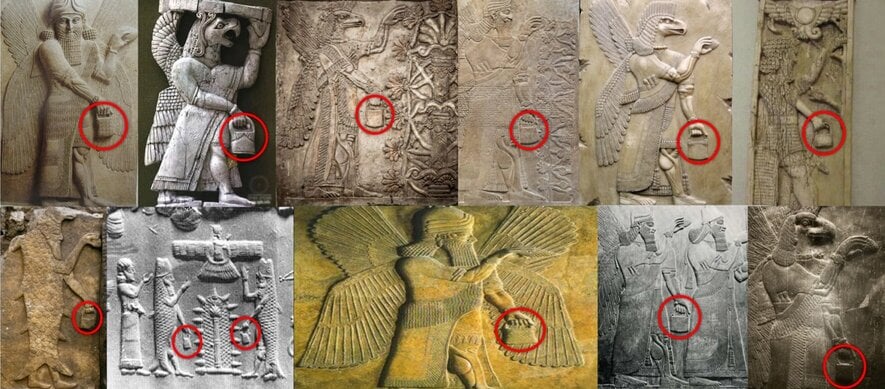
Civilizations from all over the ancient world, despite developing in different time periods and geographies, used surprisingly similar symbols. The most mysterious of these is the handbag, which appears in depictions of gods in Sumer, America, and Göbekli Tepe. Thousands of miles away, these ancient cultures depicted their gods holding a mysterious bag.
Does this common motif indicate an unknown connection between these civilizations? Or are these mysterious bags a symbol of a common understanding lost in the depths of history? In recent years, powerful evidence has emerged that has led us to question our understanding of human history. Discoveries around the world have made us reconsider everything we thought we knew about our origins, ancient civilizations, and history. Piece by piece, the mainstream scientific world is piecing together small clues that point us in the right direction as it searches for answers to unsolved problems.
Living thousands of years ago, located thousands of kilometers away Civilizations How can the surprising similarities between pyramids be explained? Why did almost all ancient civilizations feel the need to build pyramids? Why are there so many pyramids around the world? pyramid-like structure All of these ancient civilizations seem to have followed a common plan. Isn’t it thought-provoking that ancient cultures were somehow connected to each other thousands of years ago?
Anunnaki: The Mysterious God Group of the Ancient World
Ancient Mesopotamia is known as the cradle of civilizations, and some mysterious motifs here have led many writers and researchers to question the understanding of history. One of the most striking of these is the ancient Sumerian depictions Anunnaki are figures.
Anunnaki: A group of gods in ancient Sumerian, Akkadian, Assyrian and Babylonian mythology. The number of gods and their roles vary in different sources and are often inconsistent. According to the oldest Sumerian texts, the Anunnaki are considered the most powerful gods of the pantheon and are descendants of the sky god An and the earth goddess Ki. The main task of the Anunnaki is to determine the fate of humanity.
In the myth of the Descent into the Underworld, the Anunnaki are depicted as seven judges sitting before the throne of Ereshkigal in the underworld. Epic of Gilgamesh It continues in later Akkadian texts such as: In the Old Babylonian period, the Anunnaki, gods of the underworld The sky gods were known as Igigi. The ancient Hittites described the Anunnaki as the oldest generation of gods who were overthrown by the younger gods and exiled to the underworld. Today, the Anunnaki, Zechariah Sitchin And Erich von Daniken It has become a popular subject in the works of writers such as.

On the subject ”The Fifty Descending from the Sky Are Evidence for the Existence of the Anunnaki” For the article named CLICK!
Mysterious Handbag in Depictions of Gods in Sumer, America and Göbekli Tepe
In ancient artworks representing the Anunnaki, two important objects constantly appear: the ‘wristwatch’ a similar object and the mysterious thing they were carrying in their hands ‘bag’. If MesopotamiaIf we set out from here and go to America, which is thousands of kilometers away, Maya, Aztecs, Toltec, Olmec We can see that similar motifs were used in the depictions of gods in civilizations and other ancient civilizations. If we look at Egypt, we realize that the Ankh symbol carried by the gods has a similar symbolic meaning to the mysterious bag in Mesopotamia and America.
So why did ancient civilizations in the Americas, Egypt, and Mesopotamia depict their gods carrying mysterious objects? Were they all visited by the same gods?
The interesting thing is that, Anunnaki depictions and although there are clear differences between the Anunnaki figures and the regular human figures, the Anunnaki figures are usually shown in human form. The Sumerian gods had a human-like appearance with large beards, and these depictions were depicted as human-like, just like the gods of other ancient cultures in Egypt and the Americas. Why did these ancient cultures depict their gods in similar ways, even though they were thousands of miles apart? How can the gods carrying the mysterious bag in Sumerian depictions be explained, and why might people on the other side of the world have used the same symbol?

When you look at the La Venta archaeological site in Mexico, you will see a stone stele depicting the ancient Mesoamerican god Quetzalcoatl. When you look closely at this stele, you will notice that Quetzalcoatl is holding a bag similar to the one featured in Sumerian depictions.
These mysterious depictions are not limited to La Venta. If you go to Tula, you will see the large Atlantean statues in the capital of the Toltec Empire. When you look at these statues carefully, you will notice that the gods are once again carrying that mysterious bag in their hands.

Located in the south of Turkey Gobekli TepeWhen we go to , we encounter this mysterious motif. Göbekli Tepe is known as one of the oldest megalithic temples on our planet. Here, there are ring arrangements consisting of large stone columns connected to each other. These giant stones stand tall while silently telling a history of thousands of years, bearing the traces of different civilizations.
It is still a mystery how these large stone pillars, believed to have been carved by hunter-gatherers of the Neolithic period around 12,000 years ago, were made. Moreover, no stone-cutting tools used by the builders of these massive structures have been found in 13 years of excavations. In addition, new evidence has been discovered that this temple was deliberately buried for an unknown reason.
Gobekli Tepe’Do these mysterious bags that we see in the hands of gods in the Middle Ages and other parts of the world indicate that different cultures are somehow connected to each other? Why did these ancient cultures depict their gods carrying a mysterious bag? What was inside these bags? And more importantly, how could this symbol appear simultaneously in civilizations on different continents? Or were these cultures not connected, as mainstream scientists claim? Were the Anunnaki we see in Sumerian depictions and the gods of the Mayan, Aztec, Toltec and Olmec civilizations actually the same beings?
These questions show us that we need to unravel the mysterious connections in the ancient world.

On the subject ”12 Thousand Years Old Structure Göbeklitepe and Its Secrets” For the article named CLICK!
Theories About the Anunnaki Bags: Mystery and Meanings
There have been many theories about what the Anunnaki bags represent or what they are meant to represent. Here are some popular theories:
Symbol of Knowledge or Wisdom
Many researchers suggest that these bags are symbols of knowledge or wisdom. The bags may represent sacred knowledge or technology brought to humanity by the gods. In Sumerian mythology, the Anunnaki are said to have taught humanity skills such as agriculture, writing, and mathematics. In this context, the bag may be a symbol that the gods carried this knowledge.
Seeds of Life
According to some theories, these bags represent the seed or essence of life. It is believed that the gods bring life and fertility to different parts of the world. The bags can be interpreted as the means by which the gods create or spread plant, animal and human life.

High Tech Symbol
More speculative theories hold that these bags represent advanced technological devices. Writers such as Zecharia Sitchin theorize that the Anunnaki were extraterrestrial beings and that these bags could be advanced technological devices. According to this view, the bags could have been related to energy or other unknown technologies in the ancient world.
Ritual Objects
Some experts believe that the bags were objects used in religious rituals. Carried in the hands of the gods, these symbols may have played an important role in sacred ceremonies or rituals. The bag may have been a tool to bring the gods’ powers to the world or a symbol of protection.
Cosmic Connection
There are also theories that claim that the bags symbolize a cosmic or universal connection. According to these theories, the bags may be a passage or a means of connection between the sky and the earth. They are seen as a symbol through which the gods connect with extraterrestrial beings or universal forces.

Connection with Ankh
Some researchers suggest that Sumerian bags may be associated with the Egyptian symbol of the Ankh. The Ankh is considered the key to life, and Sumerian bags may similarly be associated with the essence of life or divine power.
Cultural Connections and Collective Consciousness
According to this theory, this symbol may be a kind of collective consciousness or a sign of a shared cultural heritage among different cultures. These similar depictions in different parts of the world may indicate that independently developed civilizations shared the same cosmic or spiritual understandings.
Although these theories have not reached a clear conclusion as to what the mysterious bags represent, the surprising similarities between different cultures and the discussions on the symbols continue to spark curiosity in the fields of history, mythology and archaeology.

To join our WhatsApp group CLICK!


