Mahabharata is one of the two most important epic works written in Sanskrit in ancient India. The other epic work is Ramayana. Mahabharata, the legendary epic of ancient India, attracts attention not only with its mythological elements but also with its complex and mysterious elements. The flying vehicles and enormous battles described in this epic give the impression of a nuclear conflict beyond historical facts.
Archaeological findings and modern scientific analysis reveal that this epic may not only be a fairy tale, but also part of a source bearing traces of a past disaster. vimanas With their high speeds and mysterious designs, these extraordinary flying vehicles, called ‘The Flying Vehicles’, offer clues about the existence of a technology unknown to humanity.
What is Mahabharata? Unique Structure of Mahabharata
Mahabharata, the national epic of India “The Story of Humanity” It means. In this epic, A lost civilization and a great war is explained. This war, which at first glance seems like a simple conflict between clans, is actually the result of a struggle for the dominance of the entire planet. Eventually, such a war breaks out that the entire universe is in danger of extinction.
While some of the weapons used in war are world-familiar (such as arrows, axes, swords, spears), some of them have divine properties (such as rays, atomic weapons, flying vehicles). Mahabharata details the transformation of disputes between intelligent beings into war and the use of weapons far beyond today’s technology in this war.
MahabharataIn addition to being the national epic of India, it is actually a poem. This work, in terms of word count “Masnevi”It is much further than and most likely not written by a single author. Mahabharata, written in Sanskrit, has the title of being the longest poem ever written; It consists of 100 thousand “stanzas”. This figure BibleIt contains 16 times as many words as Encyclopedia BritannicaIt corresponds to the entire .
According to some sources, the work dates back to B.C. 3.-5. Written between centuries; According to some, it was compiled in the 4th century AD. Some other interpretations are that Mahabharata was written 19-20 thousand years ago. According to Indians, nothing has ever existed that is not mentioned in the Mahabharata.
The Western world came to know this giant work after the 18th century; This only happened with “Bhagavad-Gita” translated by Charles Wilkins in London in 1785.

Science Fiction Elements of Mahabharata
Mahabharata, from some perspectives oldest science fiction is an example. This work explains in detail how disputes between intelligent creatures turn into war and the use of weapons far beyond today’s technology in this war.
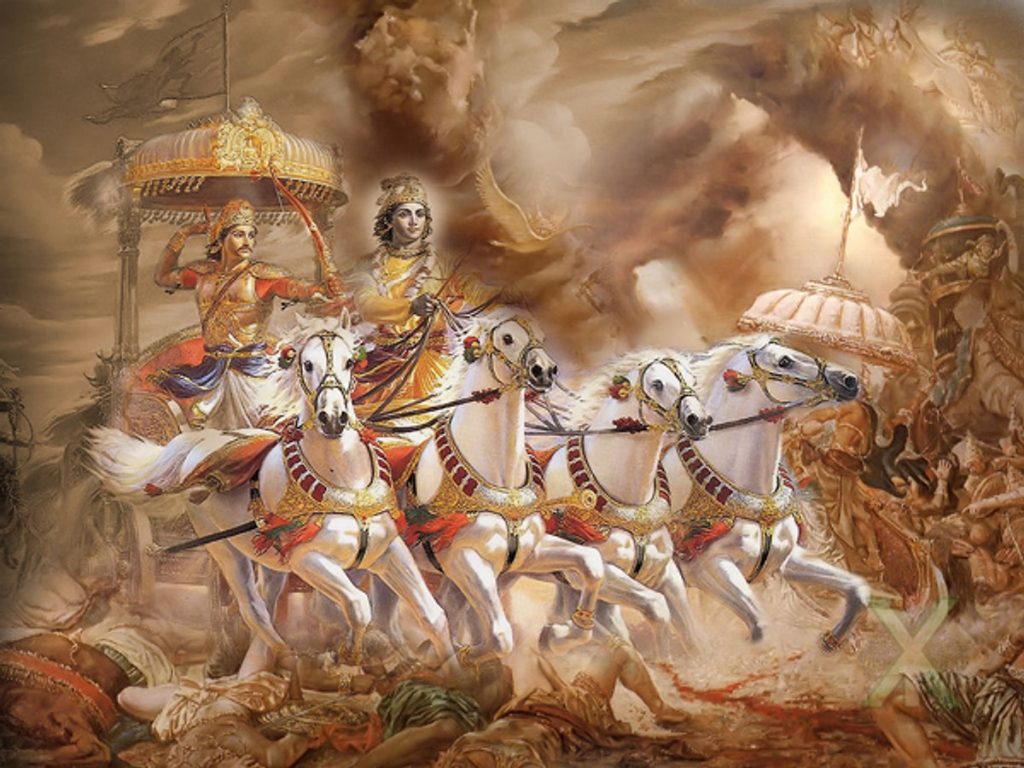
For example, in one part of the epic, the Vrishni clan, including one of the heroes, Krishna, surrounds the cruel leader Salva. Thereupon, Salva ascends to the skies on his vehicle called Saubha, which can go anywhere, and destroys a city with the brave Vrishni youth. Saubha has been described as the flagship from which the battle was conducted and was brought to the battlefield from another city of Salva.
In contrast, Vrishni warriors also have similar weapons. The hero named Pradyumna uses a special weapon that can stop even the highest gods. This weapon is described as no human on the battlefield can escape its arrows. When Salva starts charging towards Krishna, Krishna throws all his weapons at him non-stop. At that moment, hundreds of suns and moons appear in the sky, hundreds of stars are born; time becomes incomprehensible.

Traces of Nuclear War in Mahabharata
in Mahabharata Krishna‘s descriptions of the sound and impact of the weapons he uses to deflect Salva’s attacks have characteristics similar to those of modern weapons:
“I fought them off, they were like a dream. When I sent out the rapidly striking pillars, the heavens flashed and shattered into pieces. “There were great noises in the sky.”
It is further stated that Saubha has become invisible. This creates the impression that Krishna is using smart bombs that never miss their targets. At the sound of arrows being shot, warriors fall; Salva’s soldiers fall to the ground with screams of pain.
In this battle, Krishna defeats the enemy using a special fire weapon. This weapon is like a disk with a sun-shaped halo, and this disk splits Saubha in half. Salva dies as the flying “city” falls from the sky to the ground. This event marks the end of the Mahabharata.

Imbalance of Nature and Nuclear Effects
When a dark moment appears on the battlefield, no one can see the surroundings, but it is not night. A wild wind begins, clouds roar and nature loses its balance; The sun shakes in the sky, the earth trembles, and the scorching heat from terrible weapons burns everything.
While elephants run wild in the flames, other creatures crumple and fall to the ground. Wild rays are falling from the sky like rain. Those who hear the firestorm and the sound of the Gurkha’s gun also die. This situation is like an exact description of a nuclear explosion and the radioactive collapse that follows.
The Gurkha has a fast and powerful Vimana; This aircraft flies and attacks the three cities of Vrishni and Andhaka. Columns of smoke and fire erupt, while rays radiate with the brightness of tens of thousands of suns. Vimana’s superweapon, called “iron lightning”, turns countless people from both clans and their cities to ashes.

Vimanas, Flying Vehicles of Ancient Mythology
There are descriptions of flying vehicles in Indian mythology that are unprecedented in any other culture. These tools are mentioned in ancient Indian texts. “Vimanas” It is called. According to the epics, Vimanas usually have a two-storey and circular structure. There is an entrance tunnel in their domes, making them literally resemble a flying saucer.
Vimanas fly at wind speed and make melodious sounds. There are four different types available; Some are plate-shaped and some are long cylindrical, which makes them look like cigarettes.
Vimanas are described in two main types with different shapes and sizes. The type called “Ahnihotra-vimana” is equipped with two engines or systems; “Elephant-vimana” is a more advanced instrument. There are also other Vimana species that are referred to by animal names such as “King fisherman” and “Ibis”.
Mahabharata gives the impression that it tells about an atomic war. There is no tampering or isolation of the records; Fantastic weapons and flying vehicles were used during wars.

Historical Connections: Mohenjo-Daro
These extraordinary flying vehicles are frequently seen in epic Indian sagas. In particular, vehicles called “vimana-Vailix” are mentioned, referring to a war that took place on the Moon. In the Mahabharata, the effects of an atomic explosion are clearly revealed, especially radioactive effects that kill people.
Mohenjo-DaroDuring archaeological excavations in , skeletons were found lying on the streets, and some of them had clenched fists. This situation makes us think that an apocalypse has suddenly occurred. Additionally, the radioactivity detected in the skeletons is equivalent to levels in Hiroshima and Nagasaki.
Mohenjo-Daro is an excellent settlement with a grid-plan city structure; The water system is very similar to the modern systems used in India and Pakistan today. Black glass spheres consisting of clay pots exposed to high temperatures were found on the streets of the ancient city.
on topic “Mohenjo-Daro, the Lost Civilization whose Mystery Cannot Be Solved” For the article named CLICK!

Features and Mobility of Vimanas
In the Dronaparva episode of the Mahabharata and the Ramayana, it is stated that a spherical Vimana reached incredible speed and left behind a huge stream of air. The movements of these vehicles, UFOsimilar to; They can move quickly in any direction and change direction suddenly.
In another Indian epic called “Samar”, Vimanas are described as iron machines and are also stated to have soft and knitted surfaces. These vehicles are charged with mercury and spew roaring flames in their wake. The ancient text called “Samaranganasutradhara” contains information about the construction of Vimanas, but the practical applicability of this information has not yet been achieved.
‘It was a sky chariot, carrying people to the city of Ayodhya. The sky was full of these wonderful flying vehicles, their dazzling yellowish light illuminating the sky in the darkness of the night.” (Mahabarata)

Testimony of Flying Vehicles: Classical Works and Scientific Approaches
Italian scientist Dr. At the World Space Conference held in Bangalore on October 12, 1988, Roberto Pinotti emphasized the details of the battles between gods and heroes in Hindu ancient texts. Pinotti stated that the texts should not be considered as an epic, and that the battles fought in the sky with armed flying vehicles used by pilots are clearly described. It has been stated that the weapons used were for both defensive and offensive purposes and included various lens and mirror systems.
For example, a visual mirror called “Pinjula Mirror” protects pilots from “evil rays” and a weapon called “Marika” targets enemy vehicles. Dr. Pinotti argued that these ancient weapons bore great similarities with today’s laser technology and added that special heat-absorbing metals called “Somaka”, “Soundalike”, “Mourthwika” may have been used in the vehicles.
According to Pinotti, the driving force principle described is electrically and chemically based; In addition, the use of solar energy is also quite advanced. Other scientists suggest that these vehicles operate with a type of “mercury ion propulsion system”.
While Pinotti states that Vimanas existed thousands of years ago, he also draws attention to their similarities with modern UFOs. In short, there are traces of a forgotten civilization in India.

Quotes on Vimanas in Mahabharata
“The vehicle called Puspaku looked like the sun and it belonged to my brother, he got it from the mighty Ravan, it was flying and perfect, it went wherever desired, it looked like a bright cloud as it flew in the skies of the city of Lanka.” (Ramayana)
“Salva’s flying vehicle was very mysterious, sometimes appearing in the sky and sometimes disappearing. So he had the ability to be invisible; The warriors of the Yadu Dynasty could not fully perceive this strange tool; Sometimes it would appear on the ground, sometimes in the sky, and then it would suddenly appear perched on a hill or on the bank of a river. “This marvelous flying vehicle was spinning like a whirlwind of fire in the sky and did not stay still for a moment.” (Bhaktivedanta, Swami Prabhupada, Krsna)
“Pushpaka was a sky chariot, carrying people to the city of Ayodhya. The sky was full of these wonderful flying vehicles, their dazzling yellowish light illuminating the sky in the darkness of the night.” (Mahavira of Bhavabhuti ‘A Jain manuscript from the 8th century’)
“How majestic is Vata’s chariot; it sounds like thunder, it touches the heavens; it has a bright light; red dazzling and fiery; “As it swirls, it raises the dust of the world.” (Rig-Veda ‘Vata is an Aryan wind god’)
“Once upon a time, King Citaketu traveled to outer space in a bright and magnificent flying vehicle given to him by God Vishnu and saw God Shiva… Arrows “rays” were sent by Shiva. The rays emanate from a sun-like sphere and cover the three celestial vehicles inhabited, and those vehicles are never seen again.” (Srimad Bhagasvatam, Canto VI, Chapter 3)
“In the light of this research and discussions, Sanskrit texts of Hindu origin should be better reviewed and the Vimana models identified should be subjected to more scientific examination.” (Nick Humphries, “UFO Guide”)
To join our WhatsApp group CLICK!