
Borobudur Temple, located in Yogyakarta, Indonesia, is the largest single-piece Buddhist temple in the world. The majestic temple is a pyramid-shaped structure made by analogy with the lotus, the sacred flower of Budan. Located 40 km northwest of Yogyakarta City, the temple was protected by UNESCO in 1991. This temple, built far from the birthplace of Buddhism, is among the most photogenic places in the world. It attracts great attention by people who want to see and photograph the temple.
The temple, located in Yogyagarta City on the island of Java, which is surrounded by green vegetation, has an area of 2500 square meters. It is the largest temple of the Buddhism religious belief with the area it covers. There is a Buddha statue consisting of hundreds of reliefs in the temple. According to official records, it is not known exactly by whom the temple was built and for what purpose. It is estimated that it was built during the Sailendra Dynasty around 750 AD, its construction took about 75 years and was completed in 825 AD during the Samaratungga period.

Borobudur Temple was abandoned by the people and remained hidden under the volcanic ash from the active volcano on the island of Java for hundreds of years. It was rediscovered and restored by Sir Stamford Raffles in 1814, making it open to visitors. The first restoration process of the temple was started by the Dutch and then continued with the support of UNESCO. The rocks, consisting of 2 million blocks and weighing 40 kilos in each block, were given numbers one by one and placed one by one during the restoration process.

The height of the temple, which is estimated to have been built thousands of years ago, reaches 29 meters. Over 2 million stones in the temple were transported from rivers and streams and combined perfectly without using mortar. In the stones in the 2 million blocks in the temple, which was built in the form of a pyramid; There are 504 Buddha statues, 2760 reliefs and 72 stupas around the main dome. Most buddha statues in the temple were damaged or stolen by the earthquake. For this reason, many Buddha statues do not have a head.
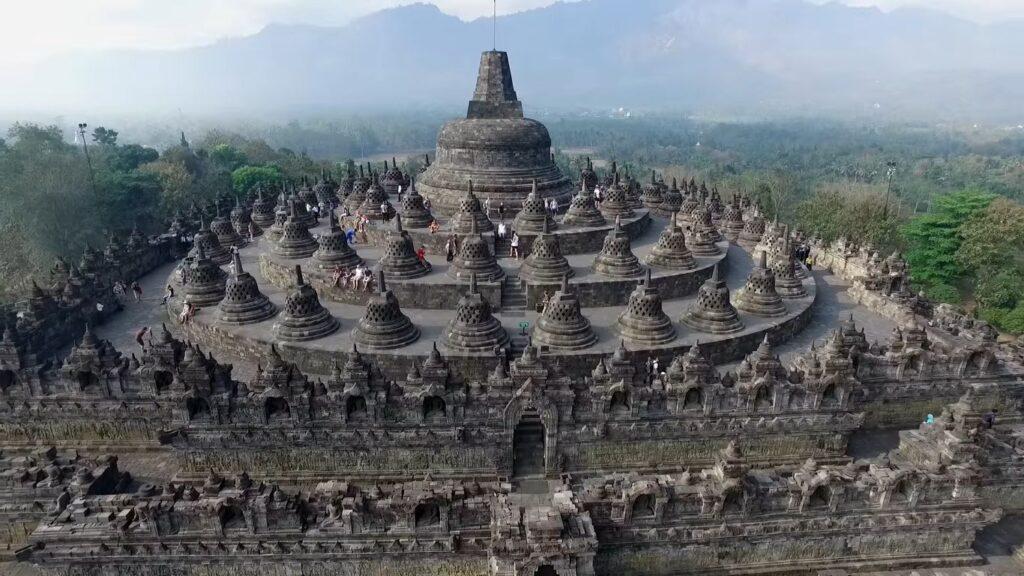
According to a belief in China, long ears mean longevity. For this reason, most Buddha statues have long ears. Buddha statues, which have preserved their original form, are mostly designed to meditate. Although the original color of the walls of the temple was black, yellow stones were used after the restoration. There are 9 main sections and 3 middle spaces in the temple, which has no rooms. The statues in the temple contain different messages and teachings about Buddha’s life. The reliefs on each floor are not on the top floor. The top floor is considered to be the place where Nirvana is reached. Although there is no elephant in the Java region, it is not known exactly what the elephant figures engraved in the reliefs mean.

The magnificent building, which has been visited for centuries, contains Chinese coins and ceramics. Coins and ceramics belonging to China are counted among the proofs of worship since the 15th year. However, with the arrival of Islam in the 13th and 14th centuries, Buddhist life in Java shifted to the east and the temple was abandoned in the 1500s. Some stones of the temple, which was hidden under the ashes for hundreds of years, were used as building materials by the villagers, and many Buddha statues were taken all over the world to be exhibited by collectors. After the restoration process was carried out and taken under protection by UNESCO, it welcomes the visitors in its current form.


