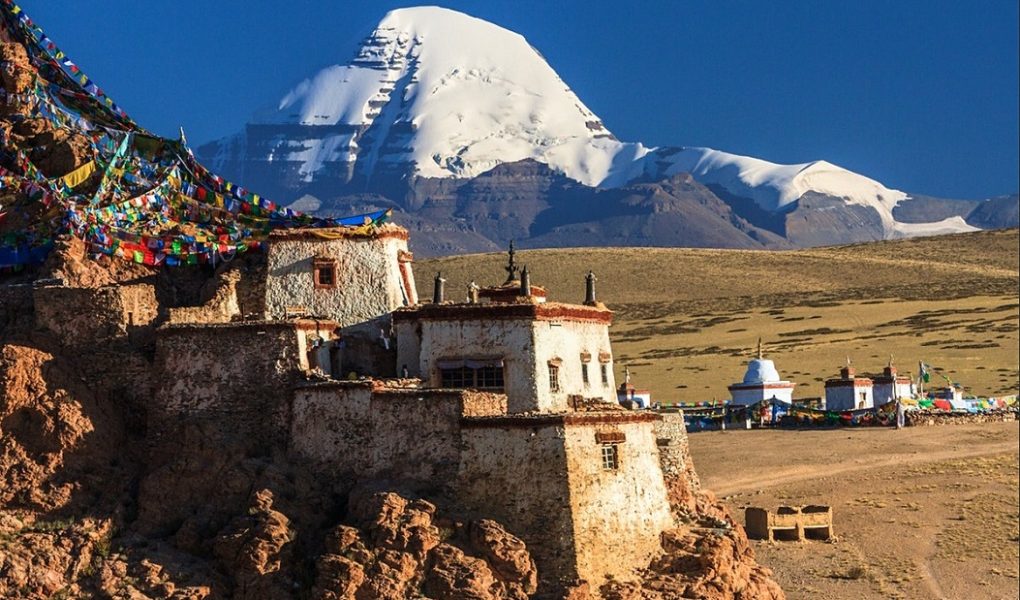
The mysterious and massive Mount Kailash; It is located on the border between Nepal and China, on the remote Tibetan plateau protected by Asia’s longest rivers and deepest lakes. This mountain has been used as a sacred pilgrimage route for many years and is considered one of the holiest places in the world. Mount Kailash and its surroundings are visited for touristic purposes as well as for pilgrimage. According to ancient beliefs, this mysterious Tibetan mountain represents the axis of the earth or the way to heaven. In many Eastern countries it is considered the holiest place on earth. Today Mount Kailash is still known as the place where very sacred and mystical knowledge is hidden.
Mount Kailash is a mountain revered by Asian people in all four Asian religions. One of the requirements of these four religions, Buddhism, Hinduism, Tibetan Bon and Jainism, is pilgrimage to Mount Kailash. For this reason, people belonging to these religions come here for faith tourism and perform ritual walks. Mount Kailash is a single peak separated from the Himalayas and rises steeply with all four sides facing the main direction, and with these features, it has become a tourist attraction.

Features of Mount Kailash
Mount Kailash is a mountain located in southwest Tibet and forms part of Transhimalaya. The mountain is located north of the Manasarovar and Rakshastal lakes and is located close to the source of the longest rivers in Asia. The mountain has a height of 6,714 meters. It is one of the “places of power” that counts among many unique places around the world.
Some scientific research shows that the geological structure of Mount Kailash is very different and separates it from other Himalayan mountains. The mountain is shaped like a granite dome and is generally resistant to erosion. In addition, many sacred sites of Kailash contain relics of historical and archaeological importance. Among them are ruins dating back to the 13th century, Buddhist temples, Hindu temples and monasteries. The sacred nature of Kailash has been recognized and revered by locals for thousands of years. For this reason, certain rituals and traditions of showing respect are involved in visits to the mountain.

Things to Know for Visiting Mount Kailash
Mount Kailash has been recognized by UNESCO as a world cultural heritage site and thousands of people visit it every year. However, these visits may have adverse effects on the natural environment and historical remains. Therefore, local and international authorities take various measures to ensure the sustainability of visits to Kailash and to protect the environment.
A private vehicle is required to reach Mount Kailash. Because there is no public transport nearby. The difficult terrain makes it a point of interest for mountaineering enthusiasts. There are certain points that those who visit this sacred mountain can visit. Since it is a steep mountain, no climber has ever been able to reach the summit of Mount Kailash. In addition, as it is believed that climbing to the top violates the sanctity, ascent is prohibited.
Although Mount Kailash is usually cold, it seems that the weather can be tricky in some cases. Therefore, it is recommended that those who plan the ascent should bring appropriate clothing and other necessities for both summer and winter seasons. The entrance to Mount Kailash is free and there are no time restrictions.

Beliefs and Mysteries About Mount Kailash
According to belief, Mount Kailash is the abode of the gods and mortals cannot climb to the top of this mountain. Because a mortal who sees the face of the gods dies on the spot. According to the locals’ accounts, when the top of the mountain is covered with clouds, there are occasional lightning-like bursts of light, while a multi-armed being appears on the summit.
The unusual shape of Mount Kailash has led to speculation that it is not actually a mountain. Russian researchers have suggested that Mount Kailash was originally a giant man-made pyramid. If this claim is true, human history must be rewritten, as this indicates that Mount Kailash is the largest known pyramid to date. It could be a pyramid built by an extraterrestrial civilization or beings thousands of years ago.
The geographical location of Mount Kailash is notable for its surprising symmetry with otherworldly pyramids. One of the theories put forward is that Mount Kailash was the center of an ancient complex consisting of a large man-made pyramid and 100 smaller pyramids. In addition, this complex may be the center of a global system that connects other places where miraculous and paranormal phenomena are observed.

Since the early twentieth century, some people have argued that Mount Kailash is an artificial rather than a natural phenomenon. This theory is based on the argument that the mountain has a perfect shape and that there may be some form of human intervention on its structure. Kailash Mountain resembles a cathedral in shape and its slopes descend at right angles. Stone blocks vary in color and dividing lines are clearly visible. This impression indicates that it was made by huge hands and was used by mighty gods according to ancient Buddhist legends. Discussions about the structure and shape of Mount Kailash still continue. However, no clear evidence has been found so far.
Mount Kailash also has various supernatural phenomena. Each face of the mountain is called a “face,” and the south face has a smooth surface cut by a flat slit. It has a structure of tiered terraces, cracked walls and giant stone stairs. At sunset, an image of the swastika sign forms on the southern surface of Mount Kailash. This symbol is one of the oldest symbols of Spiritual Power. This symbol can be seen for tens of kilometers.
On the other hand, some people believe that the shape and height of Mount Kailash may be related to some numerical symbolism. For example, some point out that the mountain, with its height of 6666 meters, carries numerical symbolism and its distance from the Stonehenge monument is 6666 kilometers. However, there is no clear information as to the source of this symbolism or whether it is true. Some consider this type of symbolism to be purely coincidental.

According to Muldashev, from Mount Kailash Stonehenge’e The distance is 6,666 km. In addition, the height of Mount Kailash is stated as 6,666 meters. However, according to official sources, the height of Mount Kailash is given as 6,714 km. In this case, the distance between Stonehenge and Kailash would also be approximately 6,714 km. Muldashev, Bermuda Şeytan Üçgeni‘ne It claims that the distance to the distance is 6,666 km. In this situation, Paskalya Adası’na The distance extending to the distance will be approximately 6,666 km.
According to Muldashev, it is not a coincidence that these distances are exactly the same, and they carry a certain meaning. However, these claims are not supported by official sources and are purely speculative.
Kailash is home to the springs of the four great rivers of Asia, the Indus, Karnapi (a tributary of the Ganges), Sutlej, and Brahmaputra. These rivers supply half of Asia’s land and are the source of life for the region. Originating from the Kailash mountain, these four great rivers have the strongest energies in Asia. A person walking around Kailash is filled with the belief that he is in contact with these energies. Kailash is a powerful energy center and carries within it the energy of dissolving old things. In Kailash, one who transcends the shell with faith and a sense of oneness with God gains a special divine power.
In some parts of Mount Kailash there is a peculiar plaster that is in no way inferior to concrete. While the delamination of these plasters is clearly visible, the solidity of the mountain is clearly felt behind this plaster. There are many mysteries about the plaster and other structures on Mount Kailash, and how they were made is still unknown. Some believe that these structures were made by extraterrestrials, while others think that these structures were formed by natural processes.
It is said that a group of researchers who went to Kailash started to do the sacred walk called “Kora” when they approached the mountain. Participants did the Kora walk for about 12 hours, and as a result, all participants had two weeks of beard and fingernails growing even after just 12 hours of walking. This shows that the biological activity of a person on the mountain is much faster than normal. There are theories that Kailash is an artificial structure and that the energy of the future from space and the past from earth is concentrated here. It is suggested that Kailash was built in a crystalline structure. The part we see on the surface continues with its mirror image on the ground.

Sanctity of Mount Kailash
Mount Kailash is a place that draws attention worldwide with its mysterious structure and mystical atmosphere. Mount Kailash is considered sacred in Hinduism, Buddhism, Jainism and Bon religions. However, according to their beliefs, only true believers are allowed to perform ritual kora.
Mount Kailash is considered in Hinduism to be the home of Lord Shiva and is also seen as the center of the world. According to Hindu belief, God Shiva is believed to live on Mount Kailash. Shiva is considered a universal power and energy capable of creating and destroying. According to Hindu belief, there are three main forces in the universe: creation, maintenance and destruction. Shiva’s power is connected with universal energy.
In Buddhism, it is thought that the mountain was discovered by the God Buddha and enlightenment can be achieved through meditation. In Jainism he is considered one of the resident deities of Kailash, and in the Bon religion he is seen as a mystical place thought to be filled with sacred lakes and caves.

The “kora”, a sacred ritual known as circling the Kailash, is performed by thousands of people once a year. The Kora journey takes about 52 kilometers around Mount Kailash and takes about three days. According to belief, Kora helps one to purify spiritually and to break the bonds of karma.
In the shell of Kailash, the journey takes 2-3 days. During this time one passes through places around Kailash, which is considered one of the most powerful divine energy centers. Kailash is a place resembling a temple, and all the stones passed along the way are offered to visitors for a fee. Visitors believe that these stones are places where demigods or higher beings live. According to ancient legends, many divine beings who visited this place were turned into stones, and these stones are believed to have a special divine power.
The journey around Kailash is a profound experience with many symbolic meanings and rituals. The crossing of the shell represents a turning point or rebirth in one’s life. The Drolma-la transit is a symbol for rebirth and karmic cleansing. It makes it easier for the person to leave the past and move forward.

The lakes and monastery inside Kailash are sanctuaries that offer stunning views. Believing that enlightened people still live there is one way to form a spiritual bond. Throughout the journey, one prays and symbolically renews himself by connecting to higher powers. The outer journey to Kailash is actually seen as an inner journey. It is a quest to get closer to God and to discover oneself. The power and symbolism of Kailash inspires people’s spiritual journeys and lifts them to a higher level of awareness.
It is common for travelers to encounter both physical and spiritual challenges on visits to Mount Kailash. Kailash tests a person’s strength, pointing out his weaknesses. It is necessary to overcome all difficulties during the pilgrimage, to clear and change one’s best path. Pilgrims leaving Kailash often find that little is needed for happiness. They have air they can breathe, they have food, and they have a roof over their heads. They understand that these outer materials are enough for happiness. Everything else is believed to be sought within.
Prayer flags are found everywhere on Mount Kailash and are considered protective symbols. People hang prayer flags to succeed for a good cause. These flags are also called “Horses of the Wind”. Prayer flags have a symbolic design that resembles a horse with a jewel on its back. It is believed to fulfill desires, bring well-being and prosperity. Flags are made in five primary colors representing the five elements of the human body. Flags in contact with the wind carry mantras that carry coded messages around the world.