
The Blue Quran is a unique manuscript in aesthetic and religious terms, considered one of the rarest works of Islamic art. This Quran, thought to have been written in Kairouan, Tunisia, between the end of the 9th century and the beginning of the 10th century, was engraved with gold and silver inks on parchment dyed with indigo blue. However, in recent years, this unique work has attracted attention not only with its artistic value but also with the secrets it carries.
Zayed National MuseumRecent research conducted in , revealed that there are verses from Surah An-Nisa hidden under the gold leaf decorations. This discovery proves once again that the Blue Quran is not only a masterpiece of art, but also a treasure offering new information about Islamic calligraphy and writing techniques of the period.
Early Records, Historical Origins and Formation of the Manuscript
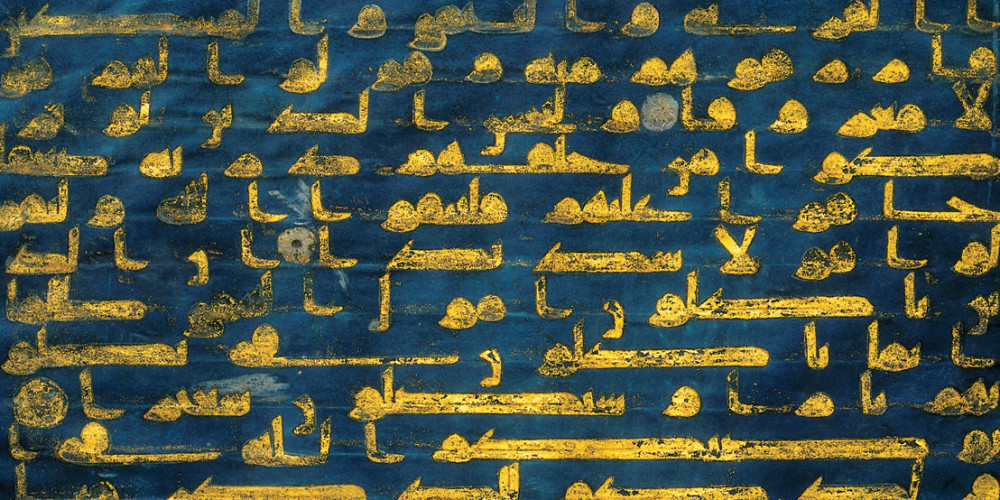
The uniqueness of the Blue Quranis written in gold and silver ink on parchment, and a blue surface colored with indigo dye is used as the background. Considered one of the greatest masterpieces of Islamic art, the Blue Quran is also one of the most expensive and artistic manuscripts ever made.
The first information about the Blue Quran dates back to 1293 in the library catalog of the Grand Mosque. While some researchers suggest that the manuscript was written in Spain, historian Elaine George argues that this work may date back to the early Abbasid Caliphate period. However, most scholars have not reached a consensus on exactly when and where the work was created.
The Blue Quran draws attention with the fact that its scrolls are completely dyed with indigo and its writings are processed using gold and silver inks. Red ink was also used in the texts. Art historian Yasser Tabbaa interprets the effect of golden letters on the indigo background as an expression that emphasizes the Mutezile’s belief in the creation of God’s word.

Blue Quran in the Ottoman and Modern Era
The manuscript consisted of 7 volumes and 600 pages during the Ottoman Empire. However, over time, it was dispersed into various collections. Some pages found in Istanbul in 1923 were sold to Europe by collector F. Martin. In 1977, Christie’s auction brought the pages of this unique work to the agenda again.
Today, most of the pages of the Blue Quran are in the National Institute of Art and Archeology in Tunisia. Apart from this, 67 of its pages are exhibited in the Raqqad National Museum of Islamic Art. Other pieces are kept in various institutions and private collections such as the Chester Beatty Library in Dublin, the Metropolitan Museum in New York, and the Tarek Rajab Museum in Kuwait. One page was sold at Sotheby’s in 1983 for £250,520.

Features of the Blue Quran
The Blue Quran is considered a work that symbolizes the wealth and power of the Fatimid dynasty. The pages contain more than 20 silver badges decorated with gold lettering. This design reveals the combination of the artistic influences of the Fatimid rule in North Africa and the Byzantine Empire. The purple color and golden writings of the scrolls reflect the wealth and splendor of the period.
The Kufic script used in the Blue Quran attracts attention with its angular lines and layout of 15 lines per page. Writing letters without vowel sounds is a common practice in 9th- and 10th-century manuscripts. The column layout of the pages reveals that each letter has been carefully designed.

Mysterious Discovery in the Blue Quran: Verses Under a Golden Leaf
Research conducted at the Zayed National Museum in the United Arab Emirates, Blue QuranHe revealed that there were verses hidden under the gold leaf decoration. During the examinations carried out in the museum, it was determined that the verses of the An-Nisa Surah were hidden under a golden decorative leaf among the pages of the Blue Quran, which is estimated to have been written between 800-900 AD. Researchers think the calligrapher probably added this leaf pattern to correct a misspelling.
These hidden verses were found using modern technology. With the multispectral imaging technique, writings that were invisible to the naked eye and erased over time were revealed. Experts state that calligraphy’s use of such a method was rarely seen in Islamic works of that period.
This discovered page of the Blue Quran will be featured in the exhibition Through Our Connections Gallery, which will open soon at the Zayed National Museum.

Academic Studies on the Blue Quran
The Blue Quran began to attract the attention of the scientific world since the early 20th century. However, especially the Islamic Arts exhibition held at the Hayward Gallery in London in the 1970s introduced this work to the international arena and increased academic studies.
Museum curator Nurul Iman Bint Rusli said, “There is only one known copy of the Blue Quran. “The 100 pages we have today have continued to fascinate academics for decades,” he says, drawing attention to the importance of the work in the world of science and art.
A Deep Look at Islamic Art
Zayed National Museum continues its work with a large academic team to understand Islamic culture more deeply and research the historical development of the Arabic language. Museum officials state that this latest discovery in the Blue Quran will provide new perspectives on early Islamic calligraphy.
The Blue Quran continues to maintain its value as not only an aesthetic work of art, but also a unique historical, cultural and religious heritage.
To join our WhatsApp group CLICK!


