Hierapolis is one of the most remarkable and fascinating cities in the ancient world. Located next to the elegant travertine terraces of Pamukkale, this sacred city contains the mystical heritage of Phrygia and the revolt of the Roman period. Hierapolis, which has been home to different civilizations for centuries, emerged as a religious center dedicated to Mother Goddess Kibele during the Phrygians.
“Holy city” The name, which means, reflects the historical and cultural importance of the city. Today, this ancient city, which attracts both history enthusiasts and nature enthusiasts, makes the traces of the past with its remains. It also offers an unforgettable experience to its visitors with many structures to visit.

HierapolisIn 1988, as both natural and cultural heritage UNESCO World Heritage List‘What has been taken. This status ensures the preservation of the history, architecture and natural riches of the city.
A date extending from Phrygians to Rome
History of Hierapolis, Phrygians It extends to the period. Archaeological excavations in 2016 revealed that the settlement in this region is based on the Iron Age. The Phrygians built a temple in the name of Kibele, the main goddess of Anatolia, when they dominated the region.

With Greek colonization over time Cibele The cult was assimilated to Greek mythology and was transformed into the cult of Hades and Persephone. In this process, the caves where the hot springs in the region and toxic gases emerged were seen as a passage to the underground world and to this temple. “Plutonium” called.
The official establishment of Hierapolis, Bergama Kingdom II. It took place by Eumes in the early 2nd century BC. The name of the city comes from Hiera, Queen of Amazon, the wife of Telephos, the legendary founder of Bergama.

Natural Disasters and Restructuring
Hierapolisis located in a region where earthquakes are frequently experienced. In 60 AD, a large earthquake that occurred during the Roman Emperor Neron was destroyed and then rebuilt. In this process, the city lost its Hellenistic features and gained a typical Roman city appearance.
After the Roman period, Hierapolis maintained its importance during the Byzantine period. From the 4th century AD Christian center The city that has become, Hz. It was accepted as a sacred place with the killing of Filipus, one of the apostles of Jesus. Hierapolis, which came under Byzantine sovereignty in 395 AD, was dominated by the Anatolian Seljuks towards the end of the 12th century.
Hierapolis’s architectural beauties
In the ancient city of Hierapolis, there are many striking buildings and areas. Among these, the following stand out:
Saint Philippus Martyrion Church
Located on the slopes in the northwest of the city of Hierapolis, It is an important pilgrimage area for Christian pilgrims. This sacred place, Hz. One of the twelve apostles of Jesus It is home to the grave of St. Philippus. The traditional route they watched during the visits of the pilgrims starts by entering the St. Philippus Gate. Then passing through the ancient bridge, purification process was performed in the octagonal bath and taking ablution in the upper part.

Finally, in the church where the grave was, they would join the holy rituals. There is also Martyrion, which is considered to be a martyr of St. Philippus. In the rooms around Martyrion, pilgrimage, mental purification and appeal were applied. This sacred area has been an important point where not only a religious center, but also the completion of the spiritual journeys of pilgrims.

Pamukkale’s healing waters and ancient pool
Hierapolis has been an important center in terms of health tourism throughout history with its travertines and thermal waters. The city, which was used as a health center during the Roman period, had many baths and treatment pools. Today is this tradition, “Cleopatra Pool” It continues with the thermal pool known as. This water, which varies between 36 ° C-57 ° C, is full of minerals thought to be good from heart diseases to rheumatism.

Artistic richness of ancient theater
Greek theater This large structure built with type, It is one of the most impressive buildings in Hierapolis. With a capacity of 9,500 people, the city population is estimated to be approximately 100,000. Theater hosting gladiator fightsHas an impressive design from the Hellenistic period to the Roman period.
The theater placed on the slope is well preserved to the present day with its length of 91 meters with its entire façade. It was started in 62 during the Flavius Dynasty after the great earthquake that occurred in 60 years. Lovers completed in the period.

Your theater Cave on Cave There are 50 seating sequences and at this time, 8 stairs are divided into 7 sections. Diozoma, which passes through the middle of Cavea, is reached with vaulted passages (vomitorium) on both sides. In the center of Cavea, there is a 6 -foot -height stage wall surrounding the orchestra, which has this wall, 5 gates and six niche and there are 10 columns in front of it. The columns are decorated with motifs in the form of oyster shell. The three column rows that adorn the rear wall of the stage draw attention as non -grooved structures where lower columns rise on octagonal pedestals.

It is possible to see the effects of the Hellenistic period in the reliefs of the theater, especially in mythological scenes. These figures have a lively, active and crowded narrative and have the effects of the Bergama art school. The embossed friezes in the stage building of the theater are similar to Perge, Side and Nysa theaters.

Necropolis of Hierapolis
Hierapolis “Holy city” Following the fact that the necropolis has also been of great importance. These necropolis areas carry traces of the city’s religious beliefs and social structure. The graves can be easily distinguished as wealthy and folk tombs with their flashy structures. NecropolisLaying in the north and south direction of the main street of the city, More than 2 thousand has been found to be.
NecropolisAre the areas that emphasize the religious importance of Hierapolis. Located in the north and south of the city, these cemetery areas offer important clues to understand the belief systems of the period. The tombs, which have been built in different styles since the Hellenistic period, also reveal the social and economic structure of society.

Apollo Temple
Known as one of the oldest religious centers of Hierapolis Apollo Temple built on Plutonionthe mystical atmosphere of the ancient world to the present day. This sacred area, which is known as the meeting point of the local goddess of the region, Kybele and Apollo, also Kybele also draws attention with the legends that the priests get rid of the influence of toxic gases.. Although the remains of the temple have been dated from the 3rd century AD, their foundations dates back to the Late Hellenistic Period.
The temple is surrounded by a sacred courtyard called Temenos, which is entered with marble steps of 70 meters long. The columns of the portics around this courtyard reveal the grace of ancient architecture with its elegant doric order and details adorned with fine workmanship.

Nevertheless, some architectural elements of the temple are dated until the 1st century AD and indicate the existence of an older structure. For example, some column headings and other architectural pieces in the Ion and Corinth order prove that this region has a much more rooted history.
One of the remarkable elements in the temple is stone blocks with inscription. In one of these blocks There is an article about Apollo’s prophecies. Apart from the remaining marble stairs and column pieces, the podium of the temple has survived to the present day. This podium exhibits the glory of the ancient Roman period with its decorations and details. The architectural decorations of the temple carry the traces of the 3rd century AD.

In the area behind the temple, a qualified female statue depicted with curved clothes from the 4th century BC was discovered. In the inscription, Zeuxis’s daughter Apphia dedicated this statue to the imperial gods and Demos, who symbolized the people of Hierapolis.
Streets and doors
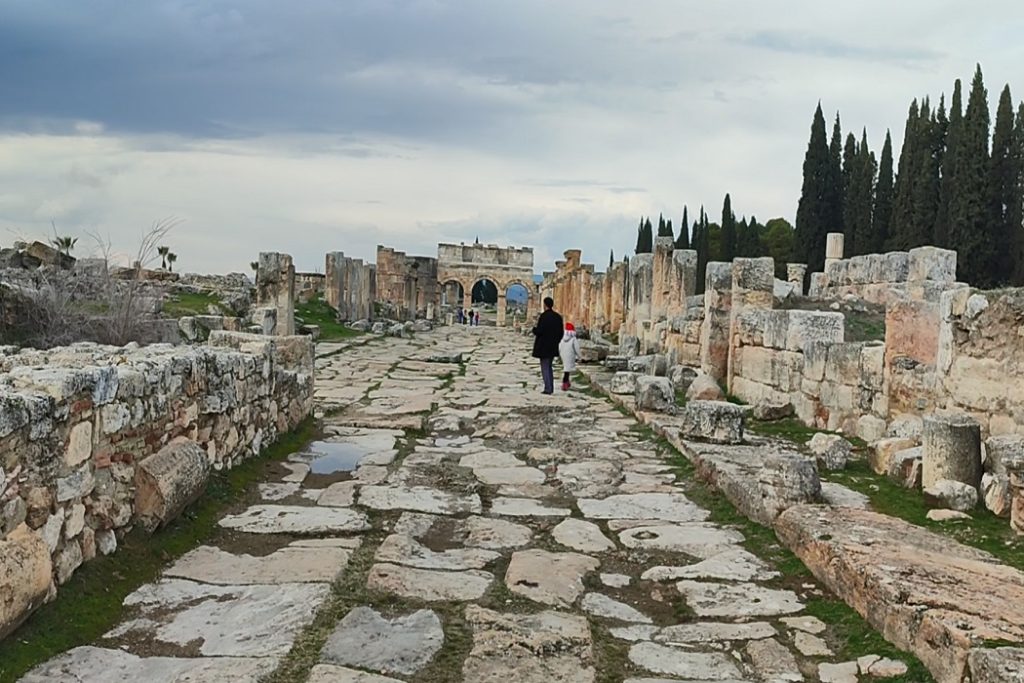
Hierapolis The columnous street with a long kilometer long stretching between the north and southern gatesis one of the most remarkable structures in the city. This street, both divides the city into two, and offers a window of the daily life of the ancient period with public buildings and columned porticoes on both sides. The monumental gates entering the street carry the magnificence of the architecture of the Roman era with its magnificent triumphs and towers next to them.

Northern Gate (Domitian Gate)
This three -eyed gate was built with proper travertine stones and carries an inscription dedicated to the Roman emperor Domitian. It is also known to be built by Julius Sextus Frontinus of Asia Prokons in 82-83 AD. While there are round towers on the sides of the door, the elements reminding the effects of the Hellenistic period are also observed.

Southern Roman Gate
This gate, which descends towards the Lykos River, looks at the breathtaking view of Honaz Mountain. It creates a fascinating atmosphere especially with the shades of blue formed at sunset. This gate, leaning on the two rectangular -planned tower, was built of travertine blocks and reflects the simple grace of Roman architecture.

North and South Byzantine GatesIt was included in the Sur system built during Theodosius during the reign of Theodosius and strengthened with square towers. Apotropeic figures in the Northern Byzantine Gate (such as lion, panther, medusa head) have the function of protecting the city from bad souls.
Baths
Hierapolis was of great importance in ancient times, not only religion, but also in terms of cleanliness and social life. The baths in the city were built in the entrances and exits of the city, especially in order to clean the passengers. There are three main baths in Hierapolis. One of them, the Hamam Church, was dated to the Empire Age, while the Byzantine bath VII. century as a result of a large earthquake. The Great Hamam is nowadays Hierapolis Archeology Museum as opened to visitors.

Bath church
Bath church It was built as a bath in ancient times, but VI. century. The architecture of the building is similar to the great bath in the center of the city. Reorganized structure as a church, At the entrance on the north side It draws attention with a four -column passage. In addition, in the well -preserved large space, there are six nis separated by arches.

Byzantine Bath
Byzantine Bath Located in the southern part of the city next to the Agora, VII. century after the great earthquake. Built on the ruins of the Agora, this bath had an apsis used as Calidarium and a structure equipped with hot water systems. It is thought that the roof cover of the structure was made with a brick dome.

Big bath
Big bath It is located in a region close to the travertines to the south -west of the city and a MS II. century. This bath, which was built after the large earthquake of the Nero period, was heated with the power of the water coming out of the source and was kept warm using the Hypokaust system.
Today, Hierapolis Archeology Museum The building, which is used as, offers important clues about the water structures of the ancient period. In addition, the interiors of the structure, which is decorated with many marble sculptures and mosaics of the Roman Period, are one of the magnificent examples of Roman architecture.

These baths in Hierapolis are of great importance in terms of seeing the social life of the ancient period, the traces of Roman and Byzantine cultures and building technologies. For both history enthusiasts and architectural enthusiast travelers, these structures are important stops to visit.

To join our WhatsApp Group Click here!