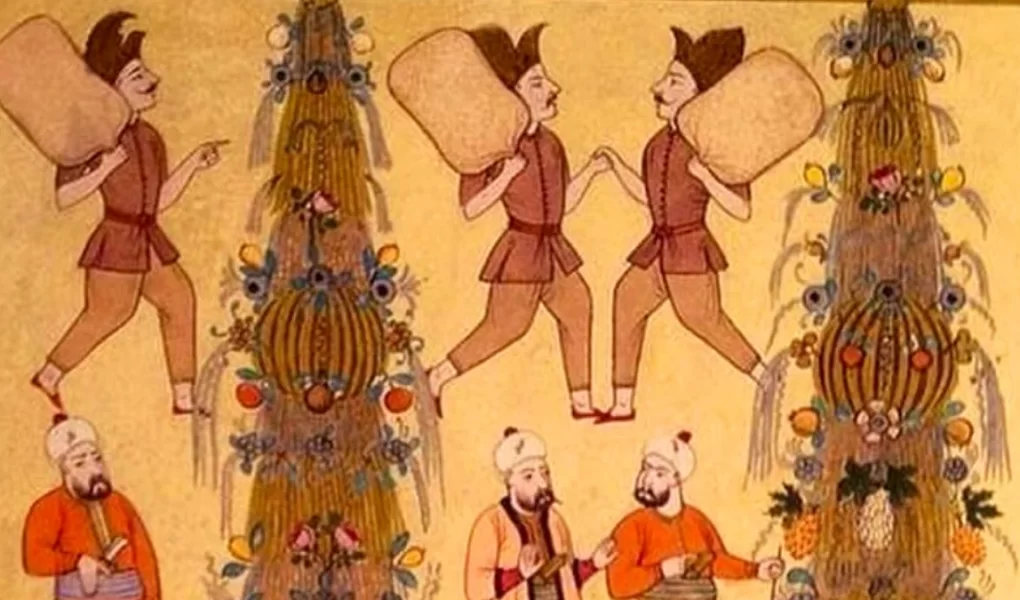
The rich cultural heritage of the Ottoman Empire is full of many traditions, both aesthetic and symbolic. One of these is the Nahıl Tree, which is frequently seen at weddings and festivals in the Ottoman Empire and creates a visual feast.
at first glance Christmas treeThis ornamentation tradition, which resembles , carries meanings especially symbolizing the unity, abundance and prosperity of the society. It had an important place in the magnificent palace festivals of the Ottoman Empire. Nahıl Tree, Although it is not remembered much today, it continues to exist as an important cultural heritage bearing the traces of the past.

Nahıl Tradition: A Forgotten Heritage from the Ottoman Empire to the Present
tree in Turkish cultureIt has a long history as a sacred symbol. In the pre-Islamic period, the tree was considered a sacred being symbolizing the connection between sky, earth and underground. This belief was also reflected in the Ottoman period, and the tree was used as a symbol of abundance, fertility and power, especially in weddings and festivals. The most striking example of this tradition is the Nahıl Tree, which resembles a date tree with its conical form.
NahlIt is an object made of wax and decorated with colorful figures, flowers, fruits and animal figures, used especially in Ottoman weddings and celebrations. Defined in dictionaries as “an ornamental item made of wax that resembles a date tree”, nahıl attracts attention with its high dimensions and aesthetic decorations. In the great festivals organized by the sultans, these decorations functioned not only as a visual feast but also as a symbol of power and the power that dominated the society.
Nahıl and Its Use in Ottoman Palaces
Nahıls used in Ottoman palaces are important elements that reflect the magnificence and richness of the period. Nahıls made in large sizes at festivals and weddings; It would create an eye-catching visual feast with candles, fruit shapes and figures hanging on it. ”Festival of 1582” At large events such as these, these decorations were a powerful tool to symbolize the wealth of the Ottoman Empire.
Nahıl not only emphasized the power of the sultanate, but was also used to create social admiration and loyalty. These elements, frequently seen in miniatures, revealed the authority of the sultan and his influence on society.

The Origin of Trees and Nahıl in Turkish Culture
In Turks, trees have been considered sacred throughout history and have been endowed with various meanings. In the pre-Islamic Shaman belief, the tree; It was seen as a bridge of life connecting the sky, earth and underground.
This belief continued in Turkish culture with the concept of the tree of life and found a place especially in architecture, handicrafts and daily life. The most striking reflection of the tree motif in the Ottoman Empire was the nahıls.
The Current Place of Nahıl
Historians provide information about the details of the nahıls designed in different sizes and shapes. While small or large scale nahıls symbolized the magnificence and power of the Ottoman sultanate, this tradition fell into oblivion with the collapse of the Empire.
Nowadays, although it is rare, it is seen that nahıls are reused in simple forms in some special weddings. UrgupIn the Ortahisar region of Turkey, the magnificent nahıl decorations of the past are reinterpreted with modern touches, contributing to the survival of the old cultural heritage.
Nahıl masters, or “nahılbentler” as they are also known, are trying to keep this culture, which is about to disappear, alive. Today, nahıls are considered as traditional heritage elements that try to carry the rich aesthetics and semantic world of the past to the future.
Today, this tradition is implemented by modern artists and designers with new projects. However, the construction and transportation of large-sized nahıls has become difficult due to high costs. However, keeping this traditional heritage alive and taking its place in cultural memory continues as an important effort that strengthens inter-communal ties and brings together the past and the future.

Nahıl with its Technical Specifications
Nahıls were designed in different width, length and height measurements and were generally made in the form of cypress or palm trees during Ottoman palace festivals. Hammer stated that large nahıls reach 24-36 meters in height, are made of wax and have a structure that tapers upwards like a pyramid. Mirrors, animal figures, fruits and decorations are hung on these nahıls, which have a base diameter of 5-6 meters.
Authors such as Evliya Çelebi and Covel conveyed the magnificence of the nahıls and the details of the moving process. The skeleton of large nahıls was usually made of iron or poplar wood, and colored papers, wax figures and valuable ornaments were hung on their branches.
Nahıls were supported by ropes to ensure their balance while being carried, and they were also carried by many people. Small nahıls, on the other hand, had a simpler structure, were 2-3 meters tall and could be carried by a few people.

The Origin of the Nahıl Tree and the Christmas Tree: Similarities and Differences
Although there are similarities between the Nahıl Tree and the New Year Tree, their origins and meanings are different.
Nahıl TreeIt is a traditional ornamental object used in the Ottoman Empire. These tree-shaped decorations, used in weddings, festivals and special celebrations in the Ottoman Empire, carry symbolic meanings such as abundance, abundance and power. Nahıl, especially at weddings, is a conical structure made of wax decorated with various figures and is often shaped like a date tree. This tradition is nourished by deep roots in Turkish culture, such as the acceptance of trees as sacred and their relationship with human life. Nahıl is important as an object symbolizing the magnificence and palace culture of the Ottoman period.
Christmas tree It is a celebration element in Western culture that has its origins in ancient pagan traditions. Especially in the Christian world, the New Year tree tradition associated with the celebration of Christmas is decorated with trees such as oak, pine and spruce. The origin of the Christmas tree dates back to Christmas celebrations in Germany in the 16th century. This tradition means “Tree of Life” in Christian mythology and has become part of festivities and New Year celebrations over the centuries. The decorations, lights and gifts hung on the pine tree have meanings such as welcoming the New Year and symbolizing the victory of light over darkness in Christian beliefs.
As a result, although tree decorations such as the Nahıl Tree and the New Year Tree are used, their origins, meanings and contexts of use are different from each other. While Nahıl was one of the symbols of cultural and social power of the Ottoman Empire, the Christmas tree is associated with Christian traditions and Christmas celebrations in the West.
To join our WhatsApp group CLICK!


