
Hurufism is a mystical belief system founded in the 14th century, in which letters and sounds are believed to carry divine meanings. This teaching, which takes its name from the Persian word meaning “dealing with letters”, was born in Iran and spread over a wide geography, including Anatolia, Central Asia, the Balkans and India in a short time.
Hurufiswas the most mysterious sect of the song. The sect, born in the 14th century, established connections between the universe and number systems and “read the future” with these connections. Sacred meanings in human faces and letters Hurufism has been subjected to intense criticism and pressure from both religious scholars and political authorities due to its teachings that contradict the classical understanding of Islam.
The mystical structure of the sect and the connections it establishes between the universe and number systems have transformed it into a mysterious and remarkable belief system. So much so that the Hurufi poet Müştak Baba, who lived in the 19th century, provided an example of these teachings by predicting that Ankara would become the capital 100 years ago.
Although it is controversial to classify Hurufism as a sect, sect or a different religion, this belief system that sanctifies humans and tries to unravel the secrets of the universe has faced tragic consequences throughout history.
Hurufism: The Mystery of Letters and Their Divine Messages
HurufismIt is a mystical system of thought that takes its name from the Arabic word “hurûf”, meaning letters, and believes that letters, words and numbers carry divine codes. According to this belief, the order and abjad values of the letters in the sacred texts are determined independently of the literal meaning of the text. deep symbolic meanings contains. With this method, Hurûfis derived new meanings from the sacred texts with allusions, allusions and signs, and tried to reach divine truths through these meanings.
Hurufism, in the 14th century Fazlullah Esterabadi (Nâimî) and was influential in a wide area, starting from Iran to Azerbaijan, Anatolia and Central Asia. Fazlullah developed his teaching based on the divine meanings of the letters and associated the human face with the letters of the Quran in his works. According to him, man is the key to truth; The number seven represents the divine order from Surah Fatiha to the conditions of faith.
Hurufism has become not only a belief system, but also a movement seen as dangerous by political authorities. For this reason, Fazlullah was executed by Emir Timur’s son Miranshah in 1394 and his followers faced heavy oppression. Despite this, Hurufism ideas continued to exist strongly, especially in Azerbaijan and Anatolia, and were influential in the fields of Sufism and poetry.

Mystical and Encrypted Structure of Hurufism
HurufisWhile trying to unravel the mystical ties of letters and numbers, pre-Islamic Jewish cabalism It was also influenced by methods such as Although names such as Hallâc-ı Mansur and İbn Arabi are sometimes associated with Hurûfism, these figures are not directly connected to the Hurûfî sect. On the other hand, Fazlullah’s legacy found an echo in literature through poets such as Nesîmî, and influenced sects such as Bektashism and Ahl-i Hak, and was incorporated into their terminology.
Hurûfî teaching has produced many poets who express the divine messages of letters and numbers through poetry. Especially Nesîmî’s poems left a legacy that reflects the holiness of man and the deep meanings of letters. This influence left its mark on different branches of literature with names such as Fuzulî, Niyâzî-i Mısrî and Kânî. Traces of Hurûfî thought continue even today in the field of mystical approaches and cryptography.
Fazlullah Esterabadi and His Works
Fazlullah Esterabâdî, the founder of the Hurûfî movement, explained the Quran and hadiths with letter interpretations in his main work, Cavidan el-Kebir, and claimed that the letters represented a universal order through the 28 and 32 system. Even after his death, this teaching was spread by Nesîmî and other Hurûfi writers, especially in Azerbaijan and Anatolia.
Hurufism has attracted attention throughout history as a mystical quest to unravel the deep secrets of man and the universe; It was criticized by both religious and political circles, but still maintained its influence.

Hurûfîyye Sect and Belief System
Hurufiyya sectbelieves that God gradually reveals himself to humanity through each prophet. According to this understanding, the final manifestation of God appeared in the body of Fazlullah Esterabadi, a descendant of the seventh Shiite imam Musa al-Kazim and the founder of Hurufism. According to Hurûfîs, Fazlullah Esterabâdî presented a text that replaced the Quran with his Câvidân el-Kebir (Câvidân-Nâme).
Hurûfis, Hz. He accepts that Muhammad (pbuh) is the last prophet. However, they argue that every prophet is obliged to unravel the secrets and meanings of those who came before him. As the last prophet, Hz. Muhammad (pbuh) has the key to access these secrets.
In Hurûfi thought, the universe consists of three basic periods: Prophethood, Imamate and Godhead. Prophetic period Hz. Starting with Adam and Hz. While the period of Imam ended with Muhammad (pbuh), the period of Imam ended with Hz. It begins with Ali and ends with the Eleventh Imam Hasan al-Askari. The period of divinity is considered to have started with the arrival of Fazlullah Esterabadi. All prophets are believed to herald this final manifestation of God.
The Sanctity of Letters and Sound
According to the Hurûfî understanding, the first manifestation of God was through “sound” or “word”. Therefore, each element of sound and letters has a sacred quality. For example, the nose symbolizes the letter alif, the eyes symbolize the letter he, and the area around the nose symbolizes the letter lam. According to this comment, The human face is the reflection of the word “Allah”, which is the name of Allah.
Just like Kabbalah, the Hurufians focused intensely on the numerical values of letters and their meanings in the Sacred Texts. Abjad calculation and combinations of letters are among the basic concepts of Hurufism.

Beliefs and Interpretations of Hurûfis
In their studies on the Quran, Hurufis interpreted especially the ambiguous and allegorical verses in detail. According to their comments:
lines on human face There is a symbolic connection between the shapes of Arabic letters. Every organ in the human body is the equivalent of a manifestation in the universe.
Soul, Just as it cannot exist without a body, meaning cannot exist without a letter. In this context, letters are seen as the body of meaning.
Throne, It is an area where human intelligence and spirit are manifested. Heaven, hell, the bridge of Sirat and other concepts are symbolized by a corresponding letter.
One of the human eyes represents Gabriel and the other represents Azrael. Gabriel Hz. Ali and Azrail are Hz. It symbolizes Muhammad (pbuh). Also, Hz. Adam’s face is considered as “Vech’ul-Lah”, that is, the face of Allah.
Hurufis believe that the words “Fazlullah” and “Fazıl” in the Quran all refer to Fadl’ûl-Lâh Yazdânî, the expected Mahdi.
Hurûf and Divine Secrets
In the Hurûfi belief, prophethood is based on twenty-eight Arabic letters and therefore Hz. Muhammad (pbuh) was called “ummi”. While these twenty-eight letters were called the “Kelime-i Muhammadî”, the thirty-two letters formed by the four new letters (“g”, “j”, “ç” and “p”) added by Fadl’ûl-Lâh to these letters became the “Kelime-i Muhammedî”. It is called “-i Adamiyye”. Thus, guardianship contains all thirty-two letters.
According to Hurûfîs, those who know the secrets of these letters constitute the “Zümre-i Nâciye”, that is, the community of those who have achieved salvation. Those who do not have this knowledge are seen as disappointed.

Hurufis divide the Quran into two basic parts:
Mûhkemât: It contains mysteries and deep meanings.
Mutashabihât: Wilayah, which consists of four letters, is also included in this.
Hurufis claim that letters of unknown meaning, such as “Elîf-Lâm-Mîm” and “Kâf-Hâ-Yâ-Ayn-Sâd”, located at the beginning of the surahs, contain deep esoteric meanings. These letters and their combinations are a symbolic key to the word of God. For example:
The letter “Ayn” is from Hz. Ali,
“Mîm” Hz. Muhammad,
“Nûn” means point,
“Kaf” represents God.
In Hurufism, in addition to the “abjad calculation”, there are also detailed calculation methods such as “sentence calculation”. These systems are based on the symbolic and numerical meanings of letters.
The Emergence of the Dot Sect
After the death of Fazlullah Esterabâdî, by his disciple Ubeyd’ûl-Lâh Mahmud “Dot Sect” has been developed. According to this belief, letters are formed by the combination of dots and the only thing that matters is the dot. According to Ubeyd’ul-Lah, the point forms the basis of all beings.
According to this understanding, the letters mentioned in Imam Zayn al-Âb-ı Dîn’s saying “En-Noktat’ûl-İlm’ûn” definitely owe their existence to the dot. In parallel with this concept, Zohar, an important text of Hebrew mysticism, associates “Yu-Jode”, the smallest letter in the Hebrew alphabet, with the name of God.
Hurufism has influenced many Sufi and esoteric sects over time and left its mark on a wide geography. Nizârî leader Murād Mīrzā, who was executed during the reign of Shah Tahmasb, and Sayyid Ali Muhammed (Báb), who was executed by the Qajars in 1850, are among the leading followers of this understanding.

Fahreddin-i Acemi: His Life and Controversial Legacy
Molla Fahreddin-i Acemî (d. 1460, Edirne) was one of the mudarris, muhaddis and sheikhulislams who stood out as an important religious figure in the early periods of Ottoman history. He is known as one of the first Ottoman muftis. In addition to his scientific studies throughout his life, he attracted attention as a cleric who defended and implemented the Sunni understanding of Islam. However, he was also mentioned as a controversial personality, especially with the fatwas he gave against the Hurufis and his harsh practices in this context.
There is no detailed information about Fahreddin-i Acemi’s childhood and youth. Fahreddin-i Acemi, who is thought to have been born in Iran, was therefore nicknamed “Novice”. There he became a student of Seyyid Şerîf Curcânî, one of the important scholars of the period. It is thought that he came to Bursa, the capital of the Ottoman Empire, in the 1410s. In Bursa, he studied hadith from Burhâneddin Haydar Herevi, who also came from Iran, and became a student of Mehmed Şah Fenari, the son of Molla Şemseddin Fenârî, at the Sultaniye Madrasa.
After completing his education, he started working as a professor and became a well-known name in the Ottoman scientific world. II. During the reign of Murad II, upon the death of Molla Şemseddin Fenârî in 1430, he was appointed as one of the first muftis of the Ottoman Empire and served in this position for approximately 30 years with a daily salary of 30 coins. During this period, he became a strong advocate of the Sunni Islamic faith.

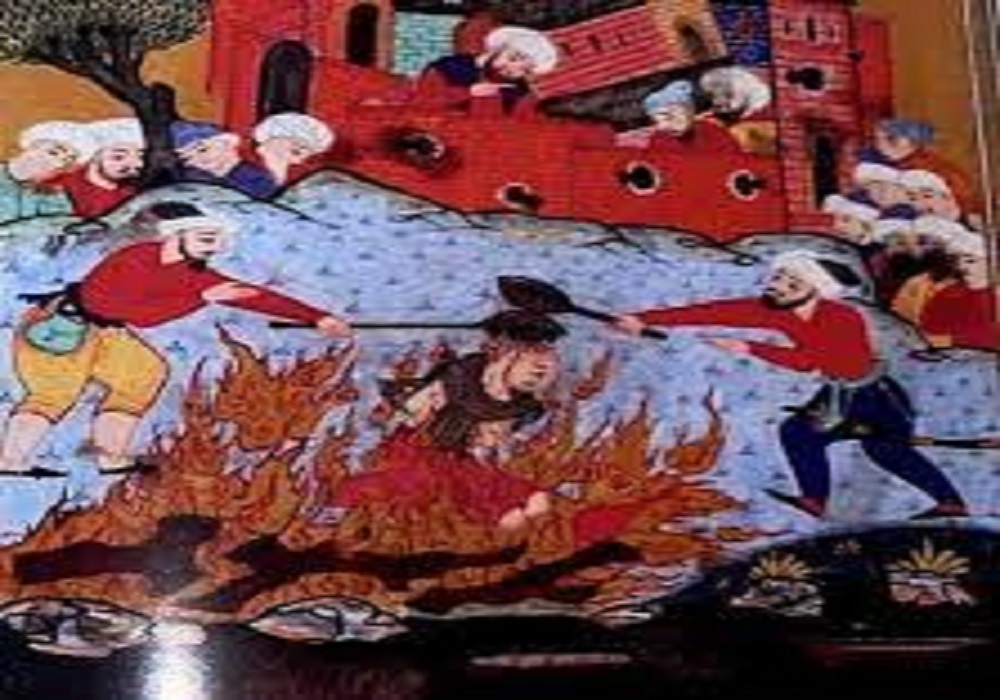
Fatih Sultan Mehmet had Hurufists burned alive
Fahreddin-i Acemi’s name is mentioned especially with the fatwas he gave against the Hurûfi sect. is mentioned. II. In the first years of Mehmet’s reign (1444-1446), there was a serious struggle between the Hurûfis who infiltrated the young sultan’s circle and Fahreddin-i Acemi. Fahreddin-i Acemi saw the beliefs of the Hurûfis as contrary to Islam and blasphemy; For this reason, he issued a fatwa for their murder.
This fatwa Fatih Sultan Mehmet It was also approved by and a group of Hurûfis were burned alive in Edirne by lighting a huge fire. According to rumors, Fahreddin-i Acemi said the first takbir and personally participated in the execution process. Although this event was considered a pious act by the Sunni scholars of the period, it remained a very controversial issue from a historical perspective.
Death and Legacy of Fahreddin-i Acemi
Fahreddin-i Acemi died in Edirne in 1460. He was buried in front of the altar of the Dar-ul-Hadis Madrasa, which he had built in his name. This madrasah, which bears his name, became an important educational institution in the Ottoman scientific life.
Fahreddin-i Acemi’s scientific studies and madrasah activities left deep traces in the Ottoman education system. However, his harsh attitude towards the Hurufis and his fatwas went down in the pages of history as a legacy that cast a shadow over his religious authority. For this reason, Fahreddin-i Acemi has taken his place in Ottoman religious history as a figure remembered for both his scientific contributions and controversial decisions.
To join our WhatsApp group CLICK!


