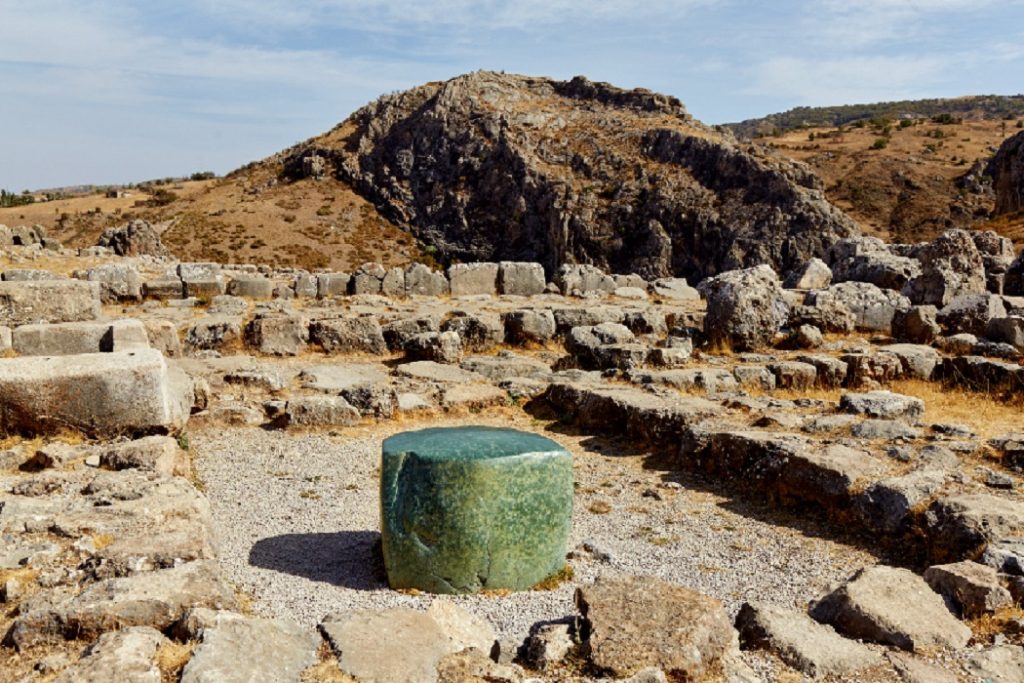
There is a striking green stone among the ruins of the Great Temple in Hattusa, located in Çorum’s Boğazkale district. This stone, a large cube-shaped monolith carved from nephrite, is one of the most interesting ruins of the Hittite Empire. Believed to be sacred, the Emerald green stone is the largest single piece of green nephrite known in the world. Nephrite, also known as jade, is a hard, precious stone that has been used for centuries in making jewelry and small sculptures, and is mostly found in green color.
This stone, which the local people call the “wishing stone”, bears the traces of the Hittite Empire, which settled in the region starting from 2000 BC and was one of the dominant powers of the Middle East in 1340 BC. Prof. Dr. In the excavations carried out under the leadership of Andreas Schachner, the reasons why this monolith is different from other stones are being investigated.
Hattusa Ancient City
Hattusa Ancient City, ” UNESCO “World Cultural Heritage” And “World Memory” It is one of the important tourism places of Turkey with the title of the only ancient city in the lists. This ancient city is dazzling with its 6-kilometer-long walls surrounding it, impressive monumental gates and a 71-meter underground passage.
Important structures such as the palace in Büyükkale, its 31 temples, huge wheat silos and Yazılıkaya Open Air Temple shed light on the rich history of Hattusa Ancient City. Hattusa is also known as the capital where the Treaty of Kadesh, the first known written treaty in history, was signed. New discoveries are constantly being made through excavations that have continued uninterruptedly for hundreds of years.

In its heyday, Hattusa was home to approximately 40,000-50,000 people and was equipped with a series of temples, royal residences and fortifications before being gradually abandoned around 1200 BC.
Many of the structures, such as the Great Temple and the mysterious nephrite piece inside, have survived to the present day despite the corrosive effects of time; However, although the cultural and ritual significance of this stone in ancient times is not fully known, its preservation and the existence of different theories increase its mystery and appeal.
Head of Hattusa Excavations Prof. Dr. According to Andreas Schachner, the green stone attracts great interest because it is different from other stones in this archaeological site. The “serpentinite” or “nephrite” (jade) from which the monolith is carved is a type of stone that can be found in the region, and although the stone itself is not very special, it is remarkable that it has been preserved as a single piece. “Although there is no information about the cultural value of this stone in ancient times, it is known for certain that it was not used in its current location,” Schachner said. says.

Theories About the Purpose of Green Stone
Many theories have been put forward to date about the purpose of use of green stone. Some say it is a place where the king sits during religious ceremonies. throne Some believe it can happen, some ceremonial altar He thinks it may have been used as a
Hittites had a spiritual connection with celestial bodies and pertaining to astronomical or astrological matters Considering that documentation has been found, it is also suggested that the stone may have been used to track the passage of time and the change of seasons. However, all of these theories are just assumptions; There is no definitive evidence of the historical function of the stone.

It is unknown to which period the stone belongs
Schachner, the head of the excavation, said, “The Hittite period door threshold to the left of the green stone shows the ground height where people walked, and this stone is located one meter below that threshold. This shows that the stone was not used here during the Hittite period. “Since the temple area continued to be used as a cemetery and settlement area after the Hittites, it is very difficult to determine exactly which period the stone belongs to,” he says.
There are also suggestions that the stone may have had religious significance, with cults common in the Hittite Empire, as seen at the nearby settlement of Alaca Höyük. According to archaeologist Damien Stone in his book “The Hittites: Lost Civilizations”, in the last periods of the Hittite Empire Alaca Höyük It seems to have become an important cult center.

In his book, Stone says, “Hittite records give clues that this place was probably dedicated to a Sun goddess. “An inscription describing its ancient name has not yet been found, but the most likely candidate is Arinna, the city of the Sun Goddess.” he writes.
Despite the abundance of nephrite in the region, the lack of similar stones suggests that the monolith is not of great importance. The ultimate purpose of the stone is still unknown; It may have served as the base of a statue. Unless significant finds are made at the site or elsewhere in the surrounding area, it seems difficult to learn the true purpose of the stone.
About the topic ”Lost Civilization Hittites and HattusaFor the article titled ” CLICK!
To join our WhatsApp group CLICK!