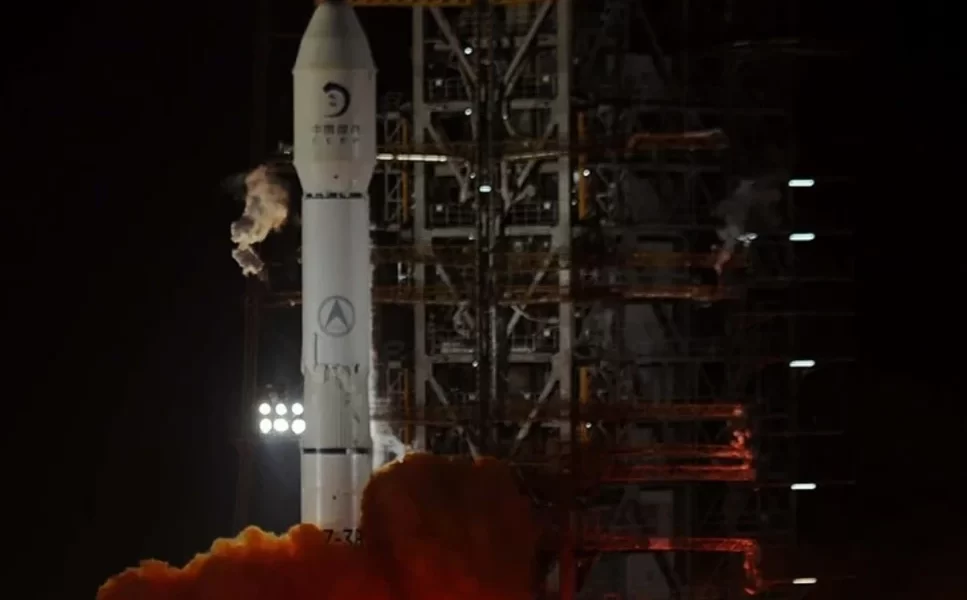
The unmanned spacecraft Chang’e-6, which China sent into space on May 3, successfully landed on the dark side of the Moon. The mission’s goal was to collect rock and soil samples from the dark side of the Moon for the first time. The China National Space Administration (CNSA) announced that the rover made a soft landing in the Apollo Dish at the Moon’s South Pole-Aitken Dish.
The rover made a successful landing on the lunar surface on June 2., After landing, it began digging into the lunar surface with its probe and collecting soil and rock samples with its robotic arm. After the collected samples were sealed in the container, they were transported from the surface to the orbiting satellite and the return shuttle via the lift vehicle. The return shuttle then set out to bring the samples back to Earth.
Chinese, Space probe succeeded in collecting samples from the dark side of the Moon for the first timeHe announced that the aircraft had successfully taken off and started its journey to Earth. Chinese state news agency Cinhua described this event as “an unprecedented achievement in the history of human lunar exploration” and emphasized that the shuttle was the first vehicle to take off from the dark side of the Moon. Analysis of the samples returned by Chang’e-6 will allow scientists to deepen their research on the formation and evolutionary history of the Moon.

Secrets of Lava Flows on the Far Side of the Moon Reveal
China’s unmanned spacecraft Chang’e-6is located on the dark side of the Moon and is the largest impact crater in the solar system. South Pole-Aitken BasinHe collected samples from above and below the surface. At the same time, China managed to plant its flag on the far side of the Moon for the first time. The research conducted on this side of the Moon, which is not visible from Earth, is expected to provide more information about the formation of this region covered with ancient lava flows.
In last decade, Chinese space missionsHe made huge investments in . China’s “space dream” plans, which gained momentum during the reign of President Xi Jinping, have made the country competitive with space powers the United States and Russia. Beijing has achieved many important achievements, such as building a space station called Tiangong (Heaven Palace), landing robot rovers on Mars and the Moon, and becoming the third country to place humans in orbit.

What is the Dark Side of the Moon?
Dark side of the MoonSince the speed of rotation around the Earth is equal to the speed of rotation around itself, the face that is constantly invisible from Earth It is called. The term “dark side” refers to the fact that this region is less well-known than the Earth-facing side of the Moon, not the absence of light.
The Soviet Union’s “Luna” satellite photographed the dark side of the Moon for the first time in 1959, and a detailed atlas was published by the Soviet Union Academy of Sciences in 1960. In 1968, astronauts on the US Apollo 8 mission became the first people to see the dark side of the Moon in person.

Chang’i 6, the First Vehicle to Collect Rock and Soil Samples from the Dark Surface of the Moon
Chang’i 6 went down in history as the first vehicle to collect rock and soil samples from the dark surface of the Moon. in chinese mythology Moon goddess “Chang”Exploration missions named after I started with the “Çang’ı 1” and “Çang’ı 2” satellites sent to lunar orbit in 2007 and 2010. These missions aimed to map the Moon and prepare for a soft landing on the surface.
In the “Çang’ı 3” mission, the rover rover named “Yütu (Jade Rabbit)” was launched on the Moon surface in December 2013. Then, in the “Chang’i 4” mission, the “Yütu-2” rover rover landed on the dark side of the Moon in January 2019. In the “Chang 5” mission, China sent a rover to collect rock and soil samples, and after being launched in November 2020, it returned to Earth in December 2020, collecting 1.73 kilograms of rock and soil samples.

China plans to continue its exploration activities on the Moon with new missions in the coming years. In this context, after “Chang’i 6”, “Chang’i 7” will be launched in 2026 to explore the south pole of the Moon, and “Chang’i 7” will be launched in 2027 to verify natural resource capacity and availability and to conduct tests for the construction of a space base on the Moon’s surface. 18” missions are planned. In addition, China aims to organize manned expeditions to the Moon starting from 2030 and to lay the groundwork for further exploration activities by establishing an International Lunar Research Base.
To join our WhatsApp group CLICK!