The Seven Wonders of the World are defined as the most impressive structures built by humanity throughout history. However, when we look at the distribution of these wonders on the world map, we see that they actually cover a very limited part of the world’s surface. Well, were no important buildings being built in the rest of the world at that time? Of course, many other works were also being built, but the Seven Wonders are identified with a specific geography and culture.
The Seven Wonders of the World is a concept that emerged in the Hellenistic period. The Greek civilization of that period made a great impact with its structures emphasizing aesthetics and history. “Seven World Wonders” for this reason actually “Seven Hellenic Wonders” It is also defined as . The selection of these wonders contains a symbolism representing the five planets, the Sun and the Moon, known at that time; Therefore, it was determined as seven structures. However, the fact that architecturally important works were built in other parts of the world cannot be ignored.
Different cultures also have their own lists of “wonders of the world”. Some societies use these works “Wonders of the Ancient World”, “Wonders of the Middle Ages” And “The New Seven Wonders” prefers to divide it into three main categories.
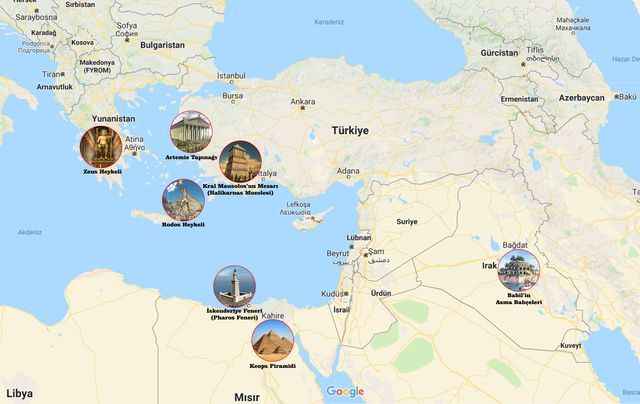
Seven Wonders of the Ancient World
Seven Wonders of the Worldalso known as “acaib-i seb’a-i âlem” in the old language, are impressive ancient structures and works built entirely by human beings. These structures, ”Seven Wonders of Antiquity” It is also defined as . The concept was first used in B.C. It was mentioned by historian Herodotus in the 5th century. Later, B.C. In the 4th century, Antipater of Sidon compiled this list in his work “On the Seven Wonders of the World”. The list of Seven Wonders we know today dates back to B.C. It took its final form in the 2nd century.
Today, only the Pyramid of Cheops has survived from the Seven Wonders. Other structures were destroyed due to fire, earthquake and similar natural disasters. These wonders hold a special place in human history as important cultural heritages that reflect the architectural skills and aesthetic understanding of past civilizations.
1- Pyramid of Cheops (Giza, Egypt)
B.C. It was built between 2580-2560. It was designed as the tomb of the Egyptian Pharaoh Cheops. It is the only structure that has survived to the present day among the Ancient Seven Wonders and world’s largest pyramidis.

on topic “The 6 Most Important Pyramids Found in Egypt” For the article named CLICK!
2- Hanging Gardens of Babylon (Babylon, Iraq)
It is said to have been built by the Babylonian King Nebuchadnezzar II for his wife Amytis. It is said that the gardens are on an artificial mountain and are watered by an enormous irrigation system. Its authenticity is still controversial.
On the subject “The Mysterious Structure Hanging Gardens of Babylon” For the article named CLICK!
3- Statue of Zeus (Olympia, Greece)
B.C. This statue, made by the sculptor Phidias in 435, depicts the God Zeus in gold and ivory. It was approximately 12 meters high and was located in the sacred area where the Olympic Games were held.
4- Halicarnassus Mausoleum (Bodrum, Türkiye)
B.C. It is a monumental tomb built for King Mausolos around 350. The building, which is 45 meters high, is very impressive in terms of both architecture and art. It was later destroyed by an earthquake.
5- Statue of Rhodes (Rhodes, Greece)
B.C. This statue, known as the Colossus of Rhodes in 280 BC, represents the sun god Helios. It was approximately 33 meters high and was located at the entrance of the port of Rhodes. It was destroyed in an earthquake in 226.

on topic “The Colossal Statue of Rhodes, a Colossal Construction of Ancient Greece” For the article named CLICK!
6- Lighthouse of Alexandria (Alexandria, Egypt)
B.C. It was built between 280-247. This lighthouse, built by Sostratus, was among the tallest structures of that period, with a height of approximately 100 meters. It was designed to guide sailors and was destroyed in the 14th century.
on topic “Lighthouse of Alexandria, whose ruins were made into a castle” For the article named CLICK!
7- Temple of Artemis (Ephesus, Türkiye)
B.C. Built in 550, this temple was dedicated to Goddess Artemis. It is considered one of the finest examples of Greek architecture. It was decorated with numerous columns and became a great center of worship; It was destroyed by the Goths in 262.

Wonders of the Middle Ages
Throughout history, people have attempted to describe the great works of their era. In the Middle Ages, thinkers and artists of the period were fascinated by the impressive structures created by humanity. In this context, many academics and philosophers who study the great classical civilizations such as Greece and Rome have resorted to creating new lists in order to revive the memories of the wonders built in ancient times.
The structures they list were mostly built in periods before the Middle Ages. However, this new “Wonders of the Middle Ages” The authors of the lists did not neglect to include their individual choices and perspectives in order to reflect the spirit of their age. Master lists often include more than just the seven wonders, and these works are referred to as “Medieval Wonders,” given that the term “Medieval” did not become commonplace until the 16th century.
1- Hagia Sophia (Istanbul, Türkiye)
Hagia Sophia, one of the most important symbols of Istanbul, is a masterpiece that has survived for 1500 years. This building, which has hundreds of years of history, is extremely important both architecturally and religiously. It is a beautiful and durable structure that has managed to survive despite disasters such as fire, earthquake and riots.

on topic “Secrets of the 1500-Year-Old Magnificent Building Hagia Sophia” For the article named CLICK!
2- Stonehenge (Wiltshire, England)
Dating from the Neolithic and Bronze Age, Stonehenge is a megalithic structure that hosts different theories as a monument for the dead, a place of healing, an observatory, a place of Moon worship or a UFO landing site.
on topic “Giant Stones That Science Couldn’t Solve: Stonehenge” For the article named CLICK!
3- Cairo Castle (Cairo, Egypt)
Built by Saladin, this fortress is one of Egypt’s most popular tourist attractions, along with the Muhammad Ali Mosque and other Islamic structures.
4- Cluny Monastery (Cluny, France)
Once one of the largest monasteries in Europe, the Abbey of Cluny was the center of an important religious movement in the Middle Ages.
5- Ely Cathedral (Cambridgeshire, England)
Known as the “ship of the Fens”, this cathedral is one of the engineering marvels of the Middle Ages with the unique structure of its Octagonal Tower.
6- Great Wall of China (Beijing, China)
The world’s largest man-made defensive wall The Great Wall of China is an impressive structure with a length of 21,196 kilometers, heights ranging from 4 to 10 meters, and a width of up to 9 meters in some places. B.C. Its construction started in the 7th century and many parts were restored during the construction process, which lasted approximately 2000 years. Today, it has become a major tourism center as one of the symbols of China.

on topic “Purpose of Building the Great Wall of China, the Longest Wall in the World” For the article named CLICK!
7- Catacombs of Kom el Shoqafa (Alexandria, Egypt)
These tombs, shaped like a multi-storey labyrinth, are decorated with sculpted columns, statues and Roman-Egyptian religious symbols.
8- Leaning Tower of Pisa (Pisa, Italy)
The leaning tower of Pisa is a structure built as the bell tower of the Pisa Cathedral. This work, completed in three stages, is an architectural achievement.
9- Porcelain Tower (Nanjing, China)
Built in its heyday, this tower is an impressive example of Buddhist architecture, combining white porcelain bricks with elegant and colorful stones.
10- Roman Colosseum (Rome, Italy)
Located in the heart of Rome, the Colosseum is one of the largest amphitheatres of antiquity. The building, which has a capacity of approximately 50,000 spectators, hosted gladiator fights and other shows. Its construction started in 72 AD and took approximately 8 years to complete. Today, it is one of the most visited tourist attractions in the world.
on topic “Coliseum, the Bloody Arena of Gladiators” For the article named CLICK!
11- Taj Mahal (Agra, India)
Built by Shah Jahan in memory of his wife Mumtaz Mahal, the Taj Mahal is considered one of the most beautiful symbols of love. The building, completed after a 22-year construction period, is made of white marble and decorated with precious stones inside and outside. Located in Agra, India, this magnificent monument attracts millions of tourists every year.

on topic “The World’s Most Expensive Artwork of Love, Taj Mahal” For the article named CLICK!
New Seven Wonders of the World
New Seven Wonders of the WorldIt was determined by a vote held in 2007, and more than 100 million people voted in this process. The Switzerland-based New7Wonders event brought together these unique structures to create new wonders of our modern world. Former “Seven Wonders of the World” While only the Pyramid of Cheops has survived on the list, all of the newly selected wonders have survived the challenges of time.
These magnificent structures, dating back centuries, continue to showcase their glorious history, attracting millions of tourists every year. Who knows, perhaps thanks to the fascinating stories and magnificent architecture of these buildings, visitors will feel as if they have gone on a journey back in time.
1- Great Wall of China (Huariou, China)
2- Petra (Jordan)
The ancient city of Petra is located within the borders of Jordan and is known for its rock-carved architecture. B.C. Founded in the 5th century, this city was an important trade center on the historical Silk Road. Petra, which was abandoned over time, has now become a major tourist attraction with its historical and archaeological importance.

on topic “Petra, the Lost City of Islam that Will Make You Question Everything You Know” For the article named CLICK!
3- Chichen Itza (Yucatan, Mexico)
Chichen Itza, located in the Cancun region of Mexico, is known as an important Mayan city in the 9th and 10th centuries AD. This ancient city has a rich cultural heritage with temples, marketplaces and other living spaces. Especially the pyramid called El Castillo is a remarkable example of architecture designed according to the Mayan calendar.
on topic “Kukulkan Pyramid: The Ancient Miracle That Turns Hand Clapping into Bird Sound” For the article named CLICK!
4- Colosseum (Rome, Italy)
5- Taj Mahal (Agra, India)
6- Machu Picchu (Peru)
Located at the top of the Andes Mountains, Machu Picchu is an ancient Inca city located at an altitude of 2,360 meters. Built in the 15th century, this structure was built in harmony with nature. It is thought that its construction took 25 years and today it attracts the attention of tourists with its mystery.

on topic “The Most Mysterious Place in the World: Machu Picchu” For the article named CLICK!
7- Statue of Christ the Redeemer (Rio de Janeiro, Brazil)
The Statue of Christ the Redeemer, the symbol of Rio de Janeiro, is one of the most well-known structures of the city with a height of 38 meters. The statue, located at the top of Corcovado Mountain, was completed in 1931 and was commissioned to commemorate Brazil’s 100th anniversary. The statue attracts the attention of millions of tourists every year with its embracing design and impressive view.
on topic “Did the Christ the Redeemer Statue Achieve Its Purpose?” For the article named CLICK!
These structures are important parts of human heritage not only in terms of architecture but also with their historical and cultural values. Each of them stands out as a unique work that reflects the historical and cultural richness of its region.
To join our WhatsApp group CLICK!